Last month, we went to the Japanese Festival at Dawes Arboretum east of Columbus. Their Japanese gardens are fabulous. I learned the difference between the dry garden shown above, and the wet garden. (Which really did have a turtle popping up its head!) I was honored when Margaret used this picture for This Photo Wants to Be a Poem.
Edited to add my Sealey reading for this past week: SINCE THE BABY CAME by Kathleen Long Bostrom, MY HEAD HAS A BELLY ACHE by Chris Harris, BLACK GIRL, CALL HOME by Jasmine Mans, TREE WHISPERS by Mandy Ross, BUGS by Shirley Raines, and two days with SOME GLAD MORNING by Barbara Crooker.
Catherine’s challenge for the Inklings this month struck a deep chord with me:
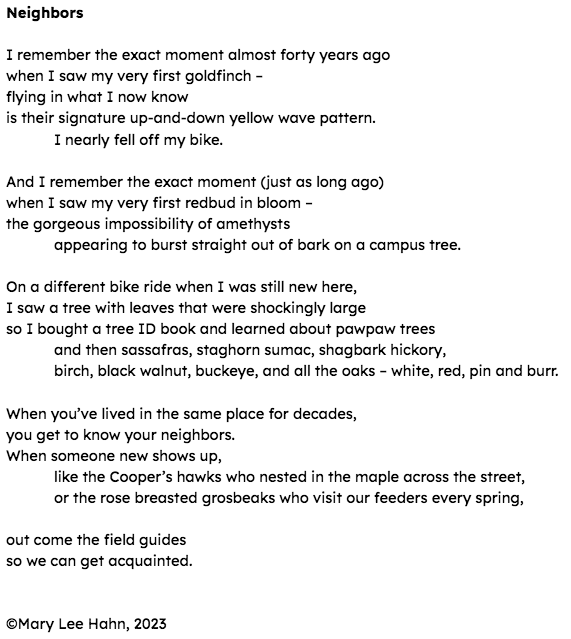
Robin Wall Kimmerer teaches us that “It’s a sign of respect and connection to learn the name of someone else, a sign of disrespect to ignore it…Learning the names of plants and animals is a powerful act of support for them. When we learn their names and their gifts, it opens the door to reciprocity.” Look closely at the flowers, birds, trees, or other natural features in your neighborhood (or if you’re traveling, a new-to-you species) and write a poem about your chosen species.
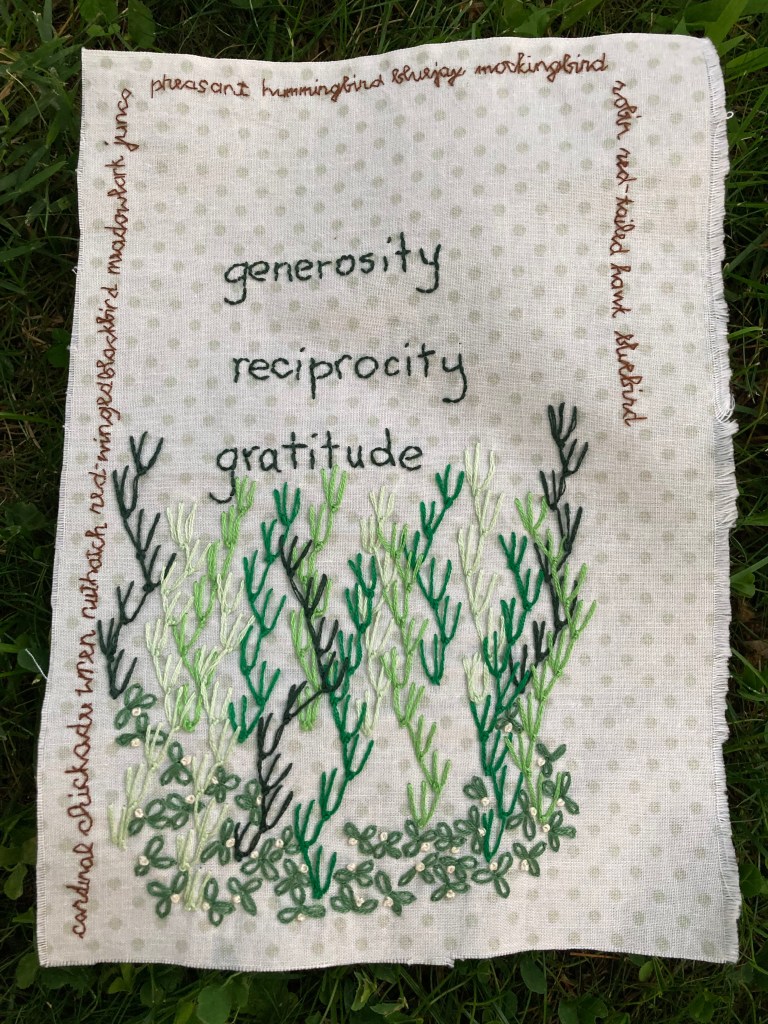
The in-progress embroidery piece illustrating this post will be part of a larger textile piece exploring Robin Wall Kimmerer’s ideas about what it means to be indigenous vs. an immigrant, and ultimately, the importance of naturalization, of “becoming indigenous to place.” (Read the chapter “In the Footsteps of Nanabozho: Becoming Indigenous to Place” in BRAIDING SWEETGRASS for more eloquent details on these ideas.) I hope my poem not only expresses my love for Earth and all her beings, but also the recognition that Earth loves me back, and expresses that love in the glorious diversity of plants and animals that she’s give me to know by name and to care for and about.
Here’s what the other Inklings came up with this month:
And here’s this week’s Poetry Friday Roundup! Add your link and enjoy the generous offerings of others!
PS: A quick Sealey Challenge update. Day 1: A WREATH FOR EMMETT TILL by Marilyn Nelson, Day 2: FELICITY by Mary Oliver, Day 3: TODAY I AM A RIVER by Kate Coombs.
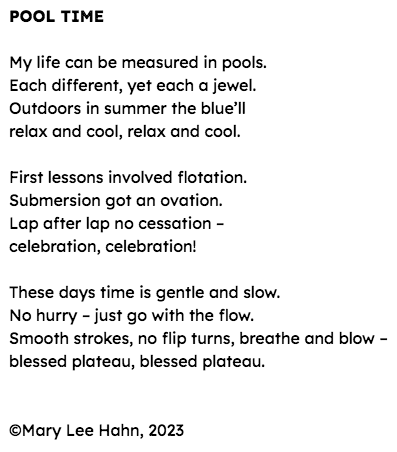
What a blessing, as a child, to spend nearly every summer day at the pool! (What amazing affordable daycare the pool provided!)
I remember with vivid details every pool in every city in every phase of my life. There was even a (very brief) time when I was an open water swimmer, and I remember those two lakes, as well.
I no longer swim a mile with confident, snappy flip turns, trying to beat my own record time. I’m in the phase where the gentle whole-body movement and the controlled breathing at a leisurely pace is all I need.
What a blessing, at this end of adulthood, to still have a pool in my life! (Although you can imagine my irritation yesterday when I got to the health club and the pool was closed because the pump was down…)
The Poetry Sisters wrote monotetras this month. Lots of rules about syllables and rhymes, but fun!
It all started with play: building quilt blocks with black and white, then realizing that I have some solids that can add pops of color that echo the splatters in the black corners.
Knowing this little quilty thing I was making would eventually have an audience through photos on social media, I wanted it to do just a little bit more good in the world than simply “look at this pretty thing I made.” I wanted it to say something that someone might need to hear. I wrote in my notebook, “I will use my art and my words to put positive messages out to the world.”
No one knew about these quilt blocks and my intentions for them except for me and the Universe.
And then, on Facebook, a former student reached out with the kind of message that reminds a teacher (or anyone, really) that we have no idea of the long-term impact of our words and actions. She wrote (in part), “will you please make me one… so that i always have something to help inspire me and that anytime my faith starts to fall i can always have something that u made in front of me to make me realize… i can do it… (and believe me when i say i need that motivation more than ever right now)”
I was already making the quilt that she needs. With the words on it that she needs to hear and remember.
Goosebumps much? I had some.
Now excuse me while I get back to the sewing machine.
Linda Mitchell has today’s Poetry Friday Roundup at A Word Edgewise.
This sudoku poem has a striking line in the left-most column: “Grow something beautiful from what might seem like dirt.” This is a quote from page 120 of Soil: The Story of a Black Mother’s Garden, by poet and scholar Camille T. Dungy.
Heidi gave the Inklings the challenge of writing sudoku poems after I shared one back in June, and I originally got the idea from Rattle. As best I can tell, these poems are meant to contain ten(ish) haiku(ish) poems within the grid, five in the columns and five in the rows. They are fun to write, but take a good amount of fiddling.
Here’s what the other Inklings came up with this month:
“If grief can be a doorway to love, then let us weep for the world we are breaking apart so we can love it back to wholeness again.”
Robin Wall Kimmerer in BRAIDING SWEETGRASS
When I chose this quote for the Poetry Sisters’ June challenge, I felt its truth in my bones. Yet, when I sat down to write a poem inspired by it, I fought hard with its ideas (as the pages of notes and thoughts in my notebook will attest).
There is SO much wrong with our world. We have DONE so much wrong TO our world. The problems seem insurmountable. How could there ever be any semblance of wholeness again when we’ve obliterated entire ecosystems, coral reefs, and rainforests? Not to mention the damage done by industrial agriculture, strip mining, offshore oil rigs, and fracking. (This would be the weeping part of the quote. Or perhaps more accurately, the wailing.)
And yet, scientists and entrepreneurs are discovering and advocating for all kinds of innovative ways to heal our lands and waters and air. There is hope. But will it be enough, and in time?
What is the impetus, the motivation, the “doorway” that moves someone to work to save our plant? The cynical side of my brain says, “Well, duh — it’s money! Money and power. Nothing will change unless there’s money to be made and power to be secured.” But the optimistic side of my brain whispers, “No. It’s love. Love really is the answer: love of a place and its plants and animals is what it takes to inspire someone to save it.”
Ultimately, the whispering side of my brain won, and I found a poem that skews towards simplistic, maybe poem for children.
Irene has this week’s Poetry Friday roundup at Live Your Poem.
BONUS BOOK REVIEWS
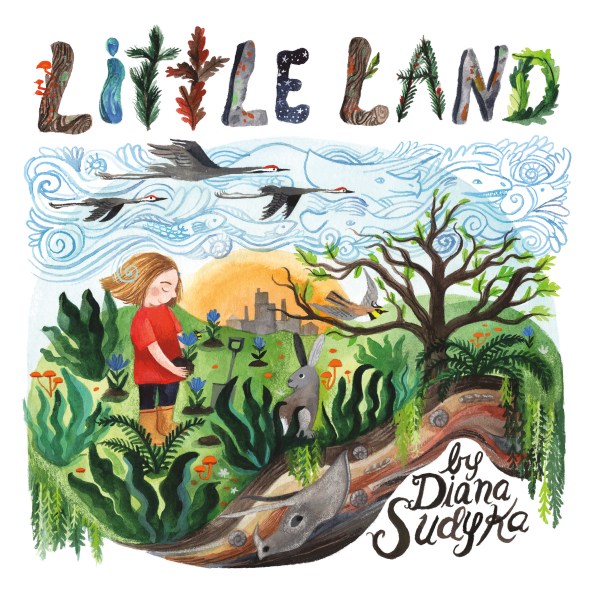
LITTLE LAND by Diana Sudyka Little, Brown Books for Young Readers, 2023 review copy is mine (because I loved it so much I had to own it!)
If you have admired Diana Sudyka’s illustrations for Joyce Sidman’s and Liz Garton Scanlon’s books, you will fall head over heels for LITTLE LAND. It has everything: gorgeous details in the cover and endpaper illustrations AND the book’s cover has a different illustration from its dust jacket. On the back of the dust jacket is the book’s Big Idea: “Do you know a little bit of land? No matter how big or little, you can take care of it. And when you give love to something, it will give back to you.”
The book begins with the geological history of a “little bit of land.” It is a history of the land’s change over time. But then, “…some change does not belong to the land. It belongs to people.” And we see how people have covered the land and taken from the land until the balance is tipped and change seems unstoppable. (two GORGEOUS and heart-breaking page spreads here)
But even when things seem unstoppable, unrecognizable, and beyond repair…with help and care, life and land can find a way…
The way out of this mess is reclaim our connection to the land. Sudyka even paraphrases Robin Wall Kimmerer’s important ideas about reciprocity in her author’s note: “…Earth has always shared its gifts with us and…we need to give back to it in return.”
Love really is the answer.
.
If you’re more in the mood for adult books on this theme, I recommend these, by Camille T. Dungy:
I’m only a little ways into this memoir, but I’m loving it! Readers can follow Camille’s journey in transforming her homogenous Fort Collins, CO suburban yard into a heterogenous haven for native plants and all kinds of pollinators and birds. Here’s a quote I loved:
Whether a plot in a yard or pots in a window, every politically engaged person should have a garden. By politically engaged, I mean everyone with a vested interest in the direction the people on this planet take in relationship to others. We should all take some time to plant life in the soil. Even when such planting isn’t easy.
p.10
Camille is the editor of this book of poetry that makes a fabulous companion book to round out your reading! (And which was a gift to me from today’s PF Hostess Extraordinaire, Irene Latham! Thanks again, Irene!!)
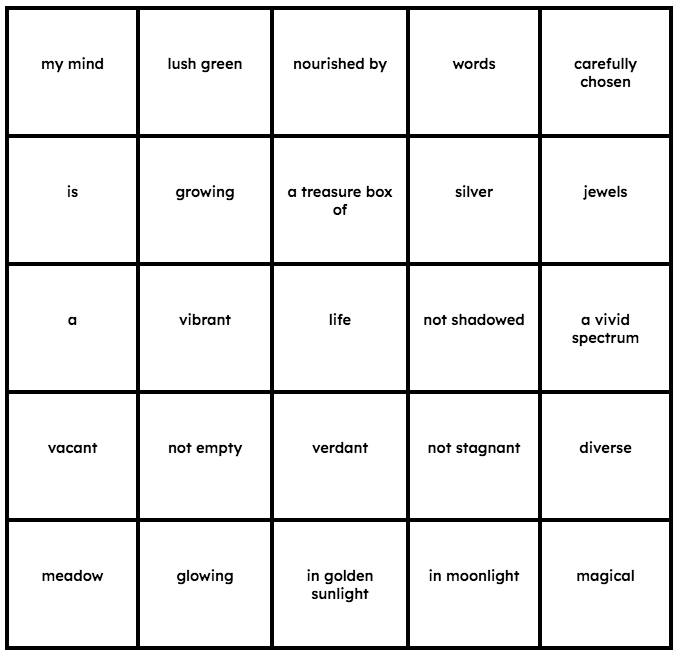
Molly’s challenge/invitation for the Inklings this month was to channel the “dazzle of color that arrives in spring after months and months of blues and whites and grays.” She gave us a couple of mentor poems, but when I saw this Sudoku poem in the Rattle newsletter, I knew I had to try one.
Sudoku are logic puzzles. “The objective is to fill a 9 × 9 grid with digits so that each column, each row, and each of the nine 3 × 3 subgrids that compose the grid (also called “boxes”, “blocks”, or “regions”) contain all of the digits from 1 to 9.” (thank you, Wikipedia for this concise explanation!) In my Sudoku poem, every row and every column reads as a sort of haiku.
I’m not entirely new to this kind of writing. Once upon a long time ago, I made some mini-canvas mix-and-match haiku sets to give away as gifts. (Could I find any pictures? No, I could not.)
This 5X5 poem started with my Metaphor Dice and the phrase down the left-most column. It grew from there, with color added where I could. If only I had done a time lapse video of the writing and revision I would be able to tell you the exact (hah!) steps for creating a Sudoku Poem. You’ll have to try it for yourself and see what happens!
Here’s what the other Inklings came up with this month:
The Poetry Sisters challenge for this month was to write a ghazal. Challenge is the right word! I had a bit of a head start because the Inklings wrote ghazals back in 2021 and I had both the experience of juggling all the rules of ghazals AND an abandoned draft to work with. Good thing, because all the other drafts I started in the past week or so came to absolutely nothing…for now! Maybe the next time I tackle ghazals, one of those drafts will be just what I need!
In June, we will be writing in response to a quote. Pick your favorite and join us!
Thank you, fellow Inkling, Linda Mitchell, for this month’s prompt which gave me permission to write an almost-definito for a word I’d been saving since mid-March:
.
You can see what the other Inklings came up with here:












 A(nother) Year of Reading