Gratitudes to John Masefield for my mentor text for this poem, Sea-Fever.
Irene has this week’s Poetry Friday Roundup at Live Your Poem. Please note a change in the roundups next month — I will be taking the November 5 roundup to help out Tabatha. Also, a team of PF Peeps are going to be organizing the Winter Poem Swap, so stay tuned for more information about that!
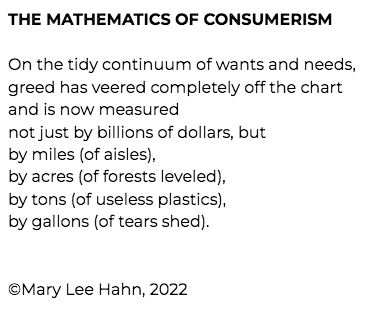
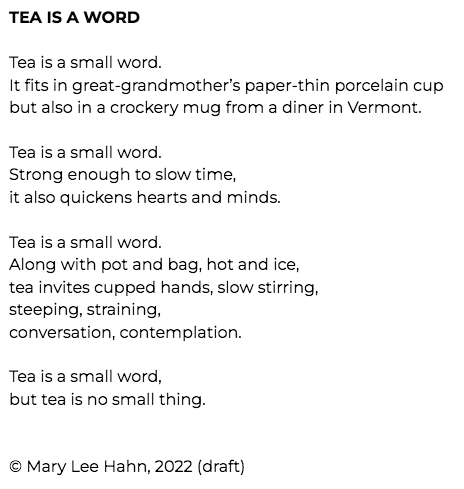
The Inklings’ challenge this month was mine. I was quite taken with the idea of this book: a book about poetry forms and techniques…written in poems. So I challenged the group to write their own poems about forms or techniques. The more we dug into the book, the more we realized that the author doesn’t always explain a form in that form. For instance, her poem about the sestina follows the form but does not explain it. And one of the flaws of the book is that nowhere is there clear definitions of the techniques and forms. Still and all, I recommend the book, and we all had fun playing around with form and techniques. Here are three of mine.
Enjambment
Writing teachers especially hate run-ons. Close the gate so the end of the line can have the pause that finishes a thought or completes a clause.
.
Haiku
small observation perhaps elaboration wry commentary
.
Personification Limerick
I once was a limerick named Sue. My rhythm was fine. Rhyme was, too. There was just this one thing caused my heart not to sing: my longing to be a haiku.
This month’s Poetry Sisters Challenge was so much fun! The first fun was diving into each sister’s blog archives to find a poem that invited me to respond. Then, the fun was in “talking back” to her poem.
The Poetry Sisters’ challenge for this month is to write a tanka in response to or conversation with a poem written by one of the other sisters. Kelly wrote a fabulous article about tankas. Who doesn’t love her analogy that “a tanka is a haiku pulling a trailer?!?” To get ready for the challenge, I’ve written a trio of tankas. I’ll share them without images, because I’m hoping the words themselves are enough to paint a picture in your imagination. The orb weaver and the buck live in Central Ohio; Rae’s house is in the dry high plains of Eastern Colorado.
Tanka for Rae’s House
Beyond the window: extravagantly green lawn, bountiful garden. In the unwatered pasture dry grass crunches underfoot.
.
Tanka for the Eight Point Buck
sun low behind trees morning air carries fall chill eight point buck sees me freezes so majestically you forget he’s in the street
.
Tanka for the Orb Weaver
Above our front door hangs a ferocious hunter alarmingly large seeming to stand in thin air. She owns the porch. I concede.
Earlier this week, Margaret got me thinking about sonnets. I knew I had written one, but had to dig hard at A Year of Reading to find it: Coffee House Sonnet. Turns out it’s from NPM 2010, and I haven’t archived that year’s project over at Poetrepository yet. (Adding that to my to-do list…)
We’ve been enjoying a few days of perfect September weather, and because it was clear this morning, I went for my walk before the sun came up and I got to say hello to my good friend, Orion, for the first time since he waved goodbye and marched over the western horizon last winter.
Jennyanydots (6 lbs) in her 21st and final year in 2008, and Hemingway (14 lbs) currently in his prime.
Margaret gave the Inklings quite a challenge this month! We wrote ghazals, (Hindi: ग़ज़ल, Arabic: غَزَل, Bengali: গজল, Urdu: غزَل, Persian: غزل, Azerbaijani: qəzəl, Turkish: gazel, Uzbek: gʻazal, Gujarati: ગઝલ) an ancient Arabic poetry form with five delightfully complicated rules.
I found Ravishing DisUnities by Agha Shahid Ali VERY helpful. This collection of ghazals by 100+ poets (including Diane Ackerman, W.S. Merwin, and Maxine Kumin, just to name a few of the poets whose names I recognized) helped me to suss out the form, AND provided all kinds of variations on the form.
(An aside, related to Bridget’s post about DuoLingo. I’m learning Spanish and Arabic and reviewing my rusty German with DuoLingo. Current status: 90 day streak. When I pasted in “ghazal” in all those different languages (thank you, Wikipedia), I was startled to realize that I can ALMOST read the Arabic! I haven’t learned the “gh” character yet, but I know the little accent mark above it means short a, I know z (with another short a), and I just learned l. WOW!)
Uncle Bob was not my uncle. He was my dad’s cousin, but the closest thing to family we had. He also was not a cowboy, but if you saw his slow, bow-legged saunter, his cowboy hat, his blue jeans and western snap-fasten shirts, that’s what you might think. You wouldn’t know by looking that he was the canniest dry-land farmer in the Great Plains of Eastern Colorado. He was born and raised in the part of Colorado without mountain peaks and rich soil. His landscape was wide and flat and dry. Dirt roads with thistle in the ditches marked the edges of native grassland pasture and wheat fields. Uncle Bob had a deep understanding of the land he farmed, never succumbing to “the grass is greener” mentality of irrigation. He was a dry-land farmer whose harvest depended on the land and the weather. There were good years with enough moisture, and plenty of years with dust devils and tumbleweedsbefore the rain came…or didn’t come. In the summer, many a cumulonimbus cloud appeared on the horizon, only to take its rain elsewhere, but perhaps also its hail. A winter blizzard was a mixed blessing of wind that carried topsoil away and brought moisture that did or didn’t cover the fields to nourish the winter wheat. Uncle Bob secured his success by collaborating with the land and the climate, but he allied with another of the vast natural resources of Eastern Colorado for his final venture — harvesting the wind with graceful lines of enormous turbines.
In my mind, it is night. I stand in the dusty yard where I played as a child, rusty tractors along the fence, the Milky Way a bright smear across the impossibly dark sky. Uncle Bob is in it all — land, sky, and wind.
This prose poem was written in 2019 using cards from “Paint Chip Poetry.” I learned yesterday that Uncle Bob passed away last weekend. I was looking forward to seeing him next week when we’re back home. We’ll drive past the home place and I’ll savor my memories.