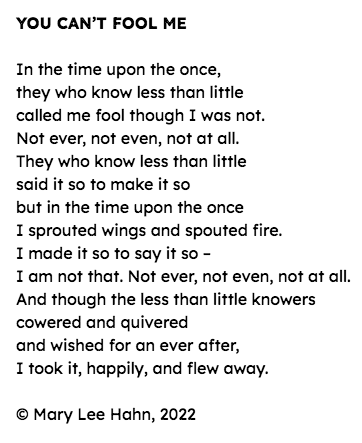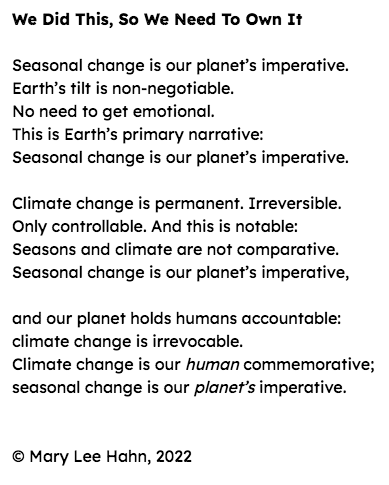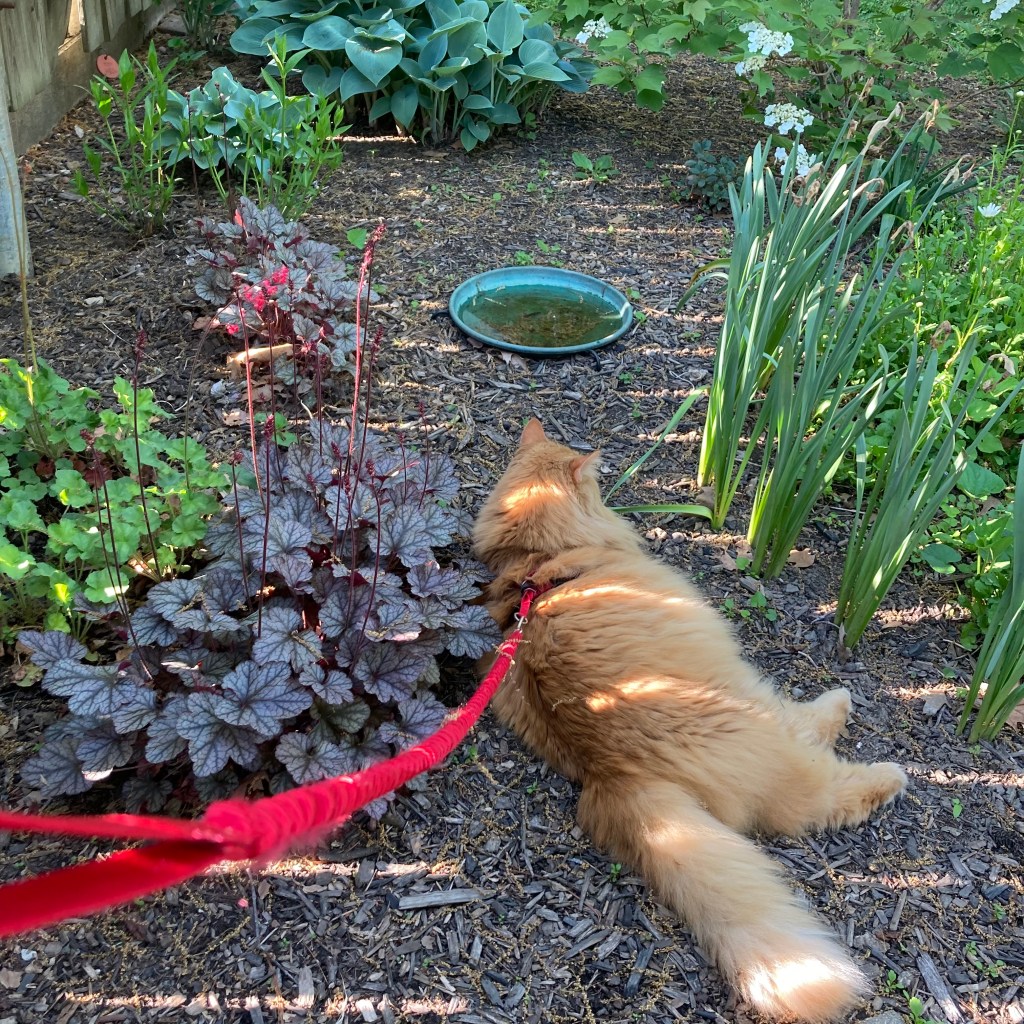
The Poetry Sisters’ challenge this month was to write Welsh Byr a Thoddaid Poems. There are a ton of rules, but when you get right down to it, the form consists of lots of syllable-counting and attention to rhymes.
My first cat, Jennyanydots, achieved the status of Truly Old Cat. She passed at the age of 21 and was a tiny thing (maybe 6 pounds in the end) with a mighty voice for wailing when she couldn’t find her “tribe.”
Hemingway is a big guy (14 pounds) and not old yet — only 7-9 (he was a rescue) — so why is he starting the yowling-for-no-reason? Maybe just to give me a poem topic!
Next month we are writing acrostic phrase poems. Choose any line from the poem “Still I Rise” by Maya Angelou and use each word in the phrase to begin a new line of your poem.
Molly’s challenge to the Inklings this month was “to write a poem about some sort of domestic task.” My loss of control in the garden is embarrassingly similar to my approach to housekeeping — tidy up just enough to get by until time and energy (and usually company coming) converge to inspire a deeper cleaning.
“The show” is in full force right now in my garden. I never cease to be amazed at the transition from the exciting first tentative emergence of spring green and bloom to summer’s (seemingly sudden) surge of exuberant (over)growth.
Here’s how the rest of the Inklings interpreted this challenge:
The Poetry Sisters’ challenge for this month was to write a poem with the theme of string, thread, rope, or chain. My brainstorming took me on a trip down memory lane, beginning with a visual memory of our precisely clothes-pinned swim suits and beach towels in a perfect suit-towel-suit-towel pattern on the clothesline.
Then came crafting memories. So many of the crafts I learned from and with my mother used thread or string: macrame, cross stitch, needlepoint, embroidery, sewing.
My mother’s mother was a home ec teacher and somewhat of a tyrant when it came to precision. Mom had to baste every seam before stitching it, and if her basting stitches were not perfectly even, she had to rip them out and start over. At the time, I never fully appreciated how much Mom had to dial back when she taught me “thread arts.”
I was definitely indoctrinated in “follow the pattern,” which left me with a healthy appreciation for rituals, routines, mentor texts, patterns, instructions, and recipes, but I also have developed a deep joy found in trial-and-error, guess-and-check, innovation, and experimentation.
Linda gave us our Inkling challenge for this month, suggesting that we “Honor someone’s April Poetry project in some way with a poem in the spirit of their project, a response poem, or some way that suits you.”
I am honoring Amy, who wrote poems in response to proverbs. I’m also honoring Tanita, who did the same, with a few twists. I didn’t dig into the history of the proverb, the way Tanita did, but like her, I wrote short enough to put my poem on a sticky note (also honoring Laura PS) along with a sketch.
MORNING WALK
one deer pair of mallards hawk on the outfield fence unseen bird chorus in the woods coal train
Today’s proverb is “Rain does not fall on one roof alone.” The contrast between the vibrant urban wildlife and the seemingly endless coal train reminded me that every human action has consequences that reverberate well beyond the point of impact. We must learn to be less myopic.
Here’s how the rest of the Inklings interpreted the challenge:
I’m for photosynthetic optimism – the bulbous kind you plant in the fall in spite of squirrels who dig ruthlessly and urban deer who nibble indiscriminately, the kind that seed packets hold through the winter believing in butterflies and hummingbirds before they’ve ever known sun and rain.
Here’s to the blazing green energy of plants– from the toughest blade of crabgrass to the most tender spring ephemeral, from the massive trunks of riverbed sycamores to the tiniest pond-floating duckweeds.
I’m for the plants – for the roots who go about their work silently, mysteriously, collaborating with mycorrhizal fungi.
And I’m for the leaves of trees – especially sweet gum’s stars and ginkgo’s fans.
I’m for the way we share the air with plants – us breathing out, plants breathing in. I’m for the generous chemistry of leaves, combining carbon dioxide with water and sun, creating carbon building blocks for itself, then sharing the extras back into the soil for the microbes.
What moves me? What plays me like a needle in a groove? Plants.
The Poetry Sisters’ challenge for this month was to write in the style of Taylor Mali. The poem I used as my mentor text is Silver-Lined Heart. Next month we are writing poems around the words string, thread, rope, or chain.
Happy Last Friday of National Poetry Month 2022! All of my NPM poems are archived here. Jone has this week’s Poetry Friday Roundup at Jone Rush MacCulloch. Like last weekend, I will be away from my computer this weekend and will look forward to catching up on your posts next week!
I love writing from an image. I love short form poetry. So this month’s Poetry Sisters challenge was right up my alley: ekphrastic dodoitsus. When we dug into the definition of dodoitsus, however, we learned that they are more complicated than a simple 7-7-7-5 syllable count. “The dodoitsu often focuses on love or work with a comical twist.” I’m not sure how well I satisfied all of the requirements, but it was lots of fun.
This first picture is at the historic Open Air School here in Columbus. They have completed renovations and one of our new favorite restaurants, Emmett’s, is located there.
After so many courses laid with rhythmic precision I can’t stand it anymore. Time for a jazz riff.
In this one, the poem only matches the photo on the theme of careless quality control. It’s based on a story Molly Hogan told, and so I’m sorry to tell you that it is as true as that unsliced apple in the picture. But a LOT more gross.
In the pickle factory, he left the frogs on the belt. Quality control loophole: squeamish inspector.
Amy LV has this week’s Poetry Friday roundup at The Poem Farm.
If you want to join the Poetry Sisters’ challenge for next month, we’re going to write in the style of Taylor Mali, which is to say there might be metaphor dice involved, and perhaps some eloquently long-winded spoken-word poetry which may or may not be recorded in videos. Mali’s mentor poems are not always appropriate for children/students, but that doesn’t mean we can’t borrow his style if not all of his subject matter and/or word and gesture choices.
I’m sure you know Mali’s “What Teachers Make,” (look at who he’s on stage with in this version) and if you don’t know “When I Miss Teaching,” it’s time to do something about that. Especially that ending. So true. You should read “The Impotence of Proofreading,” rather than watching it, but in either case, make sure you don’t have food or drink in your mouth. (if you watch, the other guy on stage has warmed up a bit…)
Next week begins the zaniness known as Poetry Month, in which I write AND PUT OUT IN THE WORLD a poem a day. According to Poetrepository, this will be my 9th year of this madness. However, there are three more years of poems at A Year of Reading that I need to move over to Poetrepository. So it’s actually my 12th year. Wow. I’ve got my 2022 theme, but not my cute graphic made on Canva, so you’ll have to stay tuned. I’ll be posting on Poetrepository, but will round up the highlights here on Fridays.
Margaret gave the Inklings their challenge for this month: “Choose a quote that speaks to you. Write a poem that responds to the quote. The words can be used as a golden shovel or throughout the poem or as an epigraph.”
I cheated just a little. I found a poem that I wrote back in June of 2021, just after retirement, and then went looking for a quote that fit with it as an epigraph.
Here’s how the rest of the Inklings interpreted Margaret’s challenge:
This month, poetry met parlor game as the Poetry Sisters collaborated to create an Exquisite Corpse poem. Unlike the “rules,” we did not use an agreed-upon structure and we constructed the poem one line at a time rather than one word at a time. Liz started us off, sending Tanita her line. Based on Liz’s line, Tanita wrote a line and then send just her line to Kelly. From Kelly, a line went to Sara. Andi was next, then Laura, Tricia, and finally me. Here’s what we wrote:
This month, odd one out, running short on days and sleep, This month, past meets pride, roots ripped from native soil still somehow grow. The once-bright future dims. Shadows grow But there, near canyon rim, in broken light the yearling hawk shrieked in futile fury and the steel-edged clouds looked away trees bow and bend on a blustery day that rattles old oak leaves down the street.
In creating our final drafts from this rich loam of raw material, we agreed that it was fair game to use as much or little of the original as we saw fit. Here’s the best of my many drafts.
Next month we are writing ekphrastic Doditsu. You can learn about this poetic from Robert Lee Brewer at Writer’s Digest. They are a little more complicated than a simple syllable count, as I once believed! The Dodoitsu often focuses on love or work with a comical twist. We are sharing images in our group, but you can write to anything you like. If you want to be inspired by my image, here’s what I shared.
Early this month, I had the good fortune to attend a Zoom session hosted by Georgia Heard, with George Ella Lyon as the special guest. I jotted PAGES of “George Ella Gems,” then typed them up and cut them apart. I had a draft I liked, but then this morning, I didn’t like it. Easy enough to create a new draft! An unspoken sub-challenge this month was to put your poem into Canva. Here’s my draft for now:
Irene has this week’s Poetry Friday Roundup at Live Your Poem, where you can “overhear” lots of poetry talk!
In February, the Poetry Sisters are going to try one or more Exquisite Corpse poems. We’re not sure exactly how we’re going to do them, and there’s a lot of wiggle room. Read about them, and then figure out how YOU’D like to use or be inspired by the game. We’ll share our poems on Feb. 25th, and you can, too! If you share on social media, use the hashtag #PoetryPals. We can’t wait to see what you (and we?) do with this! Have fun!
Heidi gave the Inklings a tough challenge this month. She suggested that we use the “The Lost Lagoon” by Mohawk poet, Emily Pauline Johnson (d. 1913) “to build your own poem FOR CHILDREN about a treasured place that you return to again and again (geographical or metaphorical).”
The first thing I did was copy the poem into my notebook and “unpack” the poem the way we used to do weekly in my classroom. As you can see, there’s a LOT going on in this poem!
What wasn’t hard was picking my topic — the swimming pool. What WAS hard was writing a poem “FOR CHILDREN.”
Here’s how the rest of the Inklings interpreted Heidi’s challenge: