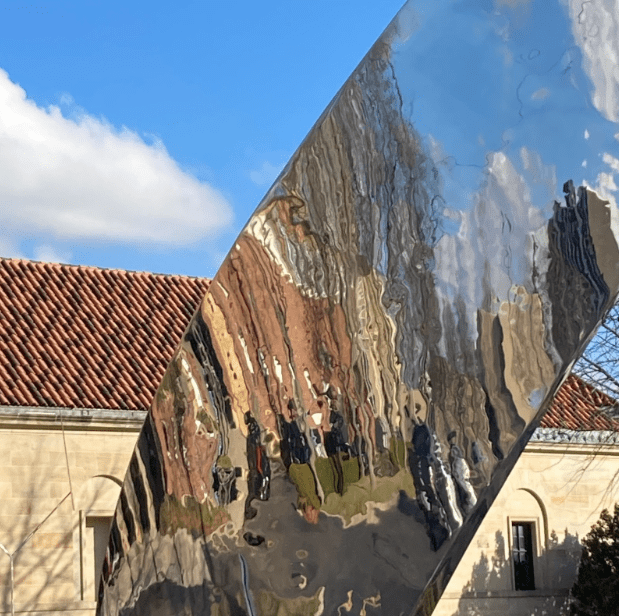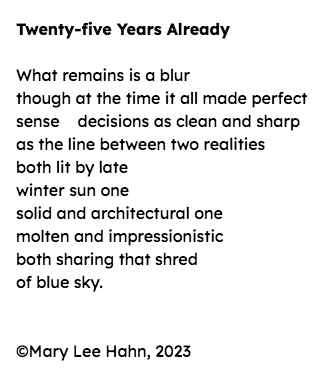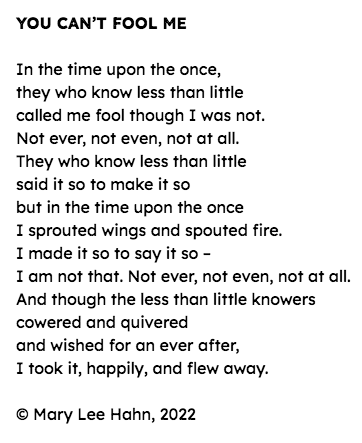
This month, the Poetry Sisters wrote Cascade poems that perhaps address our year-long theme of “Transformation.” The form is cookie-cutter easy, but evocative-images hard. I wrote plenty of the first kind before I found the first stanza of this draft in my notebook jottings on January 2.
In February, we’ll be writing Ekphrastic poems. If you’d like to join us, find a piece of art that moves you to write. Bonus points for including the theme “Transformation.”
Jan, at Bookseed Studio, is our kind and gracious hostess for this week’s Poetry Friday roundup.
Heidi gave the Inklings our January challenge: “Write a poem which weighs the pros and cons of #change. For extra fun, use any form, but consider starting in one form and gradually transitioning in the course of the poem to a quite different form.” Oof. Not a small challenge to tackle in the midst of the holidays, and other assorted moves, births of grandchildren, and COVID episodes (none of these mine).
This past Monday on our Zoom, sensing (hoping) that we were all slightly poem-less, I changed up the challenge and suggested an Exquisite Corpse Poem. One line would be written and sent to the next poet via private chat, who would send only her line to the next poet, and so on until we had, if not a poem, then at least some words to use as seeds to grow a poem.
Here’s what we wound up with:
Leaves on the forest floor understand and submit Submit without challenging the direction of the wind to wander and wind along our way the wind unwinds us day by day, shifting clouds, shining light or casting shadows Where steps and stones still lie.
Eight drafts later, I offer this:
.
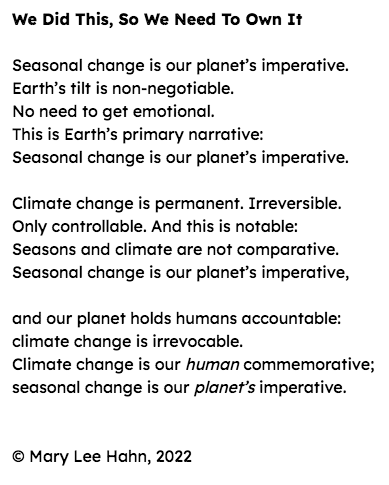
Our planet’s slow, interconnected natural changes are sharply contrasted by the selfishly rapid changes humans have caused, presumably to benefit our species, but which in reality are destroying our home.
Here’s how the rest of the crew met Heidi’s CHANGE challenge and/or CHANGED the lines we began with on Monday to make a new poem:
The topic for the Poetry Sisters’ December Challenge was Box. We met to write and brainstorm on Boxing Day, after opening a few boxes on Christmas. Box is such a rich topic: boxes of chocolate, thinking outside the box, boxes of family heirlooms in the basement, feeling boxed in. They constrain and contain, have sides, edges, vertices, volume (we study them in math). They store ashes for interment and prisoners for internment. Flat ones are glowing digital screens. And there are windows, doors, blank notebook pages, the space for a signature, the place to mail a letter. A delivery van is a rolling box filled with boxes in which are boxes…all headed to the building-box known as the food pantry which is a place where those who are boxed in by financial constraints can fill a box and some bellies.
Such a rich topic.
There are also poetry forms that pose as boxes. The 4 x 4 poem is a kind of box, and Lewis Carroll, the avid mathematician, gives us the square poem form.
I combined “thinking outside the box,” my boxes of embroidery floss/threads, and these two forms in my poems. “What next?” is a big question for me as I finish up the year of weekly embroidery mandalas. My 4×4 poem addresses that question, while my square poem reassures me that I will find my way.
Patricia has this week’s Poetry Friday roundup at Reverie, and the call for roundup hosts is here. January’s looking a little thin, but I have faith! The schedule always fills!
Here’s how this poem happened: 1. Molly’s challenge for the Inklings this month was inspired by Amy Ludwig VanDerwater’s recent post in which she invited writers to answer an unasked question. 2. I spent 4.5 days with my brother’s family in CA after NCTE. There, I met my niece and nephew in real life for the first time. Together we played, doodled in our notebooks, snuggled for read aloud, considered square and cubic numbers, explored tide pools, studied a world map, worked in the garden, and climbed to the top of the rope climber at the playground. 3. I found the poem, “Because A Redwood Grove” (by Joe Cottonwood…how fun is that?) on Your Daily Poem. 4. You didn’t ask, but this poem’s the answer to the question of what happened to my heart over the course of those 4.5 days in CA with my brother’s family…with MY family.
Here’s how the rest of the crew met Molly’s challenge:
The Poetry Sisters’ challenge for November was to write a recipe poem. I’m cheating just a bit since I’ve had little/no writing time during NCTE and visiting family for this holiday week after NCTE. As it is, I am posting from SFO before I board the redeye back home! This poem can be found in THE POETRY OF US, edited by J. Patrick Lewis.
This month, Linda (A Word Edgewise) challenged the Inklings to “Find or write a poem in any form of any length for Folktale Week November 14-20, 2022.” I came up with three that are worth sharing.
.
.
.
All three poems came as surprises. The first is the most nonsensical poem of truth I’ve ever written. I think it might have its seeds in Kelly Barnhill’s new book for adults When Women Were Dragons, a book I HIGHLY recommend. The second, though the briefest, was the hardest to get just right (not surprising, actually). And the third? Well, after all the struggle I put into my dansa for last week, I surprised myself by writing another!
Here’s how the rest of the crew met Linda’s challenge:
This month the Poetry Sisters wrote Dansas. This form features an opening quintrain (5 lines) is followed by quatrains (4 lines), with a quintrain rhyme scheme of AbbaA and the quatrain bbaA.
My first drafts were odes to Autumn. Somewhere along the line, my repeating line showed up and the rest just…flowed. Our planet just keeps doing what it’s tilted to do, and all of the changes we’ve made in its/our climate are irreversible. There’s no going back. A hard truth to swallow as we (hopefully, with votes galore) work to put on the brakes and do less damage moving forward.
If you’re inclined to join us, next month we’re creating recipe poems! Your choice of form, length, meter, or topic, but each poem will be an assemblage of elements, using recipe text/cooking instructions to create …something. From a recipe for disaster, to your favorite aperitif, you have a month to craft your creation and serve it forth on November 25th.
Anybody out there addicted to Wordle or Waffle? I assume that more than a few of you who like to play around with words might have climbed aboard one or more of the current word game crazes! That’s why my challenge for the Inklings this month was to write a Wordy 30 Poem. A Wordy 30 is a poem using exactly 30 letters. Each line should have the same number of letters. Each line should use one word. You might have 6 lines with 5 letters in each line (like Wordle), or 5 x 6, 3 x 10, 10 x 3, 15 x 2, 2 x 15, 30 x 1, or (most unlikely) 1 x 30. Here are mine — a 5×6 and a 6×5.
Sarah Grace has this week’s Poetry Friday roundup.
And if you want to join in with the Poetry Sisters’ challenge this month, we’re writing Dansas, described here by Cousin Tanita: Its opening quintrain (5 lines) is followed by quatrains (4 lines), with a quintrain rhyme scheme of AbbaA and the quatrain bbaA. You’ll note that A repeats because the opening line of the first stanza is the final line of every stanza, including the first.
I had planned to let nature take her course with the butterflies this year. I would provide ample milkweed and fennel, and not bring any caterpillars inside to mature and emerge in an artificial environment. Caterpillar after caterpillar was sighted…then disappeared. We had more than the usual number of bluejays at our feeder. Was I unwittingly providing them with caterpillar snacks? Guilt took over. The next two (and as it turns out, the last two) monarch caterpillars I found came inside and were raised successfully to adulthood. I’ve lost count of the number of black swallowtails we’ve raised to adulthood, but there are currently six chrysalises that will overwinter in our garage and be the first to emerge in the spring. The world is right again.
The Poetry Sisters’ challenge this month was to write a definito — a free verse poem of 8-12 lines (aimed at readers 8-12 years old) that highlights wordplay as it demonstrates the meaning of a less common word, which always ends the poem. I collected several juicy words from the Merriam-Webster word-a-day emails I get: assiduous, perspicacious, and effulgence. They all go together in a fun way when it comes to raising monarchs: it takes assiduous care and a perspicacious eye to fully appreciate the effulgence of the gold-spangled monarch chrysalis.
The striking line, “You can’t sum it up. A life.” comes from the poem “The Hurting Kind” from the book THE HURTING KIND by Ada Limón.
The poem itself, in response to Margaret Simon’s gorgeous photo, is a “This Photo Wants to Be a Poem…” poem, which was Margaret’s challenge this month for the Inklings.
Here’s how the rest of the crew met Margaret’s challenge: