2022 Progressive Poem, Day 4

The Progressive Poem has been around since 2012, when Irene Latham got it started. In 2020, Margaret Simon took the reins. I’ve taken part every year!

I thought I was being so clever this year, choosing a day early in the schedule when I would have a chance to perhaps bring the first quatrain to a close, or at least help set the intention for the poem, rather than trying to figure out how to continue it in the middle or turn it towards the end.

Come to find out, beginnings are just as hard as middles and ends. But I guess I already knew that. So now it’s been confirmed.

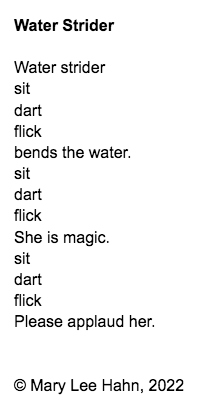
Irene gave us our first line this year, a quote from Emily Winfield Martin’s book, The Imaginaries. In the second line,  Donna gave us a quote from The Hobbit set us on the JOURNEY of a poem for two voices, perhaps told all in quotes. Catherine chose a line from The Wind in the Willows . Here’s the poem as I received it. A bold statement about the journey ahead, a polite refusal, and an enthusiastic encouragement to GO FOR IT:

For me, one of the quintessential children’s books featuring a journey is Walk Two Moons by Sharon Creech. If I had time, I’d reread the whole book. Just taking it off the shelf and flipping through the many sticky-noted and dogeared pages makes me wistful for all the times I read it aloud in my classroom. I didn’t have to read much to find the quote I needed for the poem. Salamanca Tree Hiddle both does and emphatically does NOT want to go on the journey to Lewiston, Idaho. “It was not a trip I was eager to take, but it was the one I had to take.” Her voice will add to the reluctance in Donna’s line, and we’ll have to see where Buffy takes us next.

.

.

Here’s where the 2022 Progressive Poem has been and is going:

1 April 1 Irene at Live Your Poem
2 Donna Smith at Mainly Write
3 Catherine Flynn at Reading to the Core
4 Mary Lee at A(nother) Year of Reading
5 Buffy at Buffy Silverman
6 Molly at Nix the Comfort Zone
7 Kim Johnson at Common Threads
8 Rose Cappelli at Imagine the Possibilities
9 Carol Varsalona at Beyond Literacy Link
10 Linda Baie at Teacher Dance
11 Janet Fagel at Reflections on the Teche
12 Jone at Jone Rush MacCulloch
13 Karin Fisher-Golton at Still in Awe
14 Denise Krebs at Dare to Care
15 Carol Labuzzetta @ The Apples in my Orchard
16 Heidi Mordhorst at My Juicy Little Universe
17 Ruth at There is no such thing as a God-forsaken Town
18 Patricia at Reverie
19 Christie at Wondering and Wandering
20 Robyn Hood Black at Life on the Deckle Edge
21 Kevin at Dog Trax
22 Margaret at Reflections on the Teche
23 Leigh Anne at A Day in the Life
24 Marcie Atkins
25 Marilyn Garcia
26 JoAnn Early Macken
27 Janice at Salt City Verse
28 Tabatha at The Opposite of Indifference
29 Karen Eastlund at Karen’s Got a Blog
30 Michelle Kogan Painting, Illustration, & Writing

Franki’s Weekly Text Set: Board Books for All Ages

Texts for this Text Set have been posted daily on Instagram. 

Follow @TextSets there to get daily updates!

I worry when people think board books are only appropriate for infants and toddlers. Although they are great for that age, they are also great for older readers. I am a big fan of a laundry basket of board books for K-5 as part of the classroom library. The books I am sharing this week are fun and sturdy and great for all ages!

If you don’t know the Mathical Book Awards, then you must! It is a fabulous award “for fiction and nonfiction books that inspire children of all ages to see math in the world around them”. 1 Smile 10 Toes is one of this year’s winners and I LOVE IT!! It is an interactive board book and you can flip it around and make so many animals with different combinations of features. This can be a fun counting book for younger children, but older children can think about the many combinations and all readers can just have great fun creating new combinations! One of my favorite board books of all time!

I love this series by Sophie Beers and Love Makes a Family is one of my faves. (Change Starts with Us and Kindness Makes Us Strong are two others in the series that I love). I love this book for young children but I also think this series can be used in word study for older children. Anytime a whole book defines a single word or concept, there is lots to think about as word learners. Highly recommend this whole series! s

Our Skin: A First Conversation About Race is part of another board book series that I love–the First Conversations series. The others in the series are Yes! No!: A First Conversation About Consent and Being You! A First Conversation About Gender. These provide great anchors for good conversations around important topics. The books are done in developmentally appropriate ways with lots of access points and several opportunities to extend with conversations. There is great backmatter to support adults with having these conversations with children. Another series that is incredible for all ages.

Circle Under Berry book is fun for children and adults. Really, I don’t even know how to explain it but it is brilliant. There is so much on every page of this book–spatial concepts, colors, shapes, etc. And the whole design and concept behind the book is worth study. So much to love about this one!

I recently discovered this oversized board book-Little Cat Hide-and-Seek Emotions— that is a fun way to talk to children (of all ages) about emotions they may be feeling (and how to read those emotions when others may be feeling them.). The colors and illustrations make this book extra engaging, making it a great anchor for conversations around emotions.

This week’s books were linked at Bookelicious and/or  Cover to Cover Children’s Bookstore. If you are looking for a fabulous local children’s bookstore to support, Cover to Cover is an amazing one. We are lucky to have them in Central Ohio! If you don’t have an independent children’s bookstore in your town, check out Bookelicious. They are an online independent bookstore for children with an incredible curated collection. 

Follow @TextSets on Instagram for daily books/weekly text sets!

Poetry Friday: NPM Day 1

I’m reading and listening to ALL WE CAN SAVE: TRUTH, COURAGE, AND SOLUTIONS FOR THE CLIMATE CRISIS

My poems this month will be inspired by the essays and poems in this book, and by this gorgeous living planet we call home.

Sometimes I get a panicky feeling about our future, but I’m trying hard to hold onto hope and to the actions I can take, no matter how small. It is not too late to turn things around, but I can’t sit on the couch waiting for someone else to do something. 

Throughout the week, I’ll be posting at Poetrepository, but I’ll do a mini roundup here on Fridays.

Today’s poem does double-duty. I challenged the Inklings to write a poem using The Thing Is by Ellen Bass as a mentor text. I wrote a couple of drafts, but when I fully processed that this poem would need to introduce my NPM project, it was back to the writer’s notebook to draft again.


Here’s how the rest of the Inklings interpreted my challenge:

Linda@A Word Edgewise
Heidi @my juicy little universe
Molly@Nix the Comfort Zone
Catherine@Reading to the Core
Margaret@Reflections on the Teche

Heidi has this week’s Poetry Friday roundup at my juicy little universe. Happy National Poetry Month! Let the flood of poetry begin!

Women’s History Gives Readers All Kinds of Role Models

BORN HUNGRY: JULIA CHILD BECOMES “THE FRENCH CHEF”
by Alex Prud’homme
illustrations by Sarah Green
Calkins Creek, 2022
review copy provided by the publisher

“No one is born a great cook, one learns by doing.” Julia Child was tall and loud and eager to learn to be a good cook. She learned the importance of taking “time and care” in choosing the best ingredients (making friends with the butcher, baker, and cheese maker) and in creating her dishes. Most of all, she encouraged her students, her TV fans, and her cookbook readers to have fun! What a great role model! For more images and quotes, see this review at Jama’s Alphabet Soup.

BLAST OFF! HOW MARY SHERMAN MORGAN FUELED AMERICA INTO SPACE
by Suzanne Slade
illustrated by Sally Wern Comport
Calkins Creek, 2022
review copy provided by the publisher

Although she didn’t start school until she was eight, Mary fell in love with science first, and chemistry later. She broke through gender barriers to get a job at North American Aviation developing rocket fuels. She was given the job of developing the fuel that would take a rocket into space. After several failures, she succeeded, and the rest is history! Mary Sherman Morgan is a role model for following your passion.

NELLIE VS. ELIZABETH: TWO DAREDEVIL JOURNALISTS’ BREAKNECK RACE AROUND THE WORLD
by Kate Hannigan
illustrated by Rebecca Gibbon
Calkins Creek, 2022
review copy provided by the publisher

Did you watch the recent PBS version of AROUND THE WORLD IN EIGHTY DAYS? I was fascinated by their remake of Jules Verne’s story, and even more fascinated by the real-life story of two very different woman journalists, one outgoing and bold (Nellie Bly) and one quiet and reserved (Elizabeth Bisland) who raced to make it around the globe in just seventy-five days. Both had grand adventures and broke all kinds of stereotypes about what women could and should do.

REVOLUTIONARY PRUDENCE WRIGHT: LEADING THE MINUTE WOMEN IN THE FIGHT FOR INDEPENDENCE
by Beth Anderson
illustrated by Susan Reagan
Calkins Creek, 2022
review copy provided by the publisher

The men of Pepperell, MA took big actions in the fight for independence, but Prudence led the women of Pepperell in small actions that formed “a pattern of rebellion:” burning British tea and making their own with local herbs, spinning their own cloth rather than depending on British cloth, using maple syrup instead of British sugar. “Prudence could live with inconvenience and additional work. But she couldn’t live with unjust laws and stolen rights.” A role model attitude for our times. Prudence even rallied the women to catch a Tory spy crossing the bridge that led into Pepperell.

TO THE FRONT! CLARA BARTON BRAVES THE BATTLE OF ANTIETAM
by Claudia Friddell
illustrated by Christopher Cyr
Calkins Creek, 2022
review copy provided by the publisher

This innovative biography in verse blends Clara Barton’s words with the words of the author. We’ve heard her called “The Angel of the Battlefield,” but this biography brings Barton’s heroic actions to life. This book would be a good one to pair with images of all of the aid organizations currently working on the ground in Ukraine and those helping refugees in Poland and elsewhere across Europe. Clara Barton is a role model for compassion and determination.

Franki’s Weekly Text Set: Nonfiction for Our Youngest Readers

Texts for this Text Set have been posted daily on Instagram. 

Follow @TextSets there to get daily updates!

Often, nonfiction is written with older elementary students in mind. This week, we take a look at a set of nonfiction that is perfect for younger readers. These books are actually perfect for all ages and they would be great writing mentors for middle grade writers. When we think about having enough quality nonfiction for our youngest readers, we want books that not only appeal to them, but books that meet their developmental and reading needs. These books do just that!

Love this new nonfiction guide for young readers-How to Say Hello to a Worm. There is so much content packed into this book but the question/answer format that is embedded in a narrative works well to share the information. The illustrations are bright and I love that the questions and answers are in different color font. This is a great feature that young readers will notice and just enough to begin thinking about the visual set up of some nonfiction texts.

I doubt that The Thing About Bees is officially nonfiction but it has enough nonfiction elements that I include it here. The subtitle “A Love Letter” lets readers know that this is a type of tribute to Bees. And the poetic language makes it a perfect read aloud. The way the information is embedded along with bigger themes is brilliant and there are so many access points for all readers.

Animals are often a top of interest for young readers and these two books are perfect. Animals!: Here We Grow! is filled with incredible photographs showing how animals change and grow. The combination of text and visuals make this one perfect for young readers. And in Steve Jenkins’ and Robin Page’s Who Am I? readers can guess the animal described based on the informational clues. (Another great mentor for older writers too!).

Lift, Mix, Fling! Machines Can Do Anything an engaging introduction to simple machines for young learners. There is so much on every page and key vocabulary is embedded into rhyming text. This makes for a great read aloud and there is also lots to explore in the illustrations on each page.

I discovered This Pup Steps Up and This Cat Loves That on Bookelicious and they are great fun. They are both filled with rhyming text and incredible pictures. The dog book focuses on all that dogs can do and the cat book focuses more on the things cats like and don’t like. Readers will learn a lot while they enjoy so many adorable pictures of dogs and cats. What could be better!

This week’s books were linked at Bookelicious. If you don’t know Bookelicious, check it out today. It is an online independent children’s bookstore with an incredible selection of children’s books and many supports for young readers. Lots of great free events for teachers coming up that you can check out and register here

Follow @TextSets on Instagram for daily books/weekly text sets!

Poetry Friday: Ekphrastic Dodoitsus

I love writing from an image. I love short form poetry. So this month’s Poetry Sisters challenge was right up my alley: ekphrastic dodoitsus. When we dug into the definition of dodoitsus, however, we learned that they are more complicated than a simple 7-7-7-5 syllable count. “The dodoitsu often focuses on love or work with a comical twist.” I’m not sure how well I satisfied all of the requirements, but it was lots of fun.

This first picture is at the historic Open Air School here in Columbus. They have completed renovations and one of our new favorite restaurants, Emmett’s, is located there.

After so many courses
laid with rhythmic precision
I can’t stand it anymore.
Time for a jazz riff.

© Mary Lee Hahn, 2022

In this one, the poem only matches the photo on the theme of careless quality control. It’s based on a story Molly Hogan told, and so I’m sorry to tell you that it is as true as that unsliced apple in the picture. But a LOT more gross.

In the pickle factory,
he left the frogs on the belt.
Quality control loophole:
squeamish inspector.

© Mary Lee Hahn, 2022

This last one stretches all the rules about love, work, and comical twist, but I had fun working backward from the last line — a five-syllable word!

When you’re blessed with a surfeit
of citrus deliciousness
what matters not the least is
uniformity.

© Mary Lee Hahn, 2022

Here’s what the rest of the Poetry Sisters came up with:
Tricia @ The Miss Rumphius Effect
Tanita @ {fiction, instead of lies}
Sara @ Read Write Believe
Laura @ Laura Purdie Salas
Liz @ Liz Garton Scanlon
Kelly @ Kelly Ramsdell
Andi @ A Wrung Sponge

Amy LV has this week’s Poetry Friday roundup at The Poem Farm.

If you want to join the Poetry Sisters’ challenge for next month, we’re going to write in the style of Taylor Mali, which is to say there might be metaphor dice involved, and perhaps some eloquently long-winded spoken-word poetry which may or may not be recorded in videos. Mali’s mentor poems are not always appropriate for children/students, but that doesn’t mean we can’t borrow his style if not all of his subject matter and/or word and gesture choices.

I’m sure you know Mali’s “What Teachers Make,” (look at who he’s on stage with in this version) and if you don’t know “When I Miss Teaching,” it’s time to do something about that. Especially that ending. So true. You should read “The Impotence of Proofreading,” rather than watching it, but in either case, make sure you don’t have food or drink in your mouth. (if you watch, the other guy on stage has warmed up a bit…)

Next week begins the zaniness known as Poetry Month, in which I write AND PUT OUT IN THE WORLD a poem a day. According to Poetrepository, this will be my 9th year of this madness. However, there are three more years of poems at A Year of Reading that I need to move over to Poetrepository. So it’s actually my 12th year. Wow. I’ve got my 2022 theme, but not my cute graphic made on Canva, so you’ll have to stay tuned. I’ll be posting on Poetrepository, but will round up the highlights here on Fridays.

Franki’s Weekly Text Set-Mentor Texts in Writing: Introductions in Narrative Text

Texts for this Text Set have been posted daily on Instagram. 

Follow @TextSets there to get daily updates!

This week, we’ll look at some great introductions in narrative text. When thinking about mentor texts, it is important for our students to be able to notice and name things and then to try new things in their own writing. I am a firm believer that studying introductions in narrative transfers to other genres. I worry that we are so tied to units of study that we don’t realize how much writing craft spans all types of writing. So this week, we’ll focus on narrative introductions but that doesn’t mean the craft moves learned can only be used in narrative writing.

Oge Mora is such an incredible writer and the way she introduces Saturday is definitely worth study and conversation. I’d consider the first four pages of this book the introduction. She uses great repeated language, used short phrases to set up the excitement and also gives us a bit of a clue as to what is to come. So many craft moves in such a short introduction. I like this one because sometimes students think the introduction is the first page by default but this book provides a good mentor on discussing which pages do serve as the introduction and discussing what an introduction to a story is. I’d say this is a 4 page introduction but am open to other thoughts. Understanding what an introduction is, is key for our writers so thinking about how much of the book is used to set up the story would make for a great mini lesson.

If you were at the Dublin Literacy Conference, you heard John Schu read the first page of Our Friend Hedgehog: The Story of Us aloud. I think these transitional chapter book authors are BRILLIANT at writing introductions. Because of the ways these authors support readers, the first page sets up the story. There is so much to discuss and try on this first page that I’d definitely include this book in a study of narrative introductions.

I love this introduction because it says so much in such a short paragraph. Sona Sharma, Very Good Big Sister? is a new series with the 2nd book coming soon. This introduction focuses more on setting but you learn a great deal about the main character by learning about where she lives. Such a visual is created by the words the author chose to begin with.

Mr. Watson’s Chickens is another fabulous picture book is another one that takes about 4 pages to set up. The last line of this introduction, “He started, like any sensible person, with 3.” gives the reader a bit of a clue as to what is coming as the story progresses. It is a great craft move for young writers to try out. This book also has the perfect amount of humor so writers who want to try writing something with a bit of humor can learn a great deal from this author.

Dragons in a Bag is a bit different from the others as Zetta Elliot begins by taking us right into the story–there is already a scene happening complete with some dialogue and as the reader we have to figure that out. This is a more sophisticated introduction for young writers to try and kids will have so much fun giving it a try–thinking about where in the story, they want to begin and how that might look.

This week’s books were linked at Bookelicious and/or  Cover to Cover Children’s Bookstore. If you are looking for a fabulous local children’s bookstore to support, Cover to Cover is an amazing one. We are lucky to have them in Central Ohio! If you don’t have an independent children’s bookstore in your town, check out Bookelicious. They are an online independent bookstore for children with an incredible curated collection. 

Follow @TextSets on Instagram for daily books/weekly text sets!

Poetry Friday: Marshmallow Clouds

Marshmallow Clouds: Two Poets at Play among Figures of Speech
by Ted Kooser and Connie Wanek
illustrated by Richard Jones
Candlewick, 2022

Two of my favorite poets for adults, Ted Kooser and Connie Wanek, both write poetry that is accessible and that makes me see the world in new ways. How lovely that they combined their talents to do the same for children! None of the poems are signed, so I love imagining the process of collaboration with which they were created.

The book is divided into four parts — fire, water, air, and earth. But the first poem, before the fire section begins, sets the tone for the whole book: this will be a collection of poems that encourage readers to use their imaginations.

The focus on imagination is reinforced in the poets’ afterwords, which feature Kooser’s and Wanek’s thoughts on imagination, and a bonus poem by each of them that illustrates how they (and WE!) might use imagination as we move though the world.

The poems in this collection will help to broaden children’s understanding of what poetry is and what it does for the reader. These poems don’t rhyme or have clappable rhythms. They are plain spoken observations of the world through the lens of imagination. They never talk down to the child reader, and the metaphors and similes are accessible and delightful. Who wouldn’t want to imagine their book as a sandwich, with a folded pita for covers? Or a harpist, holding a giant moth and stroking its wings? Or why our pets don’t write?

Whether they are in your lap or in your class, these poems beg to be shared with children!

Ruth has this week’s Poetry Friday roundup at There is no such thing as a God-forsaken town … and before we head off to read each other’s posts, let’s pause for a moment to think about that blog name, and send out strong and positive thoughts and prayers to all the people in all the towns in Ukraine.

Poetry Friday: Chores

You might want to go the the Poetry Foundation and read “Chores” by Maxine Kumin before you read on. I’ll wait.

After an intense month of writing and going “public” with a poem a day in February, I intended to keep that habit going through March and into Poetry Month (aka April). Instead, I have (mostly) recovered my morning exercise habit that was lost to writing, commenting, and icy weather/walkways. (Yes, I know I could have gone to the health club and exercised in spite of the weather. But I didn’t.)

So in the absence of an original poem, I decided to dig into a poem with a Poem Observation. I chose Maxine Kumin, looked her up on the Poetry Foundation site, and picked a poem with what seemed to be a promising title, “Chores.” Here’s what happened:

Like I did in my classroom, I read and reread and reread, first with just my pencil in hand, then with some color coding. The more I read, the more I found to admire about the language and storytelling in this poem. There’s the obvious story in the poem about the sawdust and the sunset, but aren’t you curious for more about the paddock gate, the airbound garden pump, the broken window? And then there’s that little aside, mid-poem, about horses making divorces.

But the language! Kumin packs this poem with end rhyme, internal rhyme, assonance, consonance, and alliteration…but none of it is terribly obvious on your first read. I love that. If you read this poem aloud, especially that fourth stanza, you can’t help but be reminded of the way Kay Ryan plays with the sounds of words.

By the end of the poem (especially after multiple reads) you kind of fall in love with these “aging fools” whose work reminds us of Marge Piercy’s “To be of use.”

Sylvia Vardell and Janet Wong are hosting this week’s Poetry Friday roundup at Poetry For Children with a YUMMY unveiling of their DELICIOUS newest book (I’m proud to have a poem in it!), THINGS WE EAT.

Poetry Friday: No Regrets

Margaret gave the Inklings their challenge for this month: “Choose a quote that speaks to you. Write a poem that responds to the quote. The words can be used as a golden shovel or throughout the poem or as an epigraph.”

I cheated just a little. I found a poem that I wrote back in June of 2021, just after retirement, and then went looking for a quote that fit with it as an epigraph.

Here’s how the rest of the Inklings interpreted Margaret’s challenge:

Linda@A Word Edgewise
Heidi @my juicy little universe
Molly@Nix the Comfort Zone
Catherine@Reading to the Core
Margaret@Reflections on the Teche

Kat has this week’s Poetry Friday Roundup at Kathryn Apel.

The photo for today’s post is via Unsplash.