Heidi gave the Inklings our January challenge: “Write a poem which weighs the pros and cons of #change. For extra fun, use any form, but consider starting in one form and gradually transitioning in the course of the poem to a quite different form.” Oof. Not a small challenge to tackle in the midst of the holidays, and other assorted moves, births of grandchildren, and COVID episodes (none of these mine).
This past Monday on our Zoom, sensing (hoping) that we were all slightly poem-less, I changed up the challenge and suggested an Exquisite Corpse Poem. One line would be written and sent to the next poet via private chat, who would send only her line to the next poet, and so on until we had, if not a poem, then at least some words to use as seeds to grow a poem.
Here’s what we wound up with:
Leaves on the forest floor understand and submit Submit without challenging the direction of the wind to wander and wind along our way the wind unwinds us day by day, shifting clouds, shining light or casting shadows Where steps and stones still lie.
Eight drafts later, I offer this:
.
Our planet’s slow, interconnected natural changes are sharply contrasted by the selfishly rapid changes humans have caused, presumably to benefit our species, but which in reality are destroying our home.
Here’s how the rest of the crew met Heidi’s CHANGE challenge and/or CHANGED the lines we began with on Monday to make a new poem:
In January of 2006, Franki and I started blogging at A Year of Reading. We had no idea what we were doing, but we jumped in and gave it a whirl. The blog was intended to be a place where we would chat about books and make our Newbery predictions.
The first few months of posts sound like a text thread. We were definitely just talking to each other when we started. Comments weren’t really a thing that first year.
In June of 2006, the term Kidlitosphere was coined.
We figured out hyperlinks in the first month, but our first post with a picture didn’t happen until July. Also in July was the first time we posted a Poetry Friday post, but there’s no mention of a roundup and no comments. In July 2006, we started our “100 Cool Teachers in Children’s Literature” list.
In August we were tagged by another blogger.
September was big — we wrote fib poems AND received a comment from Greg Pincus, the inventor of this then-new form!
October brought the first Cybils.
There is mention in November of a Poetry Friday roundup, but no link.
We hit 150 Cool Teachers in December.
Between 2007 and 2021 there is a decade and a half of great content, but also many broken links and innumerable images that need to be resized, replaced, or deleted. Hence, the reason we left Blogger and came over to WordPress.
So here we are, but now what?
Now that we’ve retired from full time teaching, we’ll continue to try to figure out who we are and/or what we’ll become.
As for this blog, because information now flows in so many streams and channels and tidal waves, we’re going to go back to the way we started: we’re just going to keep giving this a whirl and let it evolve as we do!
Here’s to whatever’s next for however long it lasts!
The topic for the Poetry Sisters’ December Challenge was Box. We met to write and brainstorm on Boxing Day, after opening a few boxes on Christmas. Box is such a rich topic: boxes of chocolate, thinking outside the box, boxes of family heirlooms in the basement, feeling boxed in. They constrain and contain, have sides, edges, vertices, volume (we study them in math). They store ashes for interment and prisoners for internment. Flat ones are glowing digital screens. And there are windows, doors, blank notebook pages, the space for a signature, the place to mail a letter. A delivery van is a rolling box filled with boxes in which are boxes…all headed to the building-box known as the food pantry which is a place where those who are boxed in by financial constraints can fill a box and some bellies.
Such a rich topic.
There are also poetry forms that pose as boxes. The 4 x 4 poem is a kind of box, and Lewis Carroll, the avid mathematician, gives us the square poem form.
I combined “thinking outside the box,” my boxes of embroidery floss/threads, and these two forms in my poems. “What next?” is a big question for me as I finish up the year of weekly embroidery mandalas. My 4×4 poem addresses that question, while my square poem reassures me that I will find my way.
Patricia has this week’s Poetry Friday roundup at Reverie, and the call for roundup hosts is here. January’s looking a little thin, but I have faith! The schedule always fills!
This poem was obviously not written about the current bitter Arctic weather, but rather last week’s morning walk in a mild rainy mist. There’s always weather, whether or not we choose to go out walking in it! (I’ll pass today, thank you very much!)
Best wishes for whatever year-end holidays you celebrate! And if you are so moved, how about hosting a Poetry Friday roundup in the new year? The call for hosts is here.
Irene has this week’s roundup at Live Your Poem. Good advice for us all.
It’s that time again. Six months have passed since last we queued up to host the Poetry Friday roundups.
What is the Poetry Friday roundup? A gathering of links to posts featuring original or shared poems, or reviews of poetry books. A carnival of poetry posts. Here is an explanation that Rene LaTulippe shared on her blog, No Water River, and here is an article Susan Thomsen wrote for the Poetry Foundation.
Who can do the Poetry Friday roundup? Anyone who is willing to gather the links in some way, shape, or form (Mr. Linky, “old school” in the comments, or ???) on the Friday of your choice. If you are new to the Poetry Friday community, jump right in, but perhaps choose a date later on so that we can spend some time getting to know each other.
How do you do a Poetry Friday roundup? If you’re not sure, stick around for a couple of weeks and watch…and learn! One thing we’re finding out is that folks who schedule their posts, or who live in a different time zone than you, appreciate it when the roundup post goes live sometime on Thursday.
How do I get the code for the PF Roundup Schedule for the sidebar of my blog? You can grab the list from the sidebar here at A(nother) Year of Reading, or I’d be happy to send it to you if you leave me your email address.
Why would I do a Poetry Friday Roundup? Community, community, community. It’s like hosting a poetry party on your blog!
Put your request in the comments and I’ll update the calendar frequently. Feel free to share this post on all the various socials.
Hard to believe that it’s been TWENTY years since my book, Reconsidering Read-Aloud was published! And here I am, still a teacher (kinda-sorta) and still thinking about the power of the books I choose for read aloud.
As the reading specialist for an after school program, I no longer have a classroom of the same-aged students every day all day long. No more chapter book read alouds that span weeks/months with conversations that evolve as our experience with the book deepens.
Now I have K-5 students in small groups or one-on-one for 15-20 minutes once a week. I try to make sure I see every child at least once every two weeks. My lesson plans are required to address information standards, literature standards, and functional skills/fluency standards. These constraints have changed the way I choose my core read alouds.
I’m still learning, but here are some successes I’ve had, and my thinking around my choices.
I have established a pre-reading ritual for each read aloud. First we look at the front and back covers to see if the image spans across both covers. If there is a dust jacket, we check to see if the dust jacket image and the cover image are the same. Next, we look at the endpapers and think about the reasons behind this design element.
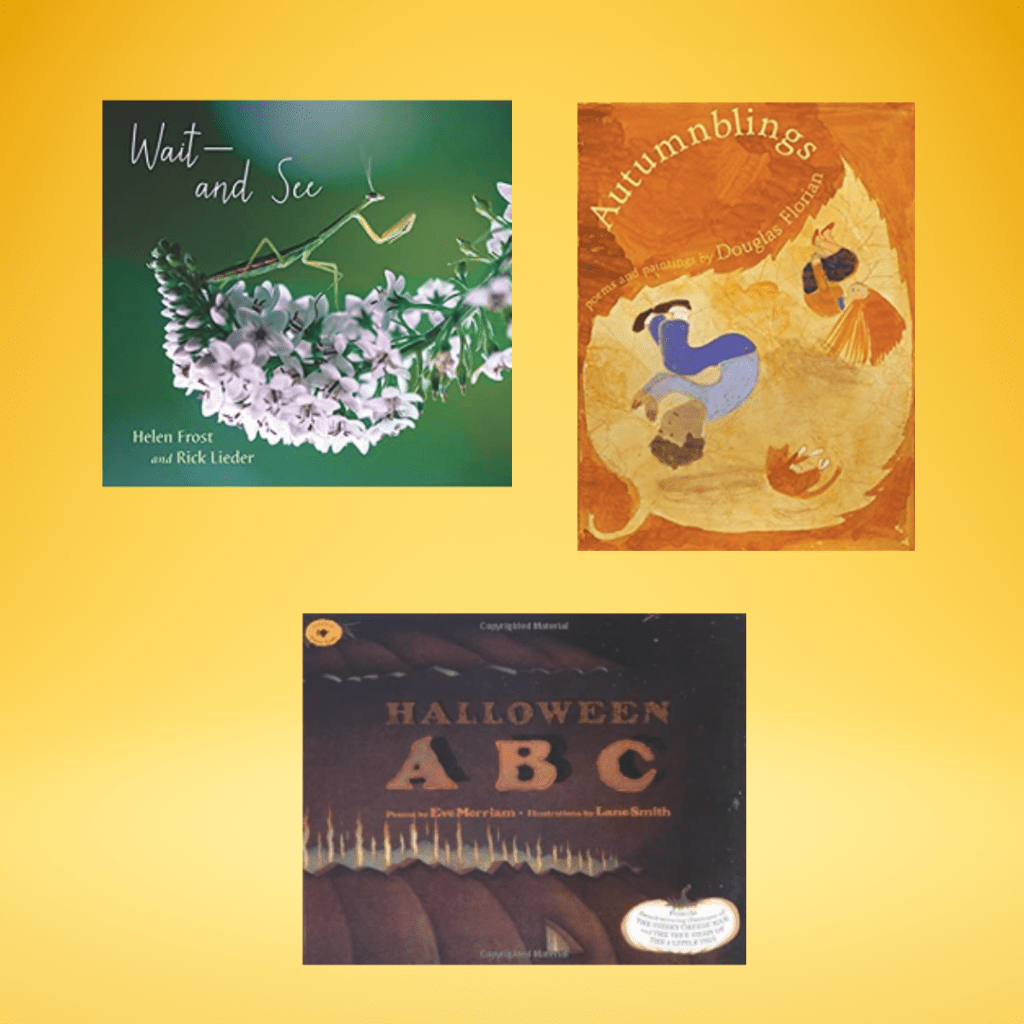
WAIT AND SEE by Helen Frost was my main read aloud in October. This book is an informational text that I’m calling “lyrical nonfiction.” It has photographic endpapers which, in the beginning, show a preying mantis hanging upside down on a spikey leaf with a light background. At the end, there is a preying mantis upright on a rounder leaf with a dark background. The conversations about the reasons behind these choices of images were fantastic! (Day/night, light/dark, colors, shapes, position, etc.) The photo-illustrations also prompted lots of conversation both during and after reading. We didn’t read the back matter, but I pointed out to every group that it was there to satisfy any curiosity you might have for more facts.
AUTUMNBLINGS by Douglas Florian and HALLOWEEN ABC by Eve Merriam were my backup literature choices. (I’d forgotten how dark Merriam’s poems are, but luckily kids are kind of into spooky, so it was all good.)
Are you noticing the trend towards poetry? I figure poetry is one of the least represented genres in the classroom and so it will have the greatest representation in my work!
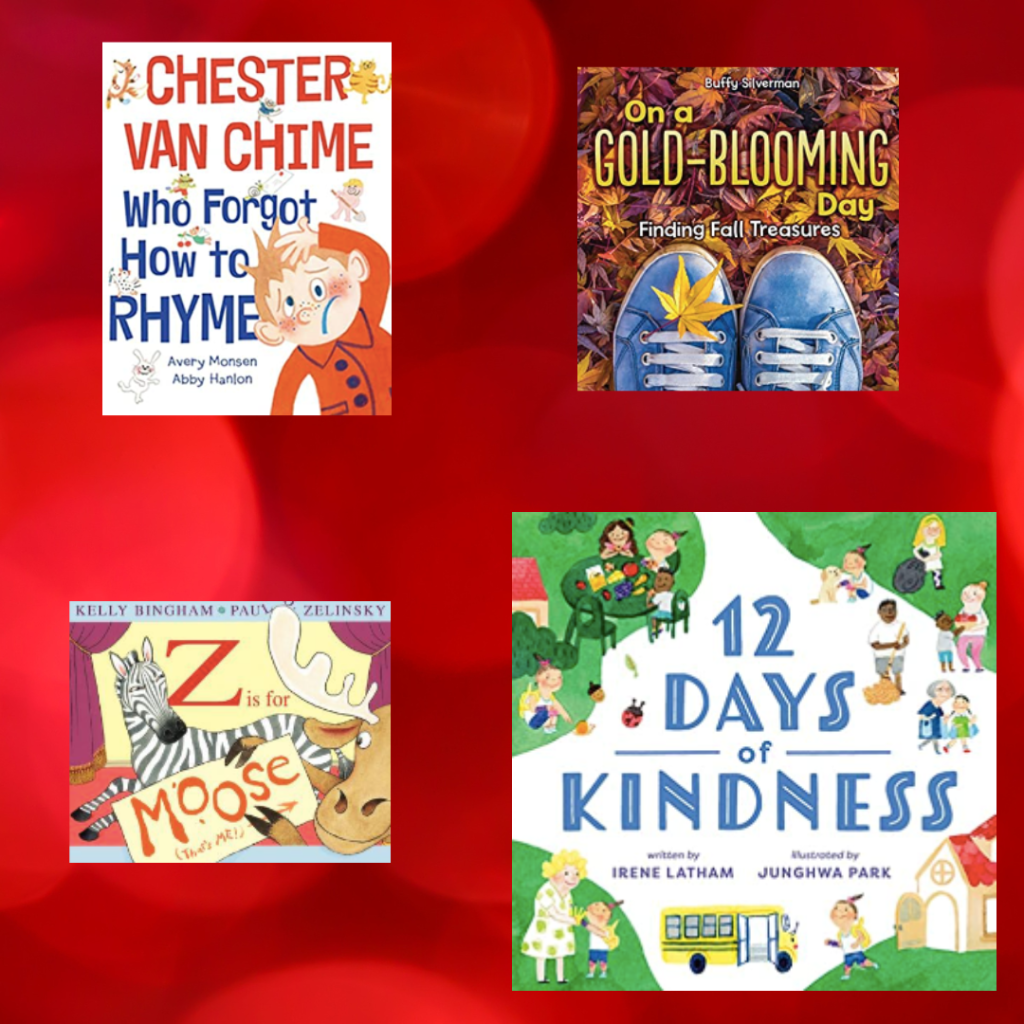
There were a couple of other books that made an appearance in October and November. I fell in love with CHESTER VAN CHIME WHO FORGOT HOW TO RHYME by Avery Monsen and tried it out with a variety of ages. Fourth and fifth graders had a ball with Chester. I was surprised that the younger students weren’t able to provide the missing rhymes. I filed that tidbit and will be doing some focused work on rhyming in the upcoming months. ON A GOLD BLOOMING DAY by Buffy Silverman was a great rhyming photographic book to pair with WAIT AND SEE. I waited until later in the fall to start working with my Kindergarteners. I wanted to meet them and read with them before I gave them their letter identification assessment, so I chose Z IS FOR MOOSE by Kelly Bingham. It has a different image on its dust jacket and its cover, and the story starts before the title page. It begins predictably, but then Moose causes chaos (which the Kinders loved!)
But the absolute best read aloud so far, the one that stood up to multiple readings with all ages, the one that kept surprising me all the way to the last reading, was 12 DAYS OF KINDNESS by Irene Latham. This book has everything! Cover and dust jacket are the same, but we had a chance to discuss the Big Idea that’s on the back of the book (“Kindness is a gift.”) The end papers are different illustrations and foreshadow the story that’s found in the illustrations, and the arc of that story (morning to night). The story begins in the illustrations before the title page. The text has repetition and rhyme and is cumulative. It can be sung to “The 12 Days of Christmas,” and I had one group of 3/4/5 girls who did just that! All the way through! So fun! Without being didactic, Irene Latham shows the reader that there are lots of small ways to be kind to those around us. There is much to discover about the way the illustrator (Junghwa Park) contrasts the new text on the left page of each spread and the cumulative text on the right page of each spread. The illustrations tell a story that doesn’t match the text, but rather extends the meaning of the text. There’s lots to infer about the characters in the illustration’s story, plus so many fun details! I didn’t notice the kisses in the last spread until one of the final readings! This is the book I’ll use as my gold standard in choosing all future read alouds!
Karen has this week’s Poetry Friday roundup at Karen Edmisten*.
Crows own the morning sky, the naked treetops, too. Clouds both amplify and muffle their sharp-edged caws. Below the grey they fly on a mission to who knows where or why.
Here’s how this poem happened: 1. Molly’s challenge for the Inklings this month was inspired by Amy Ludwig VanDerwater’s recent post in which she invited writers to answer an unasked question. 2. I spent 4.5 days with my brother’s family in CA after NCTE. There, I met my niece and nephew in real life for the first time. Together we played, doodled in our notebooks, snuggled for read aloud, considered square and cubic numbers, explored tide pools, studied a world map, worked in the garden, and climbed to the top of the rope climber at the playground. 3. I found the poem, “Because A Redwood Grove” (by Joe Cottonwood…how fun is that?) on Your Daily Poem. 4. You didn’t ask, but this poem’s the answer to the question of what happened to my heart over the course of those 4.5 days in CA with my brother’s family…with MY family.
Here’s how the rest of the crew met Molly’s challenge:
The Poetry Sisters’ challenge for November was to write a recipe poem. I’m cheating just a bit since I’ve had little/no writing time during NCTE and visiting family for this holiday week after NCTE. As it is, I am posting from SFO before I board the redeye back home! This poem can be found in THE POETRY OF US, edited by J. Patrick Lewis.
Greetings from NCTE in Anaheim! I wrote this poem in our session this morning (our being Margaret Simon, Laura Shovan, and me), using as my mentor text Margaret’s I Am poem form which is featured in the lead poem of her book, BAYOU SONG.
Jama has this week’s Poetry Friday roundup at Jama’s Alphabet Soup. Happy Thanksgiving!