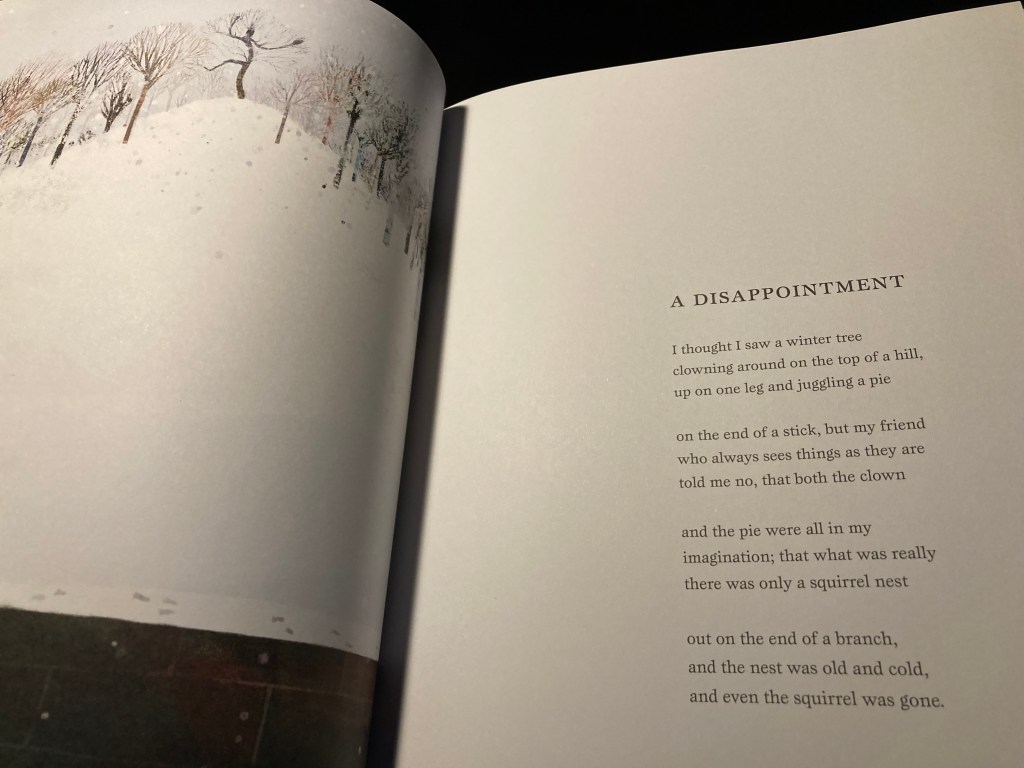
Marshmallow Clouds: Two Poets at Play among Figures of Speech by Ted Kooser and Connie Wanek illustrated by Richard Jones Candlewick, 2022
Two of my favorite poets for adults, Ted Kooser and Connie Wanek, both write poetry that is accessible and that makes me see the world in new ways. How lovely that they combined their talents to do the same for children! None of the poems are signed, so I love imagining the process of collaboration with which they were created.
The book is divided into four parts — fire, water, air, and earth. But the first poem, before the fire section begins, sets the tone for the whole book: this will be a collection of poems that encourage readers to use their imaginations.
The focus on imagination is reinforced in the poets’ afterwords, which feature Kooser’s and Wanek’s thoughts on imagination, and a bonus poem by each of them that illustrates how they (and WE!) might use imagination as we move though the world.
The poems in this collection will help to broaden children’s understanding of what poetry is and what it does for the reader. These poems don’t rhyme or have clappable rhythms. They are plain spoken observations of the world through the lens of imagination. They never talk down to the child reader, and the metaphors and similes are accessible and delightful. Who wouldn’t want to imagine their book as a sandwich, with a folded pita for covers? Or a harpist, holding a giant moth and stroking its wings? Or why our pets don’t write?
Whether they are in your lap or in your class, these poems beg to be shared with children!
Ruth has this week’s Poetry Friday roundup at There is no such thing as a God-forsaken town … and before we head off to read each other’s posts, let’s pause for a moment to think about that blog name, and send out strong and positive thoughts and prayers to all the people in all the towns in Ukraine.
You might want to go the the Poetry Foundation and read “Chores” by Maxine Kumin before you read on. I’ll wait.
After an intense month of writing and going “public” with a poem a day in February, I intended to keep that habit going through March and into Poetry Month (aka April). Instead, I have (mostly) recovered my morning exercise habit that was lost to writing, commenting, and icy weather/walkways. (Yes, I know I could have gone to the health club and exercised in spite of the weather. But I didn’t.)
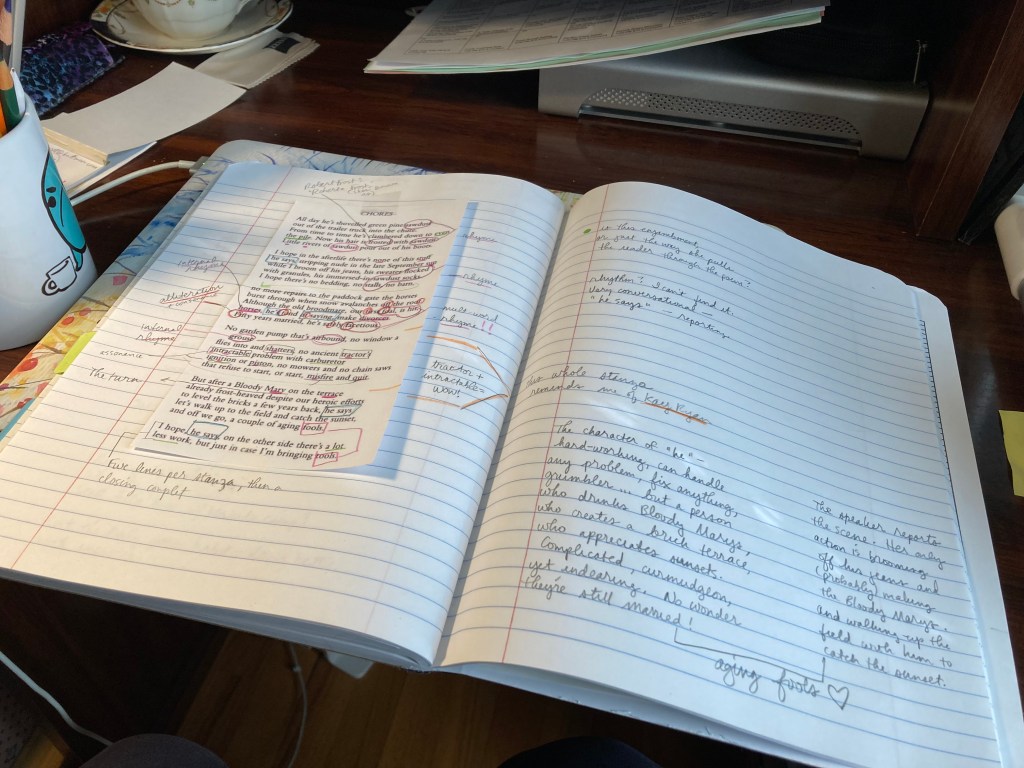
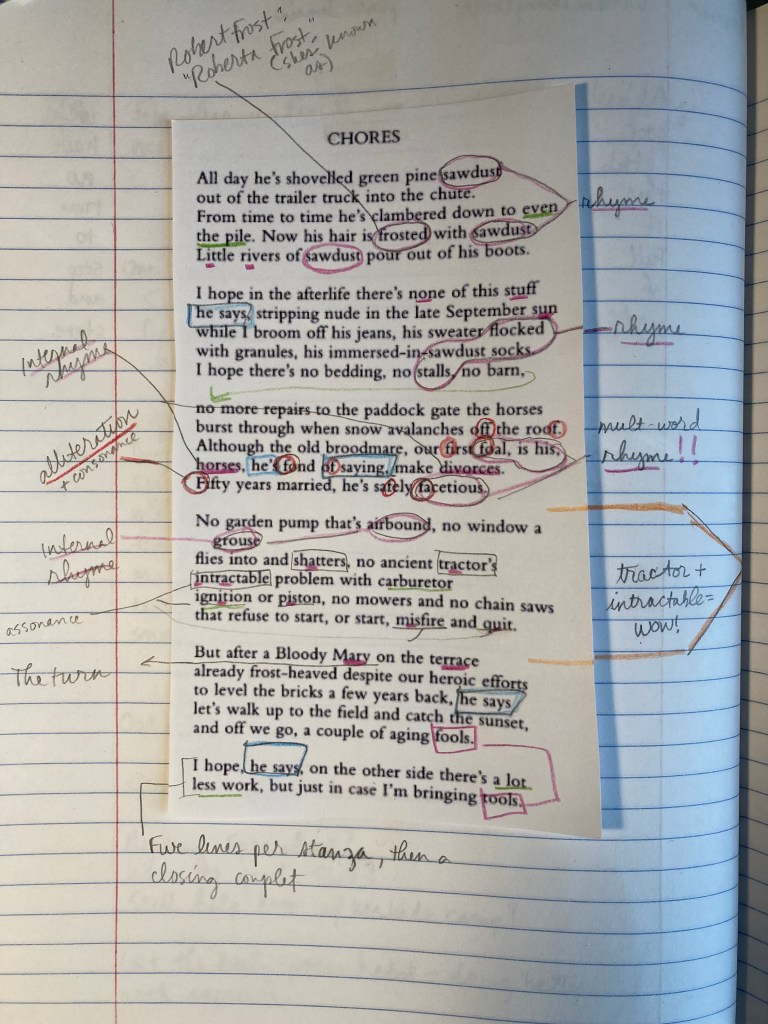
So in the absence of an original poem, I decided to dig into a poem with a Poem Observation. I chose Maxine Kumin, looked her up on the Poetry Foundation site, and picked a poem with what seemed to be a promising title, “Chores.” Here’s what happened:
Like I did in my classroom, I read and reread and reread, first with just my pencil in hand, then with some color coding. The more I read, the more I found to admire about the language and storytelling in this poem. There’s the obvious story in the poem about the sawdust and the sunset, but aren’t you curious for more about the paddock gate, the airbound garden pump, the broken window? And then there’s that little aside, mid-poem, about horses making divorces.
But the language! Kumin packs this poem with end rhyme, internal rhyme, assonance, consonance, and alliteration…but none of it is terribly obvious on your first read. I love that. If you read this poem aloud, especially that fourth stanza, you can’t help but be reminded of the way Kay Ryan plays with the sounds of words.
By the end of the poem (especially after multiple reads) you kind of fall in love with these “aging fools” whose work reminds us of Marge Piercy’s “To be of use.”
Sylvia Vardell and Janet Wong are hosting this week’s Poetry Friday roundup at Poetry For Children with a YUMMY unveiling of their DELICIOUS newest book (I’m proud to have a poem in it!), THINGS WE EAT.
Margaret gave the Inklings their challenge for this month: “Choose a quote that speaks to you. Write a poem that responds to the quote. The words can be used as a golden shovel or throughout the poem or as an epigraph.”
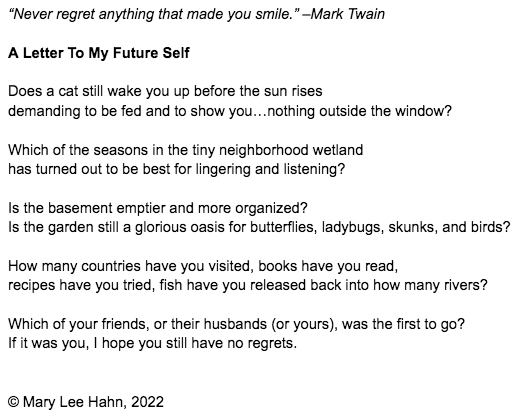
I cheated just a little. I found a poem that I wrote back in June of 2021, just after retirement, and then went looking for a quote that fit with it as an epigraph.
Here’s how the rest of the Inklings interpreted Margaret’s challenge:
This month, poetry met parlor game as the Poetry Sisters collaborated to create an Exquisite Corpse poem. Unlike the “rules,” we did not use an agreed-upon structure and we constructed the poem one line at a time rather than one word at a time. Liz started us off, sending Tanita her line. Based on Liz’s line, Tanita wrote a line and then send just her line to Kelly. From Kelly, a line went to Sara. Andi was next, then Laura, Tricia, and finally me. Here’s what we wrote:
This month, odd one out, running short on days and sleep, This month, past meets pride, roots ripped from native soil still somehow grow. The once-bright future dims. Shadows grow But there, near canyon rim, in broken light the yearling hawk shrieked in futile fury and the steel-edged clouds looked away trees bow and bend on a blustery day that rattles old oak leaves down the street.
In creating our final drafts from this rich loam of raw material, we agreed that it was fair game to use as much or little of the original as we saw fit. Here’s the best of my many drafts.
Next month we are writing ekphrastic Doditsu. You can learn about this poetic from Robert Lee Brewer at Writer’s Digest. They are a little more complicated than a simple syllable count, as I once believed! The Dodoitsu often focuses on love or work with a comical twist. We are sharing images in our group, but you can write to anything you like. If you want to be inspired by my image, here’s what I shared.
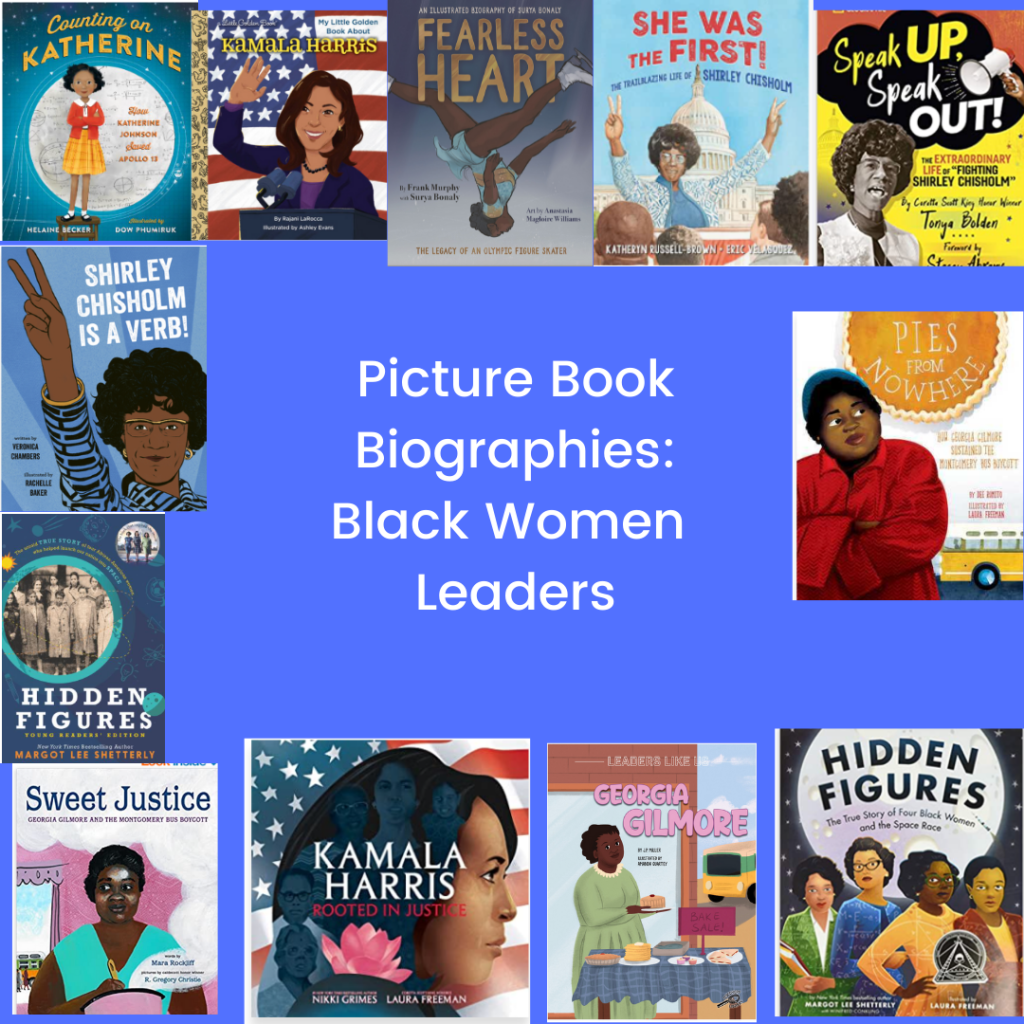
This week, we’ll look at some fabulous picture book biographies. I LOVE picture book biographies and think they invite deeper understanding and study. I love that I can read several picture book biographies about a person in the time it would take for me to read a short chapter book. With different picture books, you get more information and different perspectives. This week, we’ll look at some great picture books that teach us about Black Women Leaders.
We’ll start with Vice President Kamala Harris. I love biographies about people who are leading now. I think it is so important for young readers to learn about people from history AND people who they see now in the world. I LOVED the biography by Nikki Grimes and just recently discovered the My Little Golden Book biographies thanks to John Schu. They are all written by different fabulous authors and are really good! Loved this one by Rajani LaRocco.
Shirley Chisholm is a Verb! is such an incredible picture book. It really captures so much about Shirley Chisholm. I also loved She Was the First!. I have not read Speak Up, Speak Out! (and it is not a picture book) but when I saw that it is by Today Bolden, I had to add it to my stack and share it here. It looks like a perfect middle grade read.
There is so much to learn about the four women featured in Hidden Figures. I love that we can learn about them together and about each one’s separate contribution (Counting on Katherine). I also love that there is a lot of different media surrounding this story so children have so many sources of information to build understanding.
I learned so much reading Pies from Nowhere–such an important story in understanding the Montgomery Bus Boycott. I am happy to see that there are two newer books (Sweet Justice and Georgia Gilmore about Georgia Gilmore so readers can get to know her and her story.
I just discovered Fearless Heart last week thanks to Lynsey Burkins. What a powerful story–another story I am so glad to know. Surya Bonaly cowrote the book so it is part autobiographical. This is an important story for all of us and there are media clips, interviews, etc. online that build on what we learn in this picture book.
This week’s books were linked at Bookelicious and/or Cover to Cover Children’s Bookstore. If you are looking for a fabulous local children’s bookstore to support, Cover to Cover is an amazing one. We are lucky to have them in Central Ohio! If you don’t have an independent children’s bookstore in your town, check out Bookelicious. They are an online independent bookstore for children with an incredible curated collection.
Follow @TextSets on Instagram for daily books/weekly text sets!
Now that Valentine’s Day has passed, you thought there would be no more gifts in your future until your birthday…but you are wrong!
The folks at Candlewick contacted me with an amazing gift/opportunity for YOU: “We have a lot of poetry coming this year (and already out) and I’d love to offer interested bloggers books to post about and possibly some author engagement.”
If you’d like to request a review copy of a book that’s already published, let me know in the comments and I’ll share your contact information with Candlewick.
AND, if you’d like to connect with a Candlewick poet for a guest post or interview, here are some authors who would be interested in doing a post or chat: Allan Wolf, Betsy Franco, Carole Boston Weatherford, Carrie Fountain, David Elliott, Helen Frost, and Sally M. Walker. If you are interested in working with one of these authors, leave a note in the comments and I’ll share your contact information with Candlewick.
This morning, Mary Ann Cappiello, Professor of Language and Literacy at Lesley University, and Xenia Hadjioannou, Associate Professor of Language and Literacy Education at the Harrisburg campus of Penn State University, sent the letter below to The New York Times requesting that the paper add three children’s nonfiction bestseller lists to parallel the existing picture book, middle grade, and young adult lists, which focus on fiction.
This change will align the children’s lists with the adult bestseller lists, which separate nonfiction and fiction. It will also acknowledge the incredible vibrancy of children’s nonfiction available today and support the substantial body of research showing that many children prefer nonfiction and still others enjoy fiction and nonfiction equally.
We support this request and have added our names to the list. We agree that spotlighting bestsellers in children’s and young adult nonfiction will help to showcase some of the best books in children’s literature and acknowledge that not all child readers are fiction readers.
If you support this request, please follow the signature collection form link to add your name and affiliation to the more than 200 educators and librarians who have already endorsed the effort. Your information will be added to the letter but your email address will remain private.
LETTER TO THE NEW YORK TIMES
Nonfiction books for young people are in a golden age of creativity, information-sharing, and reader-appeal. But the genre suffers from an image problem and an awareness problem. The New York Times can play a role in changing that by adding a set of Nonfiction Best Seller lists for young people: one for picture books, one for middle grade literature, and one for young adult literature.
Today’s nonfiction authors and illustrators are depicting marginalized and minority communities throughout history and in our current moment. They are sharing scientific phenomena and cutting-edge discoveries. They are bearing witness to how art forms shift and transform, and illuminating historical documents and artifacts long ignored. Some of these book creators are themselves scientists or historians, journalists or jurists, athletes or artists, models of active learning and agency for young people passionate about specific topics and subject areas. Today’s nonfiction continues to push boundaries in form and function. These innovative titles engage, inform, and inspire readers from birth to high school.
Babies delight in board books that offer them photographs of other babies’ faces. Toddlers and preschoolers fascinated by the world around them pore over books about insects, animals, and the seasons. Children, tweens, and teens are hungry for titles about real people that look like them and share their religion, cultural background, or geographical location, and they devour books about people living different lives at different times and in different places. Info-loving kids are captivated by fact books and field guides that fuel their passions. Young tinkerers, inventors, and creators seek out how-to books that guide them in making meals, building models, knitting garments, and more. Numerous studies have described such readers and their passionate interest in nonfiction (Jobe & Dayton-Sakari, 2002; Moss and Hendershot, 2002; Mohr, 2006). Young people are naturally curious about their world. When they are allowed to follow their passions and explore what interests them, it bolsters their overall wellbeing. And the more young people read, the more they grow as readers, writers, and critical thinkers (Allington & McGill-Franzen, 2021; Van Bergen et al., 2021).
Research provides clear evidence that many children prefer nonfiction for their independent reading, and many more select it to pursue information about their particular interests (Doiron, 2003; Repaskey et al., 2017; Robertson & Reese, 2017; Kotaman & Tekin, 2017). Creative and engaging nonfiction titles can also enhance and support science, social studies, and language arts curricula. And yet, all too often, children, parents, and teachers do not know about recently published nonfiction books. Bookstores generally have only a few shelves devoted to the genre. And classroom and school library book collections remain dominated by fiction. If families, caregivers, and educators were aware of the high-quality nonfiction that is published for children every year, the reading lives of children and their educational experiences could be significantly enriched.
How can The New York Times help resolve the gap between readers’ yearning for engaging nonfiction, on the one hand, and their lack of knowledge of its existence, on the other? By maintaining separate fiction and nonfiction best seller lists for young readers just as the Book Review does for adults.
The New York Times Best Sellers lists constitute a vital cultural touchstone, capturing theinterests of readers and trends in the publishing world. Since their debut in October of 1931, these lists have evolved to reflect changing trends in publishing and to better inform the public about readers’ habits. We value the addition of the multi-format Children’s Best Seller list in July 2000 and subsequent lists organized by format in October 2004. Though the primary purpose of these lists is to inform, they undeniably play an important role in shaping what publishers publish and what children read.
Help family members, caregivers, and educators identify worthy nonfiction titles.
Provide a resource for bibliophiles—including book-loving children—of materials that satisfy their curiosity.
Influence publishers’ decision-making.
Inform the public about innovative ways to convey information and ideas through words and images.
Inspire schools and public libraries to showcase nonfiction, broadening its appeal and deepening respect for truth.
We, the undersigned, strongly believe that by adding a set of nonfiction best-seller lists for young people, The New York Times can help ensure that more children, tweens, and teens have access to books they love. Thank you for considering our request.
Dr. Mary Ann Cappiello
Professor, Language and Literacy
Graduate School of Education, Lesley University
Cambridge, Massachusetts
Former Chair, National Council of Teachers of English (NCTE) Orbis Pictus Award for Outstanding Nonfiction Committee
Dr. Xenia Hadjioannou
Associate Professor, Language and Literacy Education
Penn State University, Harrisburg Campus
Harrisburg, PA
Vice President of the Children’s Literature Assembly (CLA) of the National Council of Teachers of English (NCTE).
References
Allington, R. L., & McGill-Franzen, A. M. (2021). Reading volume and reading achievement: A review of recent research. Reading Research Quarterly, 56(S1), S231–S238. https://doi.org/10.1002/rrq.404
Correia, M. (2011). Fiction vs. informational texts: Which will your kindergarteners choose? Young Children, 66(6), 100-104.
Doiron, R. (2003). Boy Books, Girl Books: Should We Re-organize our School Library Collections? Teacher Librarian, 14-16.
Kotaman H. & Tekin A.K. (2017). Informational and fictional books: young children’s book preferences and teachers’ perspectives. Early Child Development and Care, 187(3-4), 600-614, DOI: 10.1080/03004430.2016.1236092
Jobe, R., & Dayton-Sakari, M. (2002). Infokids: How to use nonfiction to turn reluctant readers into enthusiastic learners. Markham, Ontario, Canada: Pembroke.
Mohr, K. A. J. (2006). Children’s choices for recreational reading: A three-part investigation of selection preferences, rationales, and processes. Journal of Literacy Research, 38(1), 81–104. https://doi.org/10.1207/s15548430jlr3801_4
Moss, B. & Hendershot, J. (2002). Exploring sixth graders’ selection of nonfiction trade books: when students are given the opportunity to select nonfiction books, motivation for reading improves. The Reading Teacher, vol. 56 (1), 6+.
Repaskey, L., Schumm, J. & Johnson, J. (2017). First and fourth grade boys’ and girls’ preferences for and perceptions about narrative and expository text. Reading Psychology, 38, 808-847.
Robertson, Sarah-Jane L. & Reese, Elaine. (Mar 2017). The very hungry caterpillar turned into a butterfly: Children’s and parents’ enjoyment of different book genres. Journal of Early Childhood Literacy, 17(1), 3-25.
Van Bergen, E., Vasalampi, K., & Torppa, M. (2021). How are practice and performance related? Development of reading from age 5 to 15. Reading Research Quarterly, 56(3), 415–434. https://doi.org/10.1002/rrq.309
If you support the request to add three children’s nonfiction bestseller lists to parallel the existing lists, which focus on fiction, please add your name and affiliation to the signature collection form.
This week, we’ll celebrate some incredible Black authors who write and/or illustrate picture books (and more). I worry when we use February to share books by Black authors because these books should be read, studied and incorporated into the curriculum all year. However, I do appreciate a time to celebrate the work and one event I have loved for years is NCTE’s African American Read-In. Whether you are participating or not, the authors I highlight this week have so many incredible books that have so much to teach young readers and writers. And these are 5 must-have Author Baskets in your classroom library.
Oge Mora has become a favorite author/illustator for me lately. I love so much about her work and the power of her stories for our youngest readers. Fiction, nonfiction, cumulative stories–no matter what she writes, love is a thread through all of her books. So much for readers and writers across elementary and beyond.
Vaness Brantley Newton’s Just Like Me is my go-to for baby girl gifts. The cover is one of my favorite covers of all time. Vanessa Brantley Newton writes fiction, nonfiction and poetry and her illustrations are colorful and draw the reader into every story.
Derrick Barnes is another author who writes incredible picture books (he also has a great nonfiction baseball book that I had to include because I LOVE it!). Each of these books is a celebration and I was thrilled to see that The Queen of Kindergarten is coming soon! (You may recognize Vanessa Brantley Newton’s illustrations on a few of his books.) The stories that celebrate children and the poetic language make these books must-haves.
If you’ve heard me talk books lately, you know that Daddy Speaks Love is one of my new favorites. I think it took this book and looking up the author to realize how many of Leah Henderson‘s books I love. Her writing, the topics she chooses, and her author’s notes are all gifts to readers.
Carole Boston Weatherford shows up in so many of my Text Sets (as you may have noticed) as her work is brilliant and so good across grades and ages. Her writing teaches us about people and times in history in a way that is accessible and honest. Her expertise combined with her writing means that I need every book she writes. I can always count on Carole Boston Weatherford’s work to be work I want to share with children and that I know will help us understand our world better.
Follow @TextSets on Instagram for daily books/weekly text sets!
On the third day of Laura Shovan’s February 10th Annual February Poetry Project, which is centered around the theme of time, the prompt was a photo of the massive carved stone calendar of the Aztecs. Coincidentally, I have a souvenir version of that calendar sitting on the hallway shelf beside an old Seth Thomas chiming clock. Here’s the poem I wrote.
Linda has this week’s Valentine Edition of the Poetry Friday roundup at TeacherDance.
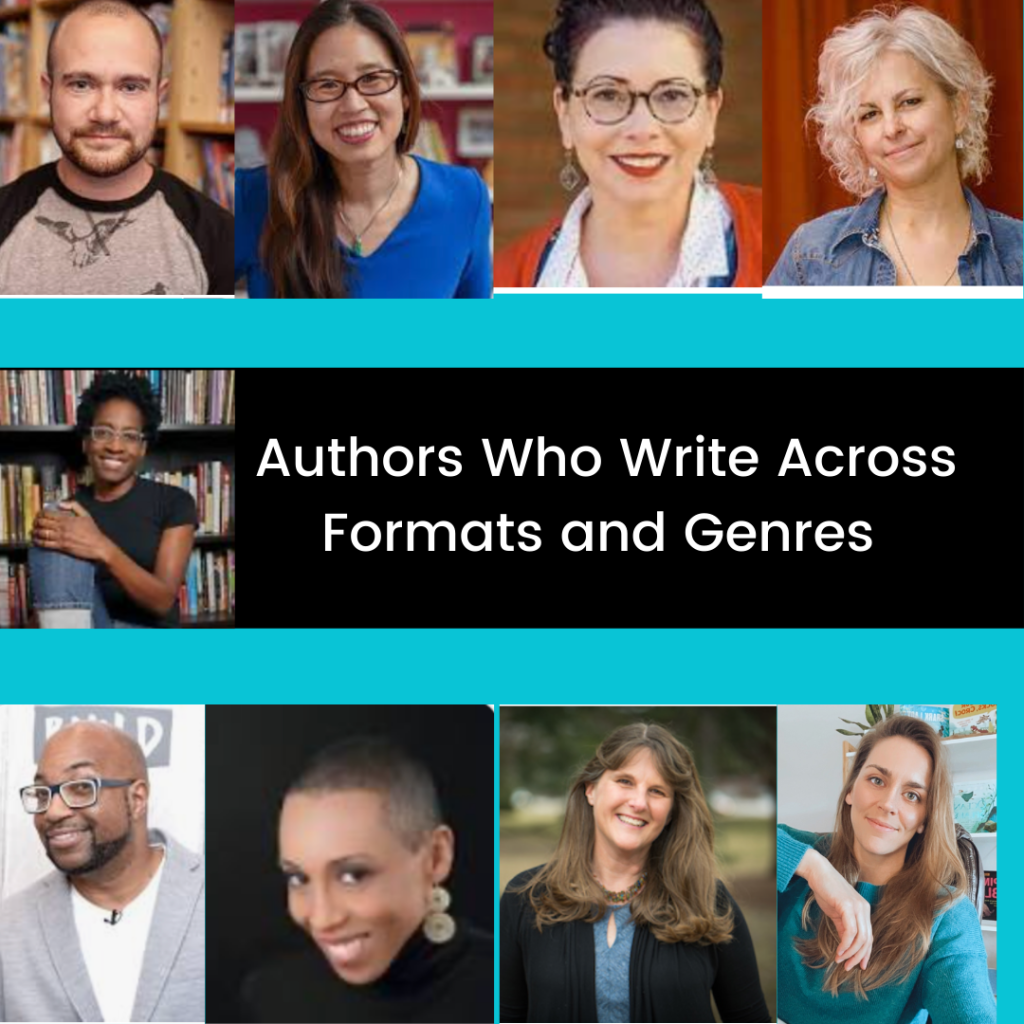
Finding authors we love is also so important to any reading community, and when we find an author we love, we want to read everything by that author.I love authors whose work spans formats and genres. I love this for readers and for writers in the classroom. As a middle grade teacher, it was so important to. me that both chapter books and picture books are valued in the classroom. Making sure we had author baskets that spanned both is critical. I also love authors that children can grow up with-who have written books for a variety of stages. This week, we’ll take a look at several authors who have such a huge variety of books. This is important for our readers and for our writers.
This week, we’ll start off with the two authors who inspired this text set-Kyle Lukoff and Donna Barba Higuera. Last week, when the awards were announced, I was THRILLED to see Too Bright to See because I am a huge fan. A must read for everyone. And The Last Cuentista was one I had on order but hadn’t read yet. When I looked dup the author after she won the Newbery, I realized she had written a picture book I love-El Cucuy is Scared Too!–and I mentioned to my friend Stella, how much I LOVE authors who write both picture books and chapter books. For our readers, especially in middle grades and beyond, having baskets of books by authors who write both picture books and chapter books can put renewed value in picture books for older children. And as writers, studying an author’s body of work, across formats is always so powerful. Thinking back, I don’t think I thought hard enough about all of the author baskets I SHOULD have had in my classroom like these.
Since we are talking about awards, let’s move right to Grace Lin, who won the 2022 Children’s Literature Legacy Award!! Grace Lin has written so many incredible books–from middle grade novels to picture books, to early series books to math board books. She writes across so many formats and genres. One of my favorite authors to read and definitely a favorite to study as a writer.
Kate Messner and Jess Keating are two of my favorite middle grade writers. I love that they write fiction and nonfiction that is so engaging for this age. And they both write a great deal of both fiction and nonfiction which I love. And so many interesting topics across nonfiction. I also love how often they weave their nonfiction interests into their novels. Both authors have nonfiction series books which I am a huge fan of!
Andrea Davis PInkney and Kwame Alexander have each created such a beautiful collection of poetry in various formats and genres. These two authors have so much to offer both readers and writers. I love that both authors invite readers into poetry in various ways and also invite readers to expand what they read–once they discover one book, they’ll want to read others by the author and naturally expand the types of things they read. And our writers can learn so much about word choice, etc. Love these two!
I will read anything and everything that Jacqueline Woodson and Kate DiCamillo write. These two are both brilliant writers who understand children so well. Their books are well loved by all ages. As with the other authors, they both write such a variety of books. These are also two authors readers can grow up with, always finding something new as they grow as readers. Lucky us to have these two in the world of children’s literature.
This week’s books were linked at Bookelicious. If you don’t know Bookelicious, check it out today. It is an online independent children’s bookstore with an incredible selection of children’s books and many supports for young readers. Lots of great free events for teachers coming up that you can check out and register here.
Follow @TextSets on Instagram for daily books/weekly text sets!








 A(nother) Year of Reading