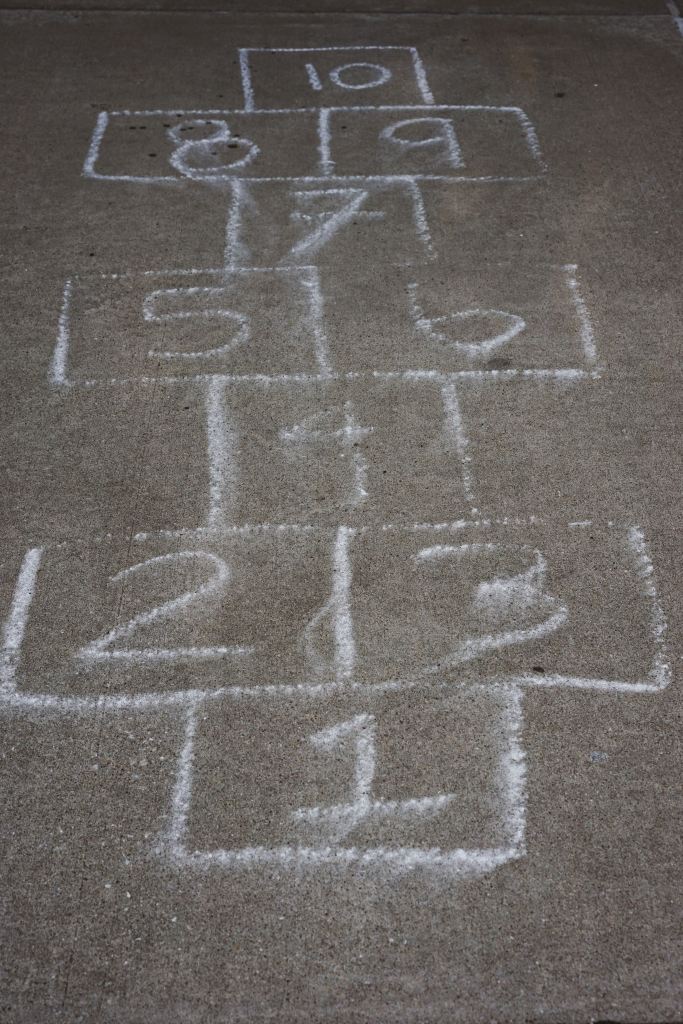
Back when I issued my challenge to the Inklings, I thought my Poetry Month project would be Dictionary Hopscotch — I would randomly choose 4 words from different spots in the dictionary and then use at least 3 of them in a poem.
So I challenged my fellow Inklings to use 3 of these 4 randomly chosen words in a poem: knuckle, denial, turn, cautious.
About the Progressive Poem: Irene Latham began the tradition in 2012 and hosted until 2019. (Early archives here.) Margaret Simon took the reins in 2020. (Recent archives are tabs at the top of her page.)
Blogs where the next lines will be found are linked in the sidebar to the right.
The rules are few: “The poem will be passing from blog to blog with each poet-blogger adding a line. The poem is for children. Other than that, anything goes.” Each blogger will copy the previous lines exactly as written (unless permission from the previous poet is obtained) and add their line, including commentary on their process if they wish.
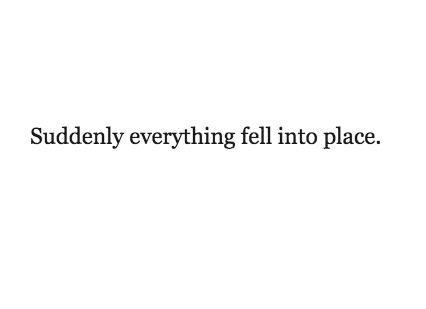
My process was scant. This line jumped into my head (and luckily, was captured in my notebook) on March 5. No other possible lines held up to the potential contained in this one. I love stories that start at the end, so here you go. Write me a story that ends with sudden clarity.
Happy National Poetry Month and Happy Progressive Poem! Let the fun and hijinks begin!
It’s a Poetry Quadfecta this week! It’s the last Friday of the month which means it is time for the Poetry Sisters’ challenge AND it’s the last day of March which means it’s National Poetry Month Eve AND the Poetry Friday roundup is here PLUS the 2023 Progressive Poem will launch right here tomorrow morning! (See sidebar for links to the rest of the lines/month.)
Let’s start off with my poem for the Poetry Sisters’ challenge. This month, we wrote etherees, a poetry form that begins with one syllable in the first line and continues growing each line by a syllable until the tenth line has ten syllables. Additionally, we tried to stick to our year-long theme of transformation. I’m using my etheree to announce my Poetry Month project.
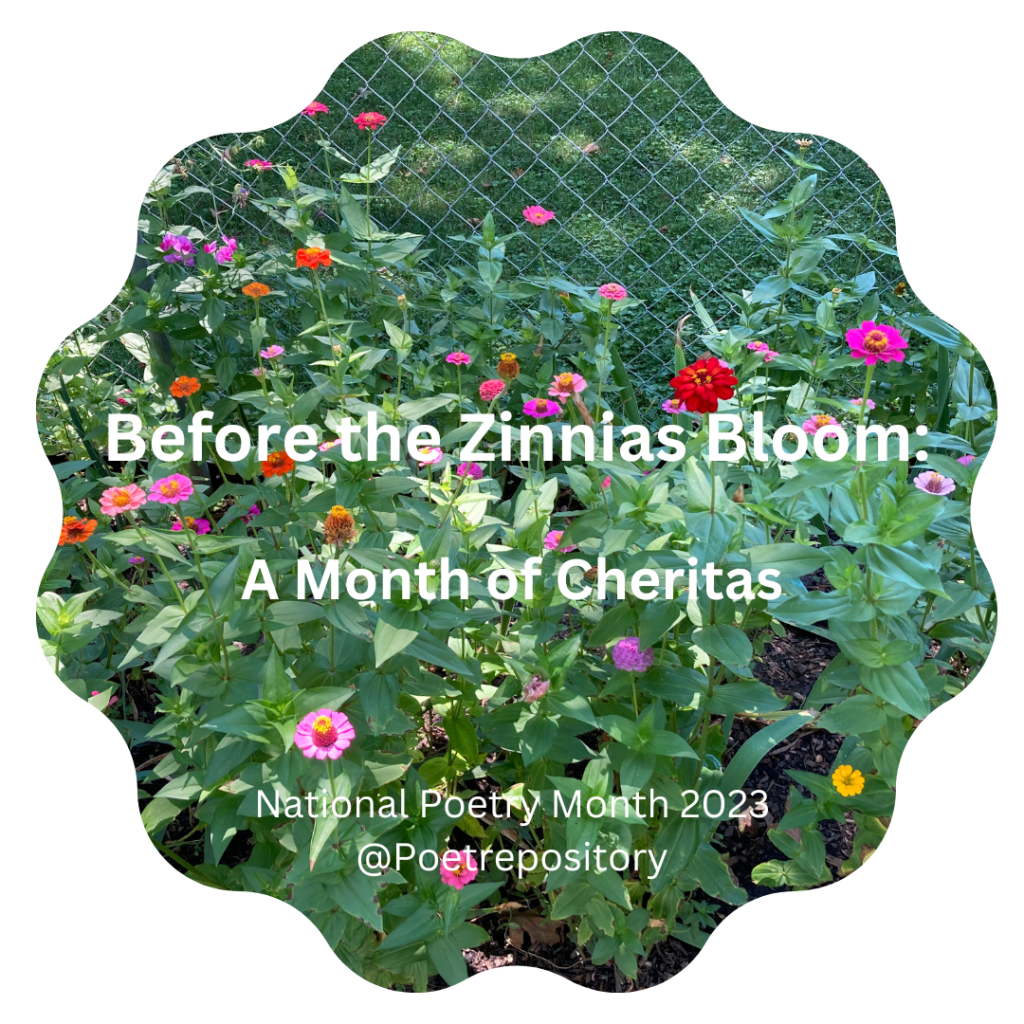
I wrote my etheree to announce my National Poetry Month project, which will be a month of cheritas.
This year, my National Poetry Month project will feature the cherita form. At the website The Cherita, the form is defined thus: “Cherita is the Malay word for story or tale. A cherita consists of a single stanza of a one-line verse, followed by a two-line verse, and then finishing with a three-line verse…The cherita tells a story.” Like last year, I will be publishing my poems daily at Poetrepository and crossposting here each Friday for Poetry Friday.
And now, for your poems! Click to add your link to the roundup:
The image doesn’t really have much to do with my cherita, except for the unreadable but definitely not antagonistic silent stare that passed from those four-leggeds to this two-legged in the early morning light earlier this week.
March. It does what its name says. Here we are, all of a sudden, a week away from National Poetry Month Eve, from Progressive Poem Eve, from the Poetry Friday roundup right here. Have I nailed down my NPM project? No. Have I written the first line of the Progressive Poem? Maybe. Is the roundup post ready? Let’s not get too far ahead of ourselves.
Let’s take a deep breath and see what everyone else has to offer this week. Rose has the first Poetry Friday Roundup of spring at Imagine the Possibilities. Next week will take care of itself, all in good time.
It’s been a dry month for poems that are Poetry Friday material. My challenge poems for the Poetry Sisters and for the Inklings are drafted and I am filling a project folder with poems that…well, you’ll have to wait and see! Luckily, I have the well of Laura Shovan’s February Poetry Project in which to dip, and look what I found! In lieu of a traditional Irish blessing, I wish you all the books you can read and all the time you need to read them and the joy of getting lost in the story as you cross its bridge.
In other news, I still haven’t nailed down my National Poetry Month project, but three poems from last year’s project were published in The Be-Zine! Click on the “Introduction & Table of Contents” button and scroll down to find the link to my poems. While you’re there, check out the poems from Michelle Kogan, Heidi Mordhorst, and Laura Shovan, too!
Laura Purdie Salas has this week’s Poetry Friday roundup. She HAS nailed down her National Poetry Month Project, and I’m tempted to join in! She also uses the word doohickey in her post, which makes me love her even more!!
Remember that time when you had your poem ready to go weeks ahead of time, but when you got ready to post, you double-checked the definition of “anaphora” and realized that your poem was an excellent example of repetition, but not at all a poem demonstrating anaphora? Yeah, me too.
What can you do except create a flash draft definito to clarify in your mind the difference between repetition and anaphora?!?
Margaret gave the Inklings our challenge this month. Here’s how the rest of the crew wrote using anaphora:
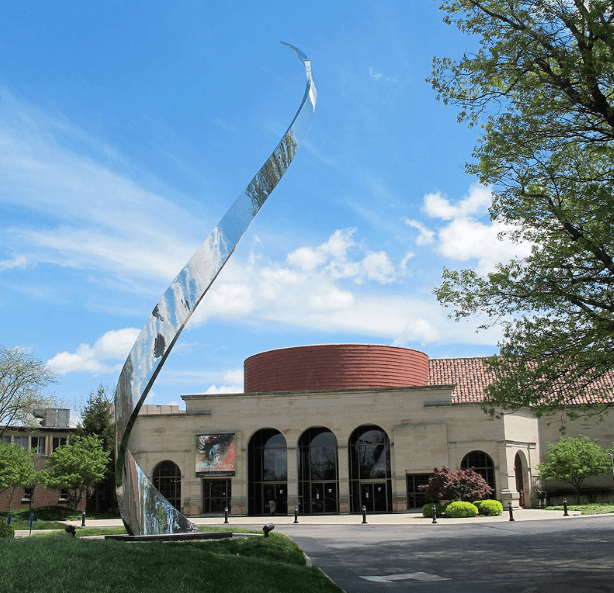
Outside the Dayton Art Institute stands “Pathway,” by John Safer, always reaching skyward with energy and beauty, and looking different in every season and from every angle. It draws the eye up and the mind in.
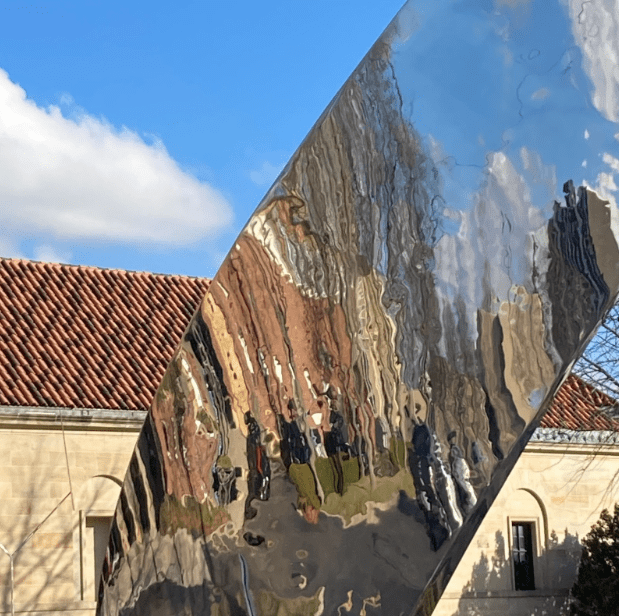
Here is a closeup I took on one visit last year:
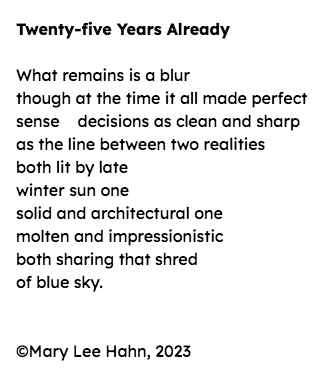
The lower part seems to blur the sharp architecture of the building, while the upper part seems almost transparent. Here’s where that combination took my imagination:
Fitting for the Poetry Sisters’ yearlong theme of transformation, this poem commemorates the twenty-fifth anniversary of my breast cancer diagnosis/surgery/chemo/radiation year.
Next month, the Poetry Sisters are writing etherees. This ten-line form begins with a single syllable, and each line expands by one syllable until the tenth line has ten. We’re continuing with our 2023 theme of transformation, but how you interpret that topically is up to you.
My prompt for Laura Shovan’s 11th Annual February Poem Project was to “search your memory archives for a smell, and then tell the story that smell evokes.”
No, I didn’t write about the smell of coffee (but just looking at those beans can you just about smell and taste it?). Alas, I couldn’t find a picture in my files of The Little Building — a green metal garden shed with a white rollup door. But I could definitely remember its smell.
When my friend from undergraduate honors English sent this book to me for my birthday, she gave me the out to trade it in for something I really wanted to read. I found out later that it was one of those gifts that you give someone because it’s what YOU want. I assumed she also had a copy and that we’d be reading it together to revisit our freshman year of college. Nope. I was on my own and I decided to go for it.
It’s a hefty volume with an extensive introduction and translator’s note, but when I looked at the table of contents and saw that it contains 24 “books” (or chapters) it occurred to me that I could “eat this elephant one bite at a time.” I divided the introduction/translator’s note into seven chunks and over the course of January, I reread this classic!
If you’ve never read THE ODYSSEY, I highly recommend this translation. The introduction itself is an education (or re-education if it’s been decades since your first read). Wilson prepared me so well for the ins and outs of each of the books that I did not need to skip to the endnotes as I read to clarify the action. (The endnotes contain a one-paragraph summary of each book, along with some clarifying information about characters, lineage, word definitions, and puns woven into the Greek that she attempted to replicate in her translation.)
In the translator’s note, Wilson elaborates on what makes her version different from others. She states, “THE ODYSSEY is a poem, and it needs to have a predictable and distinctive rhythm that can be easily heard when the text is read aloud.” She goes on, “I used iambic pentameter, because it is the conventional meter for regular English narrative verse…”
“Homer’s music is quite different from mine, but my translation sings to its own regular and distinctive beat.”
p.82 THE ODYSSEY by Homer, translated by Emily Wilson
In the translator’s note she also talks about word choice, length (hers has exactly the same number of lines as the original), staying true to the “Homeric style,” dealing with Homer’s repeated epithets, what it means to be a woman translating “a poem that is deeply invested in female fidelity and male dominance,” and her treatment of slavery and sexism…among other things. She states
“Throughout my work on this translation, I have thought hard about my different responsibilities: to the original text; to my readers; to the need to make sense; to the urge to question everything; to fiction, myth, and truth; to the demands of rhythm and the rumble of sound; to the feet that need to step in five carefully trotting paces, and the story that needs to canter on its way. I have been aware, constantly, of gaps and impossibilities in providing escort to Homer from archaic Greece to the contemporary anglophone world, as I have woven, unwoven, and woven up again the fabric of this complex web.”
p.90 THE ODYSSEY by Homer, translated by Emily Wilson
Doesn’t she make you want to read her version? Go for it. Savor it a bit at a time over the course of a month. It will stay with you forever.
…a time when you felt so consumed with the act of making something that you lost all sense of time, and your mind seemed to clear? What allowed you to enter this mindful creative space?
I wrote a draft about embroidery (no surprise), which makes a fine companion to Catherine’s knitting poem. But I also lose myself when I’m baking, especially when I knead the dough. The recipe I use for white bread is my paternal grandmother’s, and I feel a visceral connection to her and all my other bread-baking ancestors when I’m kneading.
Here’s how the rest of the crew met Catherine’s challenge:







 A(nother) Year of Reading