Thank you to Two Writing Teachers for creating an amazing community of writers and a safe, welcoming space to write and share.
It’s Election Day in Ohio. My third election serving as a roster judge.
I woke up before my 4:00am alarm, dreaming strange dreams about my first apartment. I have to be on site at 5:30am. My tea is brewing as I write.
I will spend the day greeting folks from my neighborhood/area — the ones who didn’t vote early and who will bother to come and voice their preference for presidential candidate (even though that’s already been settled) and for judges and other offices on the ballot.
Pretty much all day, I will be sitting in a folding chair in a chilly church gymnasium.
Other poll workers complain about the long day, but I have been a teacher. I have gotten up extra early to finish plans or read the last few essays, worked a day where pretty much all day I was on my feet moving from student to student, group to group, teaching, guiding, putting out behavioral fires. As a poll worker, I get a one-hour lunch. As a teacher, I often ate my lunch while I was doing recess duty. Then, with a 1/2 hour break after the students left, I started another half day of work and did parent conferences until 8:00pm or later. And got up in the morning and did it, more or less, all over again, day after day, week after week, year after year. Yes, this will be a long day, but it will be one day, and the work will not be at all hard.
When we close the polls, I will be achey and exhausted, but glad that I was able to help Democracy march forward in my small way.
When I retired, I was achey and exhausted, but glad I was able to help Public Education march forward in my small way.
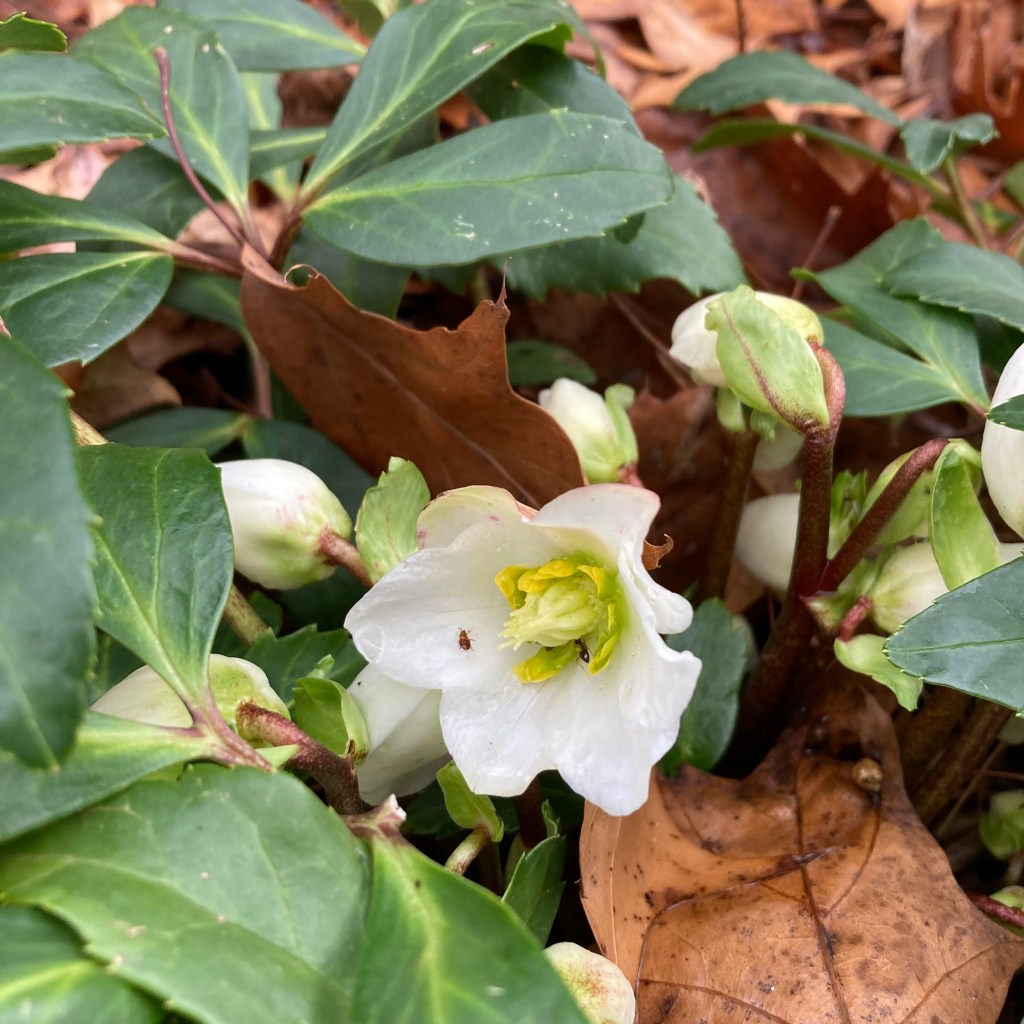
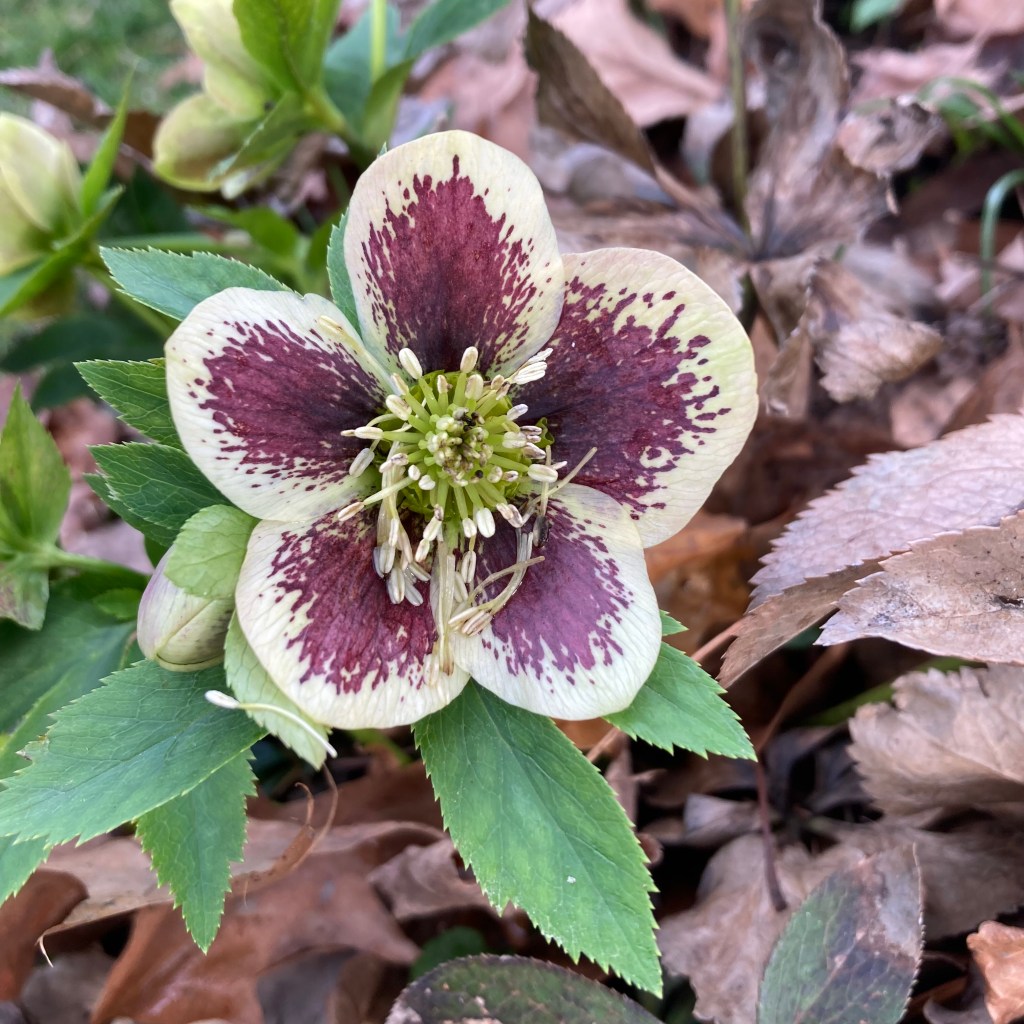
Christmas Hellebore in January (and she’s STILL blooming in March!)
Under the oak.
Such a beauty!
A daily cherita…
Before I planted hellebores

I never
noticed them.

Now
I see them everywhere.
What else have I been missing?

(c) Mary Lee Hahn, 2024
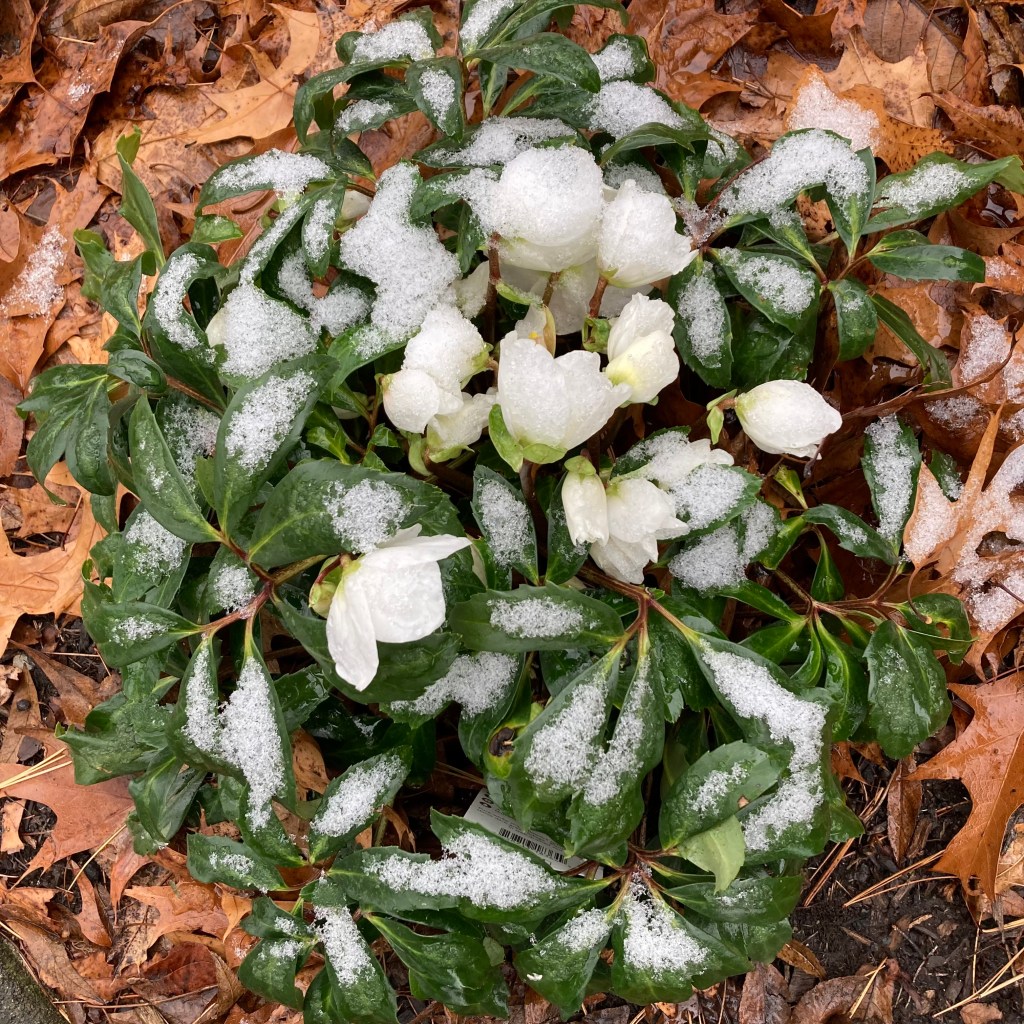
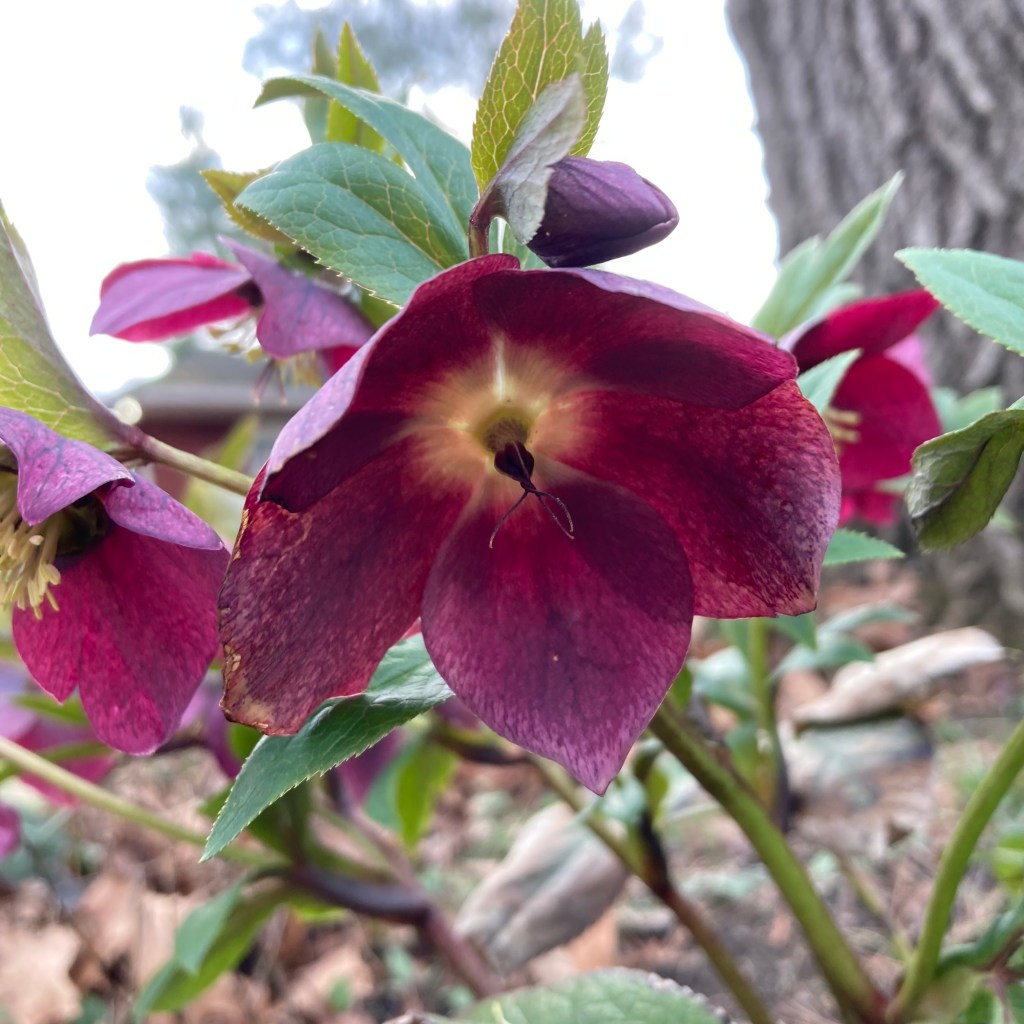
I’m going to feast my eyes on all the early bloomers in the next couple of days: forsythia, dogwood, magnolias, daffodils, hyacinths, crocuses, and of course, all the hellebores. Because Sunday through Thursday next week the nighttime temperatures will be in the twenties. Before we get there, though, we’ve got to live through the tornado watch for tonight. Ah, springtime.
Cousin Tanita at {fiction, instead of lies} has this week’s Poetry Friday roundup. Or should I say…the UNBOUND up! Here’s to “all things lax, roomy, slack, and slouchy!”
Thank you to Two Writing Teachers for creating an amazing community of writers and a safe, welcoming space to write and share.
Ten days ago, I moved an item from my bucket list to my treasured memory list. In a cold rain in the pitch-dark of nearly-bedtime on a boardwalk over a tiny patch of bald cypress swamp with a red light flashlight I met my very first in-the-wild spotted salamanders.
These were salamanders returning, as all salamanders do, to the vernal pool where they were born. As adults, they live in burrows in the nearby woods.
Salamanders respond to soil temperature to let them know when it’s time to crawl out of their burrows in the forest and return home to mate.
A female salamander can store packets of spermatophore inside her body for years as insurance for the continuation of the species.
If a vernal pool is drying up too fast, a young salamander tadpole can speed up development so that they can reach adulthood — albeit smaller than usual — before the pool is gone.
Salamanders can live twenty years in the wild.
Their mechanisms for survival are so very elegant and woven so perfectly with their corner of the natural world. Which is a sentence that can be written about every species of living thing on this planet.
Thank you to Two Writing Teachers for creating an amazing community of writers and a safe, welcoming space to write and share.
It’s like riding your bike up the street past the high school towards the swimming pool and seeing the parking lot full of cars. Which is odd, because there’s usually like three cars — just the high school lifeguards who get there early to check the chemicals and maybe vacuum some of the gravel out of the bottom of the pool after last night’s thunderstorm. Rescue a few critters and skim a bunch of crickets before the summer swim team practices.
It’s like walking up to the breezeway that’s usually silent and dark with only the bright blue of the pool on the other end to light it up and finding it buzzing with activity and the pool divided up with lane lines and decorated above with plastic banners and -bang!- there’s a starter’s gun and splashing and cheering and…
It’s like everybody else knew there was a swim meet today and you are just showing up for a regular practice.
That’s what it feels like to be tiptoeing in here on the fifth day of your big month-long swim meet of writing. I’ll just stand here in the shade by the clerk of the course while you all find your lanes and swim with your strongest strokes and team up for the relays. I’ll cheer you on and bring you bunches of cold green grapes to give you energy.
Happy March Slicing Challenge, all! May you make it to the finish line without your goggles ever fogging up!
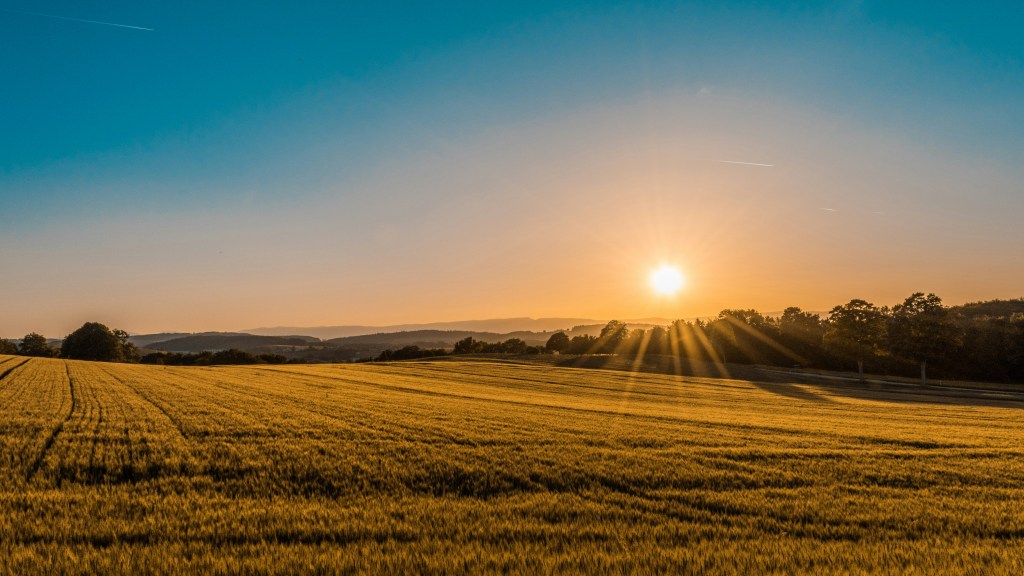
Surprised to see you all offshore this spin. Headed east towards that other continent? Good luck and safe travels – I wish brisk winds for you! What’s that you say? You left this continent clear from coast to coast? What a treat! Thanks!
Spin away, Earth! Let’s do this!
First up, the marsh. I hope Camera Lady is ready for me. I’ll give her some misty rays through the dead trees and reeds.
Next, I’ll light some south-facing windows as if on fire to give Breakfast Woman a show.
After that, I’ll lure Woman in Bathrobe halfway down the block to take pictures of my art.
Keep that spin going Earth!
I’ve got to glow awake Early Rising Writer and then shine in a kitchen window on Watercolor Doodler.
I can’t be late to join Morning Walker under the oaks along the bayou.
All through the flat middle, I’ll illuminate farmland until I flow through an east door to warm the bones of an aging Tea Drinker.
Then I’ll light up peaks and eventually their valleys until I get to my last window where I peek in on Talented Twins
before the other ocean suddenly appears below.
Behind my line of sight, it’s noon, then night. Ahead, perpetual morning. I like looking forward, creating all those beginnings over and over again.
Margaret gave the Inklings our challenge for this month — to write persona poems. For Laura Shovan’s birthday month poetry group on FaceBook, Molly challenged us to write poems inspired by the game I Spy. This poem is for both challenges and for my fellow Inklings. (Can you each find yourselves?)
Here’s how the rest of the Inklings met this challenge:
Thank you to Two Writing Teachers for creating an amazing community of writers and a safe, welcoming space to write and share.
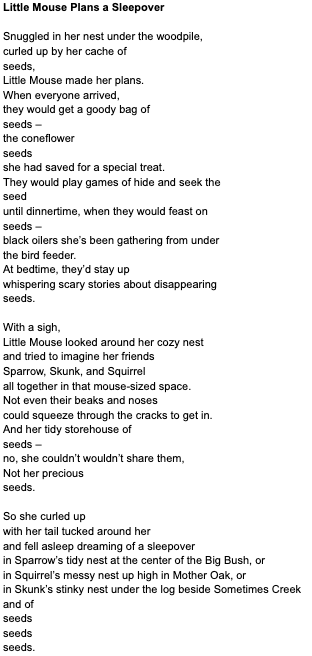
I surprised myself yesterday. There was no way I could write to the prompt of “slumber party games” by going through memory’s front door. The “slumber party memories” door is kept shut with a chair lodged under the knob.
So I had to find another way in. I looked for the farthest thing from my own reality, and came up with a mouse living in a (mostly) fictional woodpile.
Or at least I thought my character was far from my own reality. Instead, I found an very familiar introverted mouse living in my imagination. One who wishes for the things it seems like everyone else has, but who, in the end, is very happy with her own little life.
The Poetry Sisters’ challenge for February was to write a Valentine or love poem. A plethora of people, places, things, and ideas are objects of my affection. Why, then, was it so hard to pick one and write a poem?!? Thank you, Irish Breakfast Tea, for helping me crank out an eleventh hour haiku.
Here’s how the other Poetry Sisters met this month’s challenge:
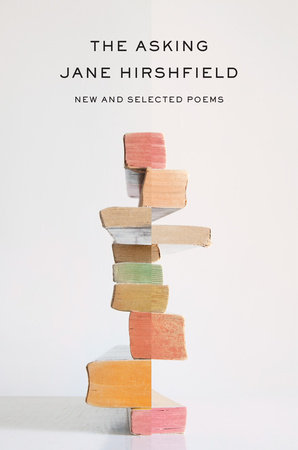
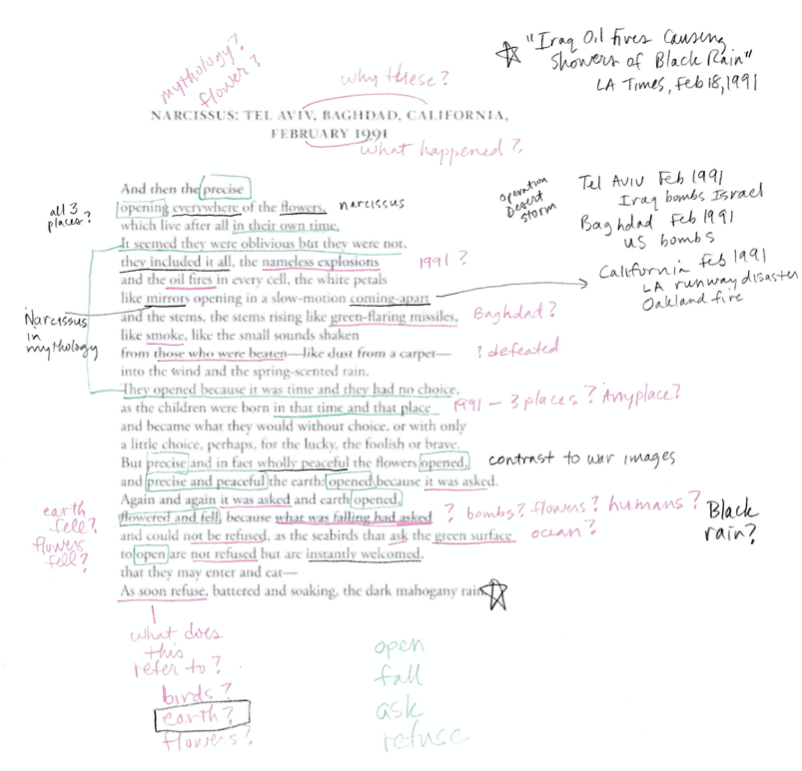
I’m reading a poem or two a day from Jane Hirshfield’s new (2023) collection. I was initially thrilled, but then stumped by yesterday’s poem, so I thought I’d dig into it and see if I could make it make more sense.
I found a faint and blurry but printable copy on Google Books and went at it with colored pencils. Red is for questions, green is for words and phrases that seemed to resonate or repeat, and black is research notes.
If we’re going to do this the way Pádraig Ó Tuama does on Poetry Unbound, you should go to Google Books and read the poem for yourself before I start nattering on about what I think it might mean. I’ll wait.
Okay. Ready? You’ll see all my notes all at once, but I’ll try to recreate my thinking as I combed through the poem over and over again, doing more and more research about what happened in February 1991.
Even though I wasn’t sure about Tel Aviv, Baghdad, California or 1991, I was drawn into this poem because it is February right now and the narcissus (daffodils) are pushing up with great determination. So I started with the delight of spring happening and flowers opening all over the world “in their own time.” But fairly quickly, the poem opened up to include “nameless explosions,” “oil fires,” “missiles,” and “smoke.” These images were clearly referring to Tel Aviv and Baghdad, but they could just as well be from Gaza in 2023-24. Ouch. I read on, and the flowers were compared to children born “in that time and place” who would become “…what they would without choice, or with only / a little choice, perhaps…” (A stab in my heart with the connection to Palestinian children.) Then I was back to the flowers opening peacefully, but now Hirshfield added the earth opening “…because it was asked.” This line: “Again and again it was asked and earth opened” made me think of all the ways we’ve taken from the earth — mining, damming, paving, plowing, deforesting. And the earth cannot refuse. Hirshfield compares this to seabirds diving into the ocean, not refused, but rather welcomed so they can eat, and there was another stab in my heart: we take and take and take from the earth and she keeps giving and giving for our survival. And then Hirshfield lost me with that last line. So many questions!
After this first read-through, I did some research (notes in pencil at the top right, except for the starred note…that came later). Clearly, this poem is speaking to the Gulf War (specifically, Operation Desert Storm). So that explained Tel Aviv and Baghdad in the title. I wasn’t so sure about California in February 1991. There was the LA runway disaster but the Oakland fire I noted turned out to be in October. Maybe California was included for the local blooming of the narcissus.
I kept reading through and noting the contrast between spring / flowering / the inevitable rising of life versus violence / destruction / falling. I kept getting stuck on that last line. What did “As soon refuse” refer to? What was “battered and soaking?” Where did that rain come from? I went back to Google one more time, and…bingo. The headline from the LA Times on February 19, 1991 was the key that unlocked the ending: “Iraq Oil Fires Causing Showers of Black Rain.”
Now I understand that “As soon refuse” refers to the earth. The earth, with its own precise timing and its gifts of life, with its mirroring of human evils in the very flowers that bloom in spring, can as soon refuse our destruction of it, can as soon refuse to soak the “dark mahogany rain” of oil fires into its battered surface, as the ocean can refuse to allow seabirds to dive in.
What do you think? Would Jane Hirshfield agree with my thinking? Do you?
YOU BROKE IT! by Liana Finck Rise x Penguin Workshop, 2024 review copy from the public library
This is a very funny book and it made for an interesting research question, but you don’t need to buy it for your classroom or school library.
It was written/drawn by a cartoonist, so it should come as no surprise that the whole story consists of a series of sight gags — adult animals scolding their young for doing what they naturally do: a turtle moving slowly, a tornado making a mess, an earthwork squirming. Finally, the young octopus stands up for itself, the adult has an AH-HA moment, and all is made well with a multi-armed hug.
My research question was, “Who would think this is a funny book?” I took it to the after-school program where I work and tested four different audiences.
The director, a mom with grown children, thought it was funny. One of the classroom aids, a college-aged lad, didn’t think it was funny at all.
When the kids arrived after school, I tested it on a group consisting of two kindergarteners and a first grader. They were quick to use the cover and endpapers to infer that the adult bird was mad at someone who broke the egg. The adult bird didn’t break the egg, and the baby bird didn’t break the egg. Someone else broke the egg and this was going to be a book about Who Broke The Egg. So when the second spread featured an earthworm, they were thrown for a loop. However, some very good inferring ensued: “I’m not sure what squirming means,” said the first grader, “but I think it might mean wiggling.”
Besides the inferring, some surprising background knowledge was revealed. Eventually they realized that the adult animals were probably parents, and because the tornado was wearing a bowtie, it was a dad. When we turned the page to the frog, the first grader refused to choose between mom and dad. “I think the frog is non-binary.” Then, concerned, she asked me, “Do you know what non-binary means?”
“Yes, I know what that means.”
“Good,” she said, turning to the kindergarteners. “Do you want me to explain what non-binary means?”
I quickly intervened, “Let’s save that conversation for later.”
Final verdict from the K/1 crew: not a funny book. It didn’t even answer the question of Who Broke It?
My next group consisted of two third graders and a first grader, all in gifted/enrichment programs at school. On the first page turn after the bird and chick (worm and wormlet), one of the third graders exclaimed, “Oh, I get it! This is going to be a book about grownups yelling at kids for doing what they naturally do!” Every page turn after that was met with a chorus of “…because that’s what we’re SUPPOSED to do!” At the pony page (“Get the hair out of your eyes!”) I stopped and asked if adults had ever said any of these things to them. And indeed, they had been told (“a million times”) to get the hair out of their eyes, or hurry up, or settle down.
Final verdict from the 1/3 crew: a very funny book.
Everything we know about the development of children’s ability to move beyond the literal and understand humor was confirmed. There also seems to be a component of experience that determines whether this book is funny. The 1/3 crew is still in the phase of life where adults are correcting their behavior on a regular basis. The college lad is well-removed from that, but hasn’t had the experience of being on the parental end of those corrections. The mom with grownup kids has the lived experience of this book.
So, who should buy this book, since lots of kids are either not going to get it, or not going to pick up a book that consists of a series of corrections they hear from the adults in their lives, with very little agency given to the young animals in each situation (except for the octopus fry)? Seems like a $20.00 baby shower card, given to remind new parents that kids will be kids, even though the “big idea blurb” on the back of the book has it the other way around: “Parents will be parents…”
Thank you to Two Writing Teachers for creating an amazing community of writers and a safe, welcoming space to write and share.




 A(nother) Year of Reading