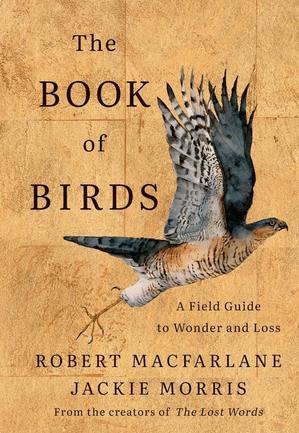
I will read anything that Robert Macfarlane writes. But when I started The Book of Birds: A Field Guide to Wonder and Loss, I was even more flabbergasted than usual. Each short piece about a once-common bird is a poem. The book blurb says, “The Book of Birds is a field guide with a difference: It shows readers not just how to identify birds, but also how to identify with them.” Nothing could be truer. Here’s a snippet to prove that this is a prose poetry mentor text (gorgeously illustrated, btw) in disguise:
Cuckoo (Cuculus canorus)
Where to start with you, Cuckoo? Your one-two call, perhaps, from high on oak or yew, which heralds spring anew then beats out summer’s hot tattoo. The curious beauty of your feathers; their smalty blue, their smoky, petrol hue. And we must not forget, of course, the chilling trick you pull on other birds — your devious, monstrous switcheroo.What a curious-looking creature you are, Cuckoo. Gawky, heavy, bulgy: a badly stuffed raptor, as if you’ve pilfered yourself in bits like a bodysnatcher — your barred chest from goshawk, your tail feathers from woodpecker, your yellow moorhen legs, your scythe-like falcon wings. Only those mad, staring eyes seem wholly yours, Cuckoo: off-kilter, askew, focused on some unseen, unholy other-world view.
Macfarlane uses all the poetry moves — internal-, end-, and off-rhyme, alliteration, perfect word choice (including, in almost every piece, a word I have to look up — smalty, in this case, from smalt, which is “a deep blue pigment, consisting of a powdered glass that contains oxide of cobalt”), and surprise. If you read the pieces/essays/poems aloud, you hear and feel the rhythm. And through it all, he teaches: “Macfarlane describes each bird’s habits and habitats, their patterns of flight and patterns of song, how they hunt or fish or scavenge or gather, how they nest and raise their chicks, the myths that attend them, the threats that shadow them–and how their lives intersect with our own.”
(Ooh! I found another excerpt of the book here.)
This is a book I’m savoring, just as I savor the dwindling number and kinds of birds we see and hear in the neighborhood, and who we welcome to our yard and feeders (around 50% of bird species are in decline worldwide). I can still remember great flocks and great variety, but those younger than me experience shifting baseline syndrome –“when each generation treats a diminished natural world as “normal,” so fewer birds or insects may not feel unusual because people are comparing it to what they’ve seen in their own lifetime.”
Here’s to the diversity and abundance we have left, and may we work to protect ALL of our neighbors on this rarest of all planets.
Tanita has this week’s Poetry Friday roundup at {fiction, instead of lies}.


I have a copy of Lost Words, so incredible! Now I have to find this one, too. The poetry in it is so full and rich. When I visited the wild bird lady, she had a few cuckoos. I didn’t even know we have them around here. Thanks for sharing!
LikeLiked by 1 person
I’ve earmarked the piece at The Walrus to return to – wow. WOW. I’ve not read anything that I can recall by this gentleman before, but now I shall.
And the shifting baseline syndrome is real – I remember finding toads on our front porch when I was a child – a deep bullfrog croaking. The nephews are nineteen and sixteen, and I remember finding frogs with them when they were babies. I remember spring peepers in the mountains around the same time. I remember crickets at night in my childhood… while the darkness now is near silent.
We don’t often take the time to think about it – because everything is so loud and so fast. I love the idea of savoring; it is a word of attention and intention. It is a better word than mourning, where our eyes are blinded by our own sorrow…
LikeLiked by 1 person
I get to be the person to introduce you to Robert Macfarlane?!? YAY!
I forgot to add in my comment on your post my appreciations for YOUR linkies. I saw the Doucette Roulette and feared that it would show up in the 2027 challenges! 🙂 The Writer Unboxed article (the comments, too) was thought-provoking. Would it be worth it to subscribe? The Brown Univ. AI “experiment” was very disheartening, as is your requirement to write shorter and simpler. Sigh.
Yes to savoring over mourning…or at least savoring more of the time. Mourning seems inevitable.
LikeLike
Oh, thank you, Mary Lee! I will look for this one. The Lost Words is incredible.
LikeLiked by 1 person
“Only those mad, staring eyes seem wholly yours” MacFarlane and Morris are a great team! Thank you also for the term “shifting baseline syndrome.” I’ve thought about that without having words for it.
LikeLiked by 2 people
I looked over this book in early June while in the Milkweed bookstore in MPLS, it’s lovely in words and images, thanks for sharing the excerpts Mary Lee!
LikeLiked by 1 person
Smalt! I also love encountering a new-to-me word. Joy! xo
LikeLiked by 1 person
Please bring that book. Let there be readings. And let us rekindle our long-abandoned LOST WORDS project anew when I am footloose and fancyfree in Brighton.
**side eyed side note: if bad verse-novel poetry is just prose chopped up into lines, then is bad prose just poetry strung across the page? Why didn’t he just write…poems?
LikeLike
Oh, my gosh, I’m smitten! I’m running to my wishlist to add it right this very minute. Thank you!!
LikeLike
I’m reading this, too, Mary Lee! I feel like I’m holding a sacred text (tassel and all!!) when I sit with a page at a time. Macfarlane makes me feel like I’m in love with language.
LikeLike
Wow! And this is just one entry in the book! I’m a great fan of The Lost Words but didn’t know about this book. The word “smalty” is new to me, too, as is the phrase shifting baseline syndrome. So sad, but true.
LikeLike
Mary Lee, thank you for introducing me to MacFarlane and his snippets that are so interestingly written. I am astounded with the information: “around 50% of bird species are in decline worldwide”. I paused to think about that. As a child I woke to the sounds of the birds. Now I am lucky to hear a few single notes in the morning as opposed to the chorus of sounds I used to listen to. Thanks also for The Walrus link. I enjoyed reading the beautiful prose that MacFarlane writes.
LikeLike
Thank you for sharing this stunning excerpt from The Book of Birds. Macfarlane and Norris are so inspiring. The idea of shifting baseline syndrome is heartbreaking, but I have noticed it myself when I am out walking. I’m with on working “to protect ALL of our neighbors on this rarest of all planets.”
LikeLike
Wow! That excerpt is just stunning. I have The Lost Words, but haven’t read anything else by MacFarlane, despite many good intentions. This one is going to the top of the list. Thanks so much for sharing.
LikeLike
Mary Lee, aren’t you right in your prose poetry mentor assessment. Beautiful excerpts. And I so love your call to “protect ALL or our neighbors on this rarest of all planets.” Thank you.
LikeLike