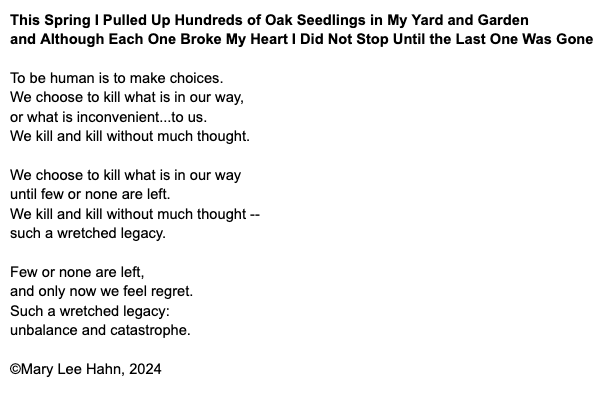
I gave the Poetry Sisters this month’s challenge. We brainstormed our year of challenges in January, just after I began reading a poem a day from Jane Hirshfield’s newish (2023) book THE ASKING: NEW AND SELECTED POEMS. “Two Versions” is on page 9, but can’t be found in its entirety anywhere on line, making it tricky for you to discover the ways her poem inspired our writing. Lucky for you, though, I used the structure of Hirschfield’s poem for mine. So…my poem might give you some hints, in the event that you don’t own her book (which you should, so get to an independent bookstore this weekend and help that small business survive the One Big Store that would weed out all the little stores…in a poignant analogy to my very poem).
I realized, when I was combing through the blog correcting my misspelling of Hirshfield (not sch, just sh), that I also wrote about the oak seedling murders back in May. The guilt is strong enough for two poems, apparently.
I’m not sure who’s in for this month’s challenge, but here are the Poetry Sister links just in case:
I am conflicted by what it means to be human. Some days more than others, but this month is one of those days. And wouldn’t you know it, my poem of the day today from Jane Hirshfield is “Let Them Not Say,” which just serves to reinforce these feelings. I am also listening the The Anthropocene Reviewed by John Green which probably fuels this conflict as well. Not probably, certainly.
We have done so much harm, and yet we do so much good.
We kill and kill and kill, and yet there are five no longer invisibly small black swallowtail caterpillars sprinkling frass on our kitchen table from atop the fennel in the drinking glass.
We break so much, and yet we can dedicate ourselves to repair, and gather around picnic tables in a community garden to form a mending circle so we can repair beloved articles of clothing and dream other forms of repair into being.
I am an animal, an omnivore, and therefore other plants and animals have died so that I can live.
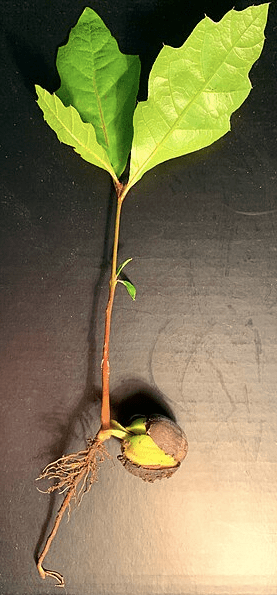
I know that our oak and our neighbors’ oaks send way more acorns out into the world than could ever possibly survive (even if this were a forest and not a neighborhood). I do not mourn all the possible oak trees that were eaten by squirrels and deer or that fell on pavement and rolled away down the street. But I do mourn the ones whose brief lives I ended with my weeding fork.
What to do about this existential conundrum? I guess the only thing to do is to go on. And to do the best we can in spite of what we, as an individual and as a species, are and have been. Do the best we can do. Which Kate DiCamillo would say is to have a “capacious heart.”
Michelle has a capaciously generous Poetry Friday roundup post that is bound to fill you with way more hope and joy than mine!
I’m reading a poem or two a day from Jane Hirshfield’s new (2023) collection. I was initially thrilled, but then stumped by yesterday’s poem, so I thought I’d dig into it and see if I could make it make more sense.
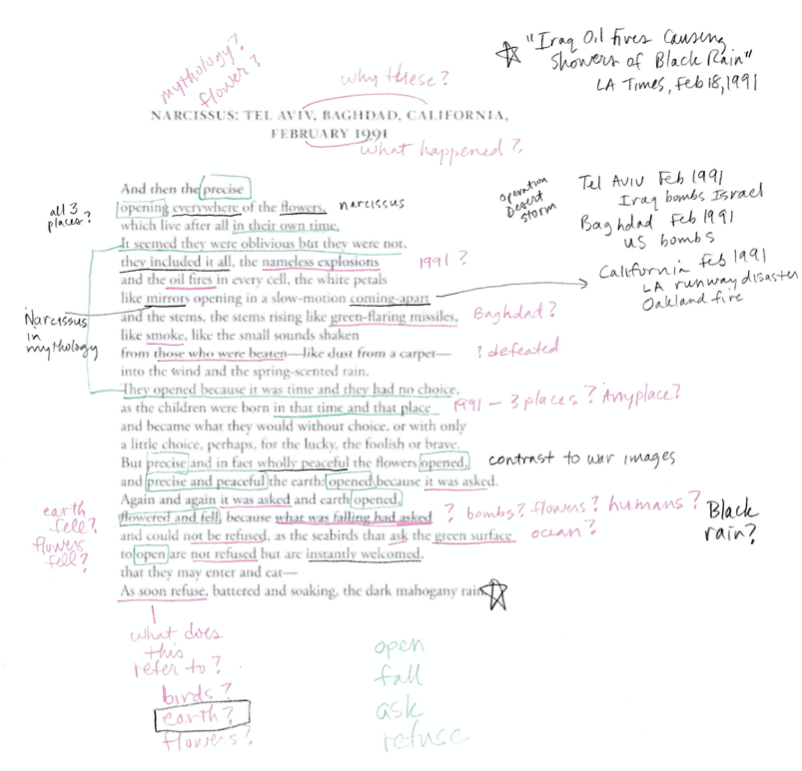
I found a faint and blurry but printable copy on Google Books and went at it with colored pencils. Red is for questions, green is for words and phrases that seemed to resonate or repeat, and black is research notes.
If we’re going to do this the way Pádraig Ó Tuama does on Poetry Unbound, you should go to Google Books and read the poem for yourself before I start nattering on about what I think it might mean. I’ll wait.
Okay. Ready? You’ll see all my notes all at once, but I’ll try to recreate my thinking as I combed through the poem over and over again, doing more and more research about what happened in February 1991.
Even though I wasn’t sure about Tel Aviv, Baghdad, California or 1991, I was drawn into this poem because it is February right now and the narcissus (daffodils) are pushing up with great determination. So I started with the delight of spring happening and flowers opening all over the world “in their own time.” But fairly quickly, the poem opened up to include “nameless explosions,” “oil fires,” “missiles,” and “smoke.” These images were clearly referring to Tel Aviv and Baghdad, but they could just as well be from Gaza in 2023-24. Ouch. I read on, and the flowers were compared to children born “in that time and place” who would become “…what they would without choice, or with only / a little choice, perhaps…” (A stab in my heart with the connection to Palestinian children.) Then I was back to the flowers opening peacefully, but now Hirshfield added the earth opening “…because it was asked.” This line: “Again and again it was asked and earth opened” made me think of all the ways we’ve taken from the earth — mining, damming, paving, plowing, deforesting. And the earth cannot refuse. Hirshfield compares this to seabirds diving into the ocean, not refused, but rather welcomed so they can eat, and there was another stab in my heart: we take and take and take from the earth and she keeps giving and giving for our survival. And then Hirshfield lost me with that last line. So many questions!
After this first read-through, I did some research (notes in pencil at the top right, except for the starred note…that came later). Clearly, this poem is speaking to the Gulf War (specifically, Operation Desert Storm). So that explained Tel Aviv and Baghdad in the title. I wasn’t so sure about California in February 1991. There was the LA runway disaster but the Oakland fire I noted turned out to be in October. Maybe California was included for the local blooming of the narcissus.
I kept reading through and noting the contrast between spring / flowering / the inevitable rising of life versus violence / destruction / falling. I kept getting stuck on that last line. What did “As soon refuse” refer to? What was “battered and soaking?” Where did that rain come from? I went back to Google one more time, and…bingo. The headline from the LA Times on February 19, 1991 was the key that unlocked the ending: “Iraq Oil Fires Causing Showers of Black Rain.”
Now I understand that “As soon refuse” refers to the earth. The earth, with its own precise timing and its gifts of life, with its mirroring of human evils in the very flowers that bloom in spring, can as soon refuse our destruction of it, can as soon refuse to soak the “dark mahogany rain” of oil fires into its battered surface, as the ocean can refuse to allow seabirds to dive in.
What do you think? Would Jane Hirshfield agree with my thinking? Do you?
Thank you to Two Writing Teachers for creating an amazing community of writers and a safe, welcoming space to write and share.
Do weeks start for you on Sunday or on Monday? Mondays start my weeks, so this New Year was a new day, a new week, a new month, and a new year, all rolled into one.
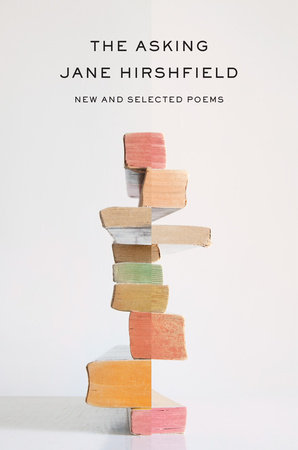
I’m keeping all the usual goals and routines (exercise, DuoLingo, stitching, doodling, writing), but I’m adding a commitment to more diverse blogging, and I’m launching a year-long reading of Jane Hirshfield. I enjoyed savoring Pádraig Ó Tuama’s book POETRY UNBOUND one poem a day, so I bought Hirshfield’s new collection THE ASKING with the intention of lingering with it the same way. In conversations with my brother, and following links he sent to interviews with Hirshfield, I learned about her books of essays, NINE GATES: ENTERING THE MIND OF POETRY and TEN WINDOWS: HOW GREAT POEMS TRANSFORM THE WORLD. An essay a week seems doable, doesn’t it? I thought so.
I’m curious to see if and how this immersion will impact my own writing. Time will tell.




 A(nother) Year of Reading
