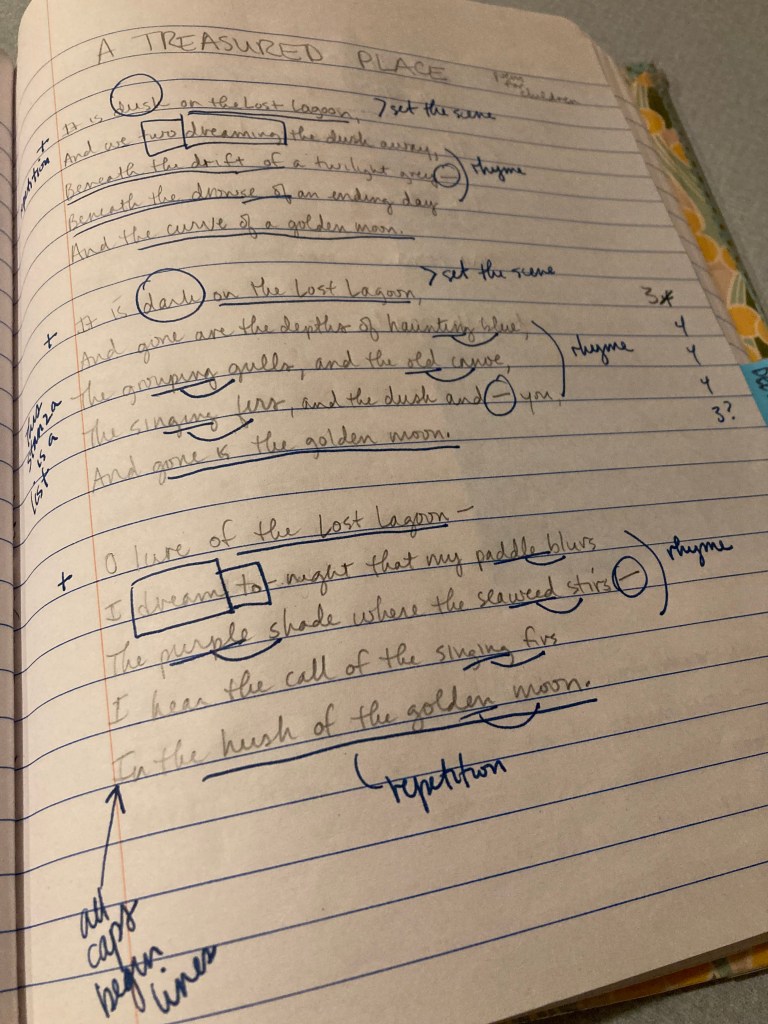
Heidi gave the Inklings a tough challenge this month. She suggested that we use the “The Lost Lagoon” by Mohawk poet, Emily Pauline Johnson (d. 1913) “to build your own poem FOR CHILDREN about a treasured place that you return to again and again (geographical or metaphorical).”
The first thing I did was copy the poem into my notebook and “unpack” the poem the way we used to do weekly in my classroom. As you can see, there’s a LOT going on in this poem!
What wasn’t hard was picking my topic — the swimming pool. What WAS hard was writing a poem “FOR CHILDREN.”
Here’s how the rest of the Inklings interpreted Heidi’s challenge:
There are my favorite bells in music, “The Bells of St. Geneviève”…
…and my favorite bells in film…
…and my favorite classic bell poem which contains my favorite bell word: tintinnabulation. (I so wanted to include that word in my own bell poem, but it was not to be.)
I was all over the place trying to write my bell poem this month, but my drafts kept getting closer and closer to my heart, until this memory emerged:
Carol Wilcox, at Carol’s Corner, has this week’s final Poetry Friday roundup. Let’s hold her, and all of those in the Denver area who are reeling from the recent wildfires, close in our hearts.
There are bound to be lots of bell poems around the roundup, ringing in the New Year. I can’t wait to read them all! Check out what the other Poetry Sisters came up with:
Little grey dreams holding up the hawk: a blur in the periphery. I’ve little time left. Everything’s been said. My heart is so giant this evening following old migratory patterns that would have been better left alone. Someone raised a camera to capture us both in a moment; the only gift I have to give.
Molly’s challenge for the Inklings this month was to try a poetry form that was new to us. I tried a tricube, a rondelet, and this cento. The definition of a cento (from poets.org) is “From the Latin word for “patchwork,” the cento (or collage poem) is a poetic form composed entirely of lines from poems by other poets.”
I was downstairs in my “studio,” doing some stitching and catching up on episodes of The Slowdown podcast. Rather than using a concrete/old school approach (poring over books of poetry, copying down lines by hand, cutting them apart, and rearranging them into a poem), I used a digital approach (listening to the poem, copy/pasting the line I liked, and hyperlinking the poem in my list of sources).
Here’s how the rest of the Inklings met Molly’s challenge:
Michelle has this week’s Poetry Friday roundup at her blog, Michelle Kogan. She’s celebrating holidays and happy poetry news along with some of her gorgeous cards and several poems!
Take note…next week I’ll put up the signup for Poetry Friday Roundup Hosts for January-June 2022! Get ready to claim your spot!
Yesterday’s Ode to Thanksgiving is perhaps a more proper ode (even though it starts off angry and critical) in that it directly addresses Autumn, and focuses narrowly on a single autumnal event: Thanksgiving.
This Ode to Autumn, on the other hand, is really only an ode because I say so in the title. Poet’s prerogative.
Here’s how the rest of the Poetry Sisters met the challenge of writing an Ode to Autumn:
You’re invited to join the Poetry Sisters’ challenge for the month of November! We’re writing an Ode to Autumn. An ode is a lyrical poem in the form of an address to a particular subject, often meant to be sung. Whether you choose an irregular ode with no set pattern or rhyme, or the ten-line, three-to-five stanza famed by Homer himself, we hope you’ll join us! You can share your offering with the rest of us on November 26th (the Friday after Thanksgiving, so plan ahead) in a post and/or on social media with the tag #PoetryPals.
The Inklings’ challenge this month was mine. I was quite taken with the idea of this book: a book about poetry forms and techniques…written in poems. So I challenged the group to write their own poems about forms or techniques. The more we dug into the book, the more we realized that the author doesn’t always explain a form in that form. For instance, her poem about the sestina follows the form but does not explain it. And one of the flaws of the book is that nowhere is there clear definitions of the techniques and forms. Still and all, I recommend the book, and we all had fun playing around with form and techniques. Here are three of mine.
Enjambment
Writing teachers especially hate run-ons. Close the gate so the end of the line can have the pause that finishes a thought or completes a clause.
.
Haiku
small observation perhaps elaboration wry commentary
.
Personification Limerick
I once was a limerick named Sue. My rhythm was fine. Rhyme was, too. There was just this one thing caused my heart not to sing: my longing to be a haiku.
Time to start working on the Poetry Peeps August challenge! The last Friday of August will be here before you know it! Here’s the challenge: We’re writing after the style of Jane Yolen’s eight line, rhyming poem, “What the Bear Knows,” a poem written in honor of her 400th book, Bear Outside. Our topic is What the ____ Knows. You might have written one of these for Michelle Barnes’ Today’s Little Ditty Spotlight on Joyce Sidman.
You’ve got a couple of weeks to craft your creation(s), then share your offering on August 27th in a post and/or on social media with the tag #PoetryPals.