Franki’s Weekly Text Set–Nonfiction Picture Book Series for Elementary Readers

Texts for this Text Set have been posted daily on Instagram.

Follow @TextSets there to get daily updates!
Many of us can remember favorite series books from childhood–those books we read nonstop, those books that were so important on our journeys to becoming lifelong readers. We know how important series books are for young readers and that is true for both fiction and nonfiction. I remember when I read my first Scientists in the Field series as a teacher. I loved it so much that I read others that were not even on topics I thought I was interested in. During the last several years, having baskets of nonfiction series books was important for classroom library set up.

If we want our students to choose to read nonfiction, we have to invite them in in a variety of ways. Series books invited children into nonfiction reading by giving them a collection that could expand the topics they read and support them as readers as they knew what to expect from the next book in the series. They build different skills as different series require different skills as readers. Nonfiction series books are a great invitation for readers to read more nonfiction, to expand topics they love, to get to know nonfiction authors and to build strategies as nonfiction readers. This week’s text set will highlight some series books I’ve found to be popular with elementary readers in grades K-5. These books are perfect for all ages as there are several entry points depending on the reader.

Suzi Eszterhas is one of my favorite nonfiction authors. She is a wildlife photographer so the photos in every one of her books are incredible and they engage readers immediately. This series–Eye on the Wild–focuses on the first year in a baby animal’s life. Suzi Eszterhas has other books and series (Wildlife Rescue)–all about animals– so this series is a great way to introduce this incredible author.

Two other authors who have several nonfiction series books for young readers are Melissa Stewart and Kate Messner. A Place for Birds and Over and Under are two series that have so much interesting content. I love these because understanding of the bigger science concepts build across the series. So the more children read in the series, the better they understand the bigger, complex concepts of our environment.

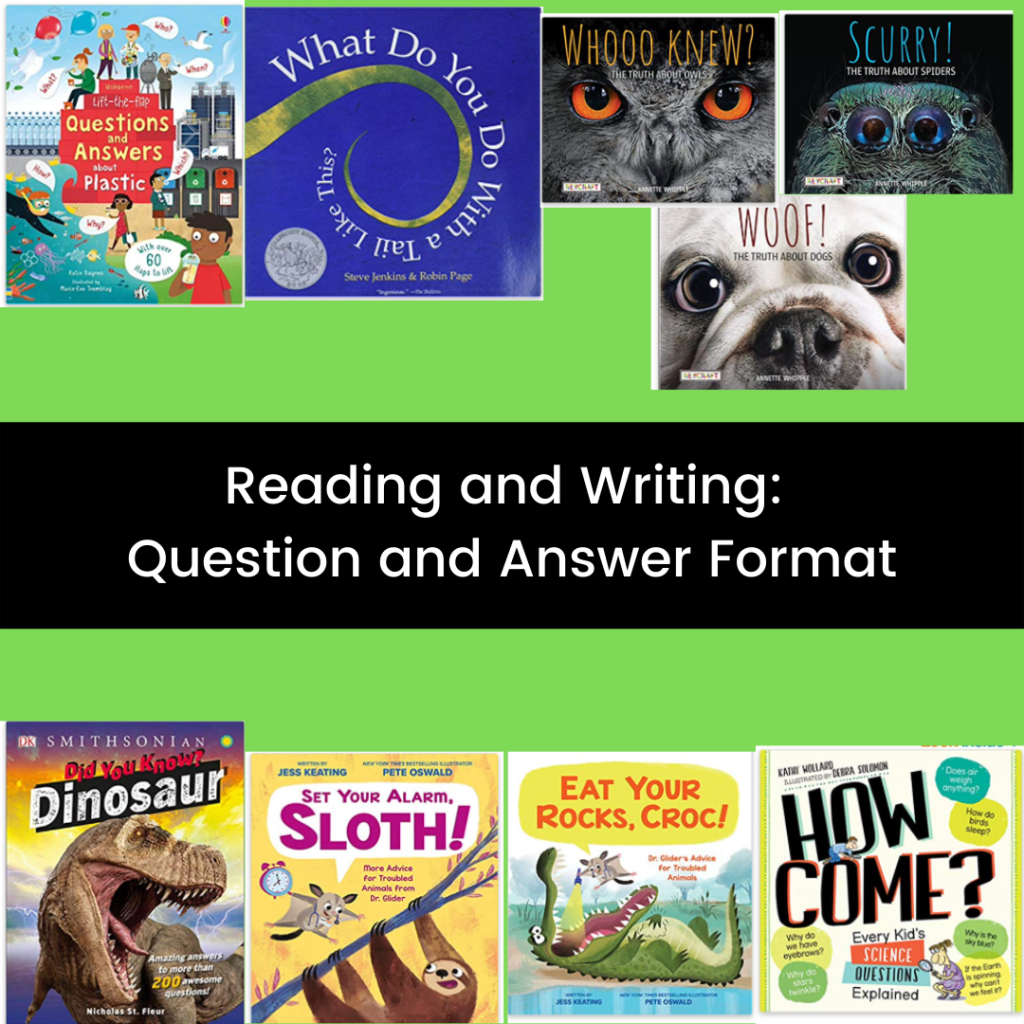
The Truth About series is a fun series with lots of entry points. There is a lot of content packed into a fun format and readers enjoy the humor throughout. We are lucky to have so many great series books about animals as so many children are interested in animals. Reading across a series or finding a variety of books about a single animals support young readers and there are plenty of options for laddering their reading (Thanks Dr. Teri Lesesne for teaching us about Reading Ladders!).

The If Animals Disappeared Series is a powerful one in helping children (and adults) understand the interconnectedness of our world. These books are packed with information and also make for great read alouds. The author makes a very complex issue accessible for our youngest children.

Jess Keating is definitely an author that knows how to engage young readers. Her photos, her sense of humor and her expert knowledge of the topics she writes about make every one of her books a must-read. Jess Keating has two nonfiction series books that engage readers of all ages. Big as a Giant Snail and Set Your Alarm, Sloth! are both new this fall so celebrating these book birthdays would be a great way to introduce the series.

This week’s books were linked at Bookelicious and/or  Cover to Cover Children’s Bookstore. If you are looking for a fabulous local children’s bookstore to support, Cover to Cover is an amazing one. We are lucky to have them in Central Ohio! If you don’t have an independent children’s bookstore in your town, check out Bookelicious. They are an online independent bookstore for children with an incredible curated collection. (Warning: You will want to create a bookmoji while you are there. This will be the highlight of your weekend I’m sure! Below is one of mine:-)

Poetry Friday: Conversations

This month’s Poetry Sisters Challenge was so much fun! The first fun was diving into each sister’s blog archives to find a poem that invited me to respond. Then, the fun was in “talking back” to her poem.

Tricia wrote “The Dizzying Stress of Tidying Up (with apologies to Marie Kondo),” to which I reply

The urge to collect
runs as deep as arthritis
in mom’s bones and mine.
A small house is a good thing.
I collect miniatures.

.

Tanita’s poems were in response to the Poetry Peeps prompt: Wish I’d Been There, or an historical event that incites wistfulness, to which I reply

take me back in time
not very far, or for long:
my parents’ wedding
before arthritis plagued mom
while dad was still a pilot

.

Sara’s poem using Linda Hogan’s “Innocence” as her model and including the phrase, “There is nothing more ____ than ____” was a poem about trees, to which I reply

there is nothing
more glorious than twin gingkoes
until one falters
slowly dying limb by limb
one tree left holding fall’s flame

.

.I borrowed the last line of Liz’s haiku from April 26, 2021 for the first line of my tanka in which I reply

no one stays for long
learn to cup your hands gently
loosen your tight grip
now you are the steady tree
next you’ll be leaves on the wind

.

Laura wrote “Why You Cry When You Read Me,” to which I reply

Where the Red Fern Grows,
Love Story, Little Britches,
Old Yeller, Charlotte’s Web:
books that squeeze my heart so hard
I cry every single time.

.

Kelly wrote “Cookie Time,” to which I reply

Dozens and dozens:
gingerbread for twenty years
then seventeen years
of sugar cookie cutouts.
One thing I always got right.

.

.Andi wrote a snake poem, to which I reply (about a different species)

backyard visitor
every day just after dusk
black formal attire
accented by white cap, stripe
the dropped birdseed is all yours

.

All of these tanka are ©Mary Lee Hahn, 2021. The image is via Unsplash, by Tom Hill.

Laura’s response to the challenge and today’s Poetry Friday roundup are at Laura Purdie Salas: Small Reads for Brighter Days.

The other Poetry Sisters’ posts are here:
Tricia
Tanita
Sara
Liz
Kelly
Andi

.


Franki’s Weekly Text Set-Launching the Writer’s Notebook

Texts for this Text Set have been posted daily on Instagram. Follow @TextSets there to get daily updates!

It’s the time of year where many of us are launching writer’s notebooks with our students. During these first weeks of writing, we want children to become confident writers, to find joy in writing and to see what’s possible. As a teacher my goal, thanks to the work of Shelley Harwayne has been on volume and variety. Over the years, I have relied on picture books to support this phase of the school year and I keep refreshing the set of books I use.

List writing is one of the best ways I’ve found to engage writers who have not had great experiences with writing. Creating lists is sometimes a great way for these writers to ease into writing. And let’s face it, list writing is part of every writer’s life. These books (I Wish You Knew, I Am Every Good Thing, What I Am, and My Heart Fills With Happiness) invite list writing by following the thread of the book. Reading one of these books and inviting students to make a list similar to what the author did is a good option for writers during those first days of workshop.

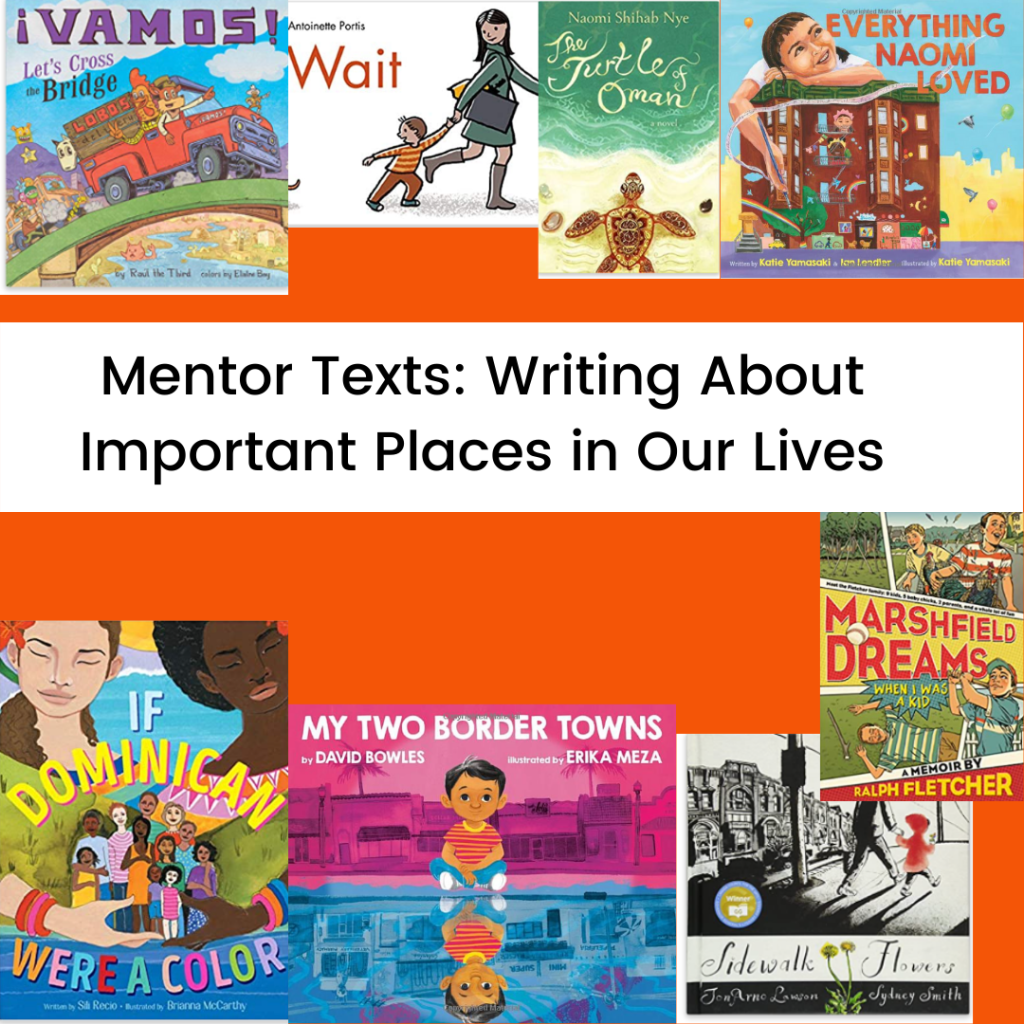
Writers often write about places they love. This set of books (My Casa is My Home, From My Window, and In My Mosque) does that but in three very different ways. For writers who struggle with a topic, place is something that gives lots of options. I have used these books along with the map in Ralph Fletcher’s Marshfield Dreams to think about writing and drawing about places that are important to us.

We want our students to learn from other writers and one way we do that is to play with mimicking or copying something a writer does-playing with it a bit. Guess Who, Haiku and Ribbit! both invite writers to Try it! Trying to write a riddle Haiku or trying to write a description with the 3 sentence part used so obviously in Ribbit! make for a fun day in writing workshop. This type of writing invitation encourages young writers to play with language-to have fun with it!

Writers use their senses and these two books help young writers see what is possible when they do that. Hello, Rain! is a poem in picture book format and the whole book describes a rainy day. Writers might think about describing something in a poetic way. And Listen reminds writers that sound is an important part of description.

So much of our writing revolves around people, especially those that we love. There are so many ways to show our love of the favorite people in our life though writing. Each of these 3 books– My Papi Has a Motorcycle, Not Enough Emilys in Hey World, Here I Am, and Your Mama–does this in different ways and each is accessible to young writers.

This week’s books were linked at Bookelicious and/or  Cover to Cover Children’s Bookstore. If you are looking for a fabulous local children’s bookstore to support, Cover to Cover is an amazing one. We are lucky to have them in Central Ohio! If you don’t have an independent children’s bookstore in your town, check out Bookelicious. They are an online independent bookstore for children with an incredible curated collection. (Warning: You will want to create a bookmoji while you are there. This will be the highlight of your weekend I’m sure! Below is one of mine:-)

Poetry Friday: A Trio of Tankas

The Poetry Sisters’ challenge for this month is to write a tanka in response to or conversation with a poem written by one of the other sisters. Kelly wrote a fabulous article about tankas. Who doesn’t love her analogy that “a tanka is a haiku pulling a trailer?!?” To get ready for the challenge, I’ve written a trio of tankas. I’ll share them without images, because I’m hoping the words themselves are enough to paint a picture in your imagination. The orb weaver and the buck live in Central Ohio; Rae’s house is in the dry high plains of Eastern Colorado.

Tanka for Rae’s House

Beyond the window:
extravagantly green lawn,
bountiful garden.
In the unwatered pasture
dry grass crunches underfoot.

.

Tanka for the Eight Point Buck

sun low behind trees
morning air carries fall chill
eight point buck sees me
freezes so majestically
you forget he’s in the street

.

Tanka for the Orb Weaver

Above our front door
hangs a ferocious hunter
alarmingly large
seeming to stand in thin air.
She owns the porch. I concede.

all three ©Mary Lee Hahn, 2021

.

Denise has this week’s Poetry Friday roundup at Dare to Care. Our Casting for Recovery retreat is this weekend, so I’ll read and comment next week.

Franki’s Weekly Text Set–Understanding Theme: Books About Friendship

Theme is often a difficult concept for elementary students. Many children give a single word as the theme and stop there. But I’ve found that exploring several books with the same idea/one word theme, helps students dig in and see the more specific theme of the book. So this week’s text set is a set of books about friendship. And even though “friendship” may be the one word answer for theme, each of the books teaches us something very different and very specific about the idea of friendship. I love exploring several books like this with students as we are learning to dig deeper with the idea of them.

One of my favorite new picture books about friendship is Evelyn Del Rey is Moving Away. This book captures so much that is friendship and there are a few themes within. This book is one that can be read over and over and it has access points for students no matter where they are in their understanding of theme.

Both Be a Friend and Nothing in Common explore the concept of making new friends, but both books do this in very different ways and both have different messages for the reader. I paired these because Making Friends is the thread that connects them.

I debated including Little Brown in this set because it isn’t quite about friendship but it is one that I would pull in and ask readers if there is a message here about friendship and if so, what it is. This is a book that leaves the reader a bit unsettled and one that can be read over and over. It is a favorite of mine for talking about theme and I think it always invites deep conversations with lots of right answers.

I love Jenny Mei is Sad so much. It is a book about friendship with a theme that I don’t see often and one that is very accessible to young readers. The words and images work together perfectly and there is lots to discuss and ponder about the friendship in this book.

City Dog, Country Frog is classic book about friendship, grief and healing. There is no single theme in this book so readers can explore the multiple themes in this heartfelt book by Mo Willems. I like this in a monocycle on theme and I also love that it is by author Mo Willems-it is such a different kind of book than the ones our young readers know that it is always a good way to expand what they know about a favorite author.

This week’s books were linked at Bookelicious and/or  Cover to Cover Children’s Bookstore. These are my two favorite children’s independent bookstores. If you are looking for a fabulous local children’s bookstore to support, Cover to Cover is an amazing one. We are lucky to have them in Central Ohio! If you don’t have an independent children’s bookstore in your town, check out Bookelicious. They are an online independent bookstore for children with an incredible curated collection. (Warning: You will want to create a bookmoji while you are there. This will be the highlight of your weekend I’m sure! Below is one of mine:-)

Poetry Friday: A Sonnet for September

Earlier this week, Margaret got me thinking about sonnets. I knew I had written one, but had to dig hard at A Year of Reading to find it: Coffee House Sonnet. Turns out it’s from NPM 2010, and I haven’t archived that year’s project over at Poetrepository yet. (Adding that to my to-do list…)

We’ve been enjoying a few days of perfect September weather, and because it was clear this morning, I went for my walk before the sun came up and I got to say hello to my good friend, Orion, for the first time since he waved goodbye and marched over the western horizon last winter.

Tricia has this week’s Poetry Friday Roundup at The Miss Rumphius Effect.

#PoemPairs

Three Little Engines
by Bob McKinnon
illustrated by Lou Fancher and Steve Johnson
Grosset & Dunlap, 2021
review copy provided by the publisher (thanks!)

FIRST THE PICTURE BOOK

It’s graduation day, and three little engines (Little Blue Engine, Yellow Passenger Engine, and Red Freight Engine) are ready to take their final test and make a solo trip across the mountains. Little Blue Engine makes it across just fine with her traditional “I think I can”s. But the other two engines have obstacles in their paths that Little Blue did not have, and she realizes that sometimes no matter how much you think you can, you can’t make it over the mountain without some help. She changes her mantra into “I think WE can” and they all make it over the mountain supporting each other.

Sunday Morning did an interview with the author.

AND NOW THE POEMPAIR

I’ve chosen a poem from WOKE: A Young Poet’s Call to Justice to pair with this picture book. The poems in WOKE help young readers to identify issues of inequity in our world, but it also gives them big and small ways to fight back or speak out. Just like Little Blue Engine learned — it’s not enough to SEE that there is inequity, we need to search our hearts and our resources and DO something about it.

What’s In My Toolbox
by Olivia Gatwood

We can’t choose the way we’re born.
Some of us are born with two parents, some one, some none.
Some of us are born with legs that we can walk with,
some of us need a little help. Some of us get to eat when
we are hungry, some of us still haven’t. When a person
has privilege, it is a toolbox they were born with,
hammers and nails that make it easier for them
to walk through the world because the world,
in all of its beauty and excitement and variety,
can still be a very hard place in which to live.
.
.
.

Read the rest of the poem in WOKE and discuss all the different kinds of privilege that give some people advantages over others.

Franki’s Weekly Text Set-Studying Font Across Genres

Texts for this Text Set have been posted daily on Instagram. Follow @TextSets there to get daily updates!

This week’s Text Set focuses on font changes across. This is a great quick study to do early in the school year as it creates access points into mentor texts for all readers and writers. The books shared this week have font changes that can be studies for readers (how the font change impacts meaning) as well as for writers as they find possibilities for their own writing.

I Can Make a Train Noise is the perfect book to begin a mini-unit on fonts and font changes. The same line repeats itself throughout the book (“I can make a train noise now.”) but the size and layout of the words change. The font tells the reader how they might read the words differently on each page. This is a book that readers of all ages will have fun with and then will be able to learn about font choices throughout.

Poetry is always important when looking at font. These two books give readers and writers so much to think about. In No Voice Too Small, the concrete poem about Mari Copeny: Little Miss Flint (Written by Carole Boston Weathorford) is worth studying when it comes to font. The choices in which words to enlarge is important for readers and writers. In Have I Ever Told You Black Lives Matter, each page is a work of art in the way the words are placed on the page, the size and color of words, etc.

Font changes in narrative can be fun and it doesn’t take a lot of font changes to give new meaning or emphasize dialogue, etc. One Word from Sophia is a book that plays a bit with font and the choices of each font change can be invitations for writers to try something new in their own narratives.

Curious Comparisons uses a variety of fonts and sizes in the way the book is formatted. Different information is given with different fonts and the layout/font choices on any individual page would make a great mini lesson. As our students write informational texts, font and layout are critical visual pieces and this is a great nonfiction book to invite those possibilities.

The picture book biography, Shirley Chisholm is a Verb, is an incredible story of Shirley Chisholm. The verbs in the book–that tell so much about the impact Shirley Chisholm has made are in different fonts and colors. Discussing the ways font is used to highlight important ideas throughout is the way I’d start this conversation and invitation for readers and writers. #TextSets #kitlit #BuildYourStack #MentorTexts

This week’s books were linked at Bookelicious and/or  Cover to Cover Children’s Bookstore. If you are looking for a fabulous local children’s bookstore to support, Cover to Cover is an amazing one. We are lucky to have them in Central Ohio! If you don’t have an independent children’s bookstore in your town, check out Bookelicious. They are an online independent bookstore for children with an incredible curated collection. (Warning: You will want to create a bookmoji while you are there. This will be the highlight of your weekend I’m sure! Below is one of mine:-)
One of my 4 bookmojis on Bookelicious!

Poetry Friday: Ghazal for Your Cats

Jennyanydots (6 lbs) in her 21st and final year in 2008, and Hemingway (14 lbs) currently in his prime.

Margaret gave the Inklings quite a challenge this month! We wrote ghazals, (Hindi: ग़ज़ल, Arabic: غَزَل‎, Bengali: গজল, Urdu: غزَل, Persian: غزل‎, Azerbaijani: 
qəzəl, Turkish: gazel, Uzbek: gʻazal, Gujarati: ગઝલ) an ancient Arabic poetry form with five delightfully complicated rules.

I found Ravishing DisUnities by Agha Shahid Ali VERY helpful. This collection of ghazals by 100+ poets (including Diane Ackerman, W.S. Merwin, and Maxine Kumin, just to name a few of the poets whose names I recognized) helped me to suss out the form, AND provided all kinds of variations on the form.

Heidi has this week’s Poetry Friday roundup at my juicy little universe, and here are all the other Inklings’ ghazals:
Catherine
Linda
Margaret
Molly

(An aside, related to Bridget’s post about DuoLingo. I’m learning Spanish and Arabic and reviewing my rusty German with DuoLingo. Current status: 90 day streak. When I pasted in “ghazal” in all those different languages (thank you, Wikipedia), I was startled to realize that I can ALMOST read the Arabic! I haven’t learned the “gh” character yet, but I know the little accent mark above it means short a, I know z (with another short a), and I just learned l. WOW!)


Franki’s Weekly Text Set-Writing Mentors: How Do Different Writers Approach Similar Topics?

Texts for this Text Set have been posted daily on Instagram. Follow @TextSets there to get daily updates!

This week’s Text Set focuses on writing mentors. Often for writers, it is helpful to see the various ways different writers approach similar topics. Studying the possibilities is important in all genres and formats of writing. This week, we’ll focus mostly on narrative texts that would work well in a narrative unit of study.

(You’ll notice a few sets of these books were shared last spring with a reading focus. I am a big believer in using anchor mentor texts across the year for a variety of reasons. So even though some sets are the same or similar, the focus of this set is study as a writer, especially as part of a narrative unit of study.)

Family Get-Togethers

The Relatives Came by Cynthia Rylant is a classic text used in many writing workshops in the study of narrative. To deepen the study, comparing different ways writers write about a family reunion–the word choice, the focus, the imagery, etc. can be done using this classic along with Family Reunion and Going Down Home with Daddy. Each of these has a very different writing style and young writers can learn a great deal from comparing these.

A Trip

Writing about a trip is something young writers like to do, especially within a narrative unit of study. Fatima’s Great Outdoors and The Camping Trip each focus on a camping trip and the experiences of that one trip. Writers can study the format and also the focus that each story has within the topic of a camping trip.

Learning Something New

Learning a new skill takes patience and practice and each of these characters’ stories shows that. The Electric Slide and Kai, The Most Magnificent Thing, Jabari Tries and Amy Wu and the Perfect Bao show the messiness of the learning process! Learning something new is a great topic for narratives and there are so many ways to approach the topic. This set shows writers the variety of things learned as well as a variety of ways to approach the topic as a writer.

Someone We Love

Writing about someone we love to spend time with or someone we miss is a common topic in narrative writing. When Lola Visits, Saturdays are for Stella, and I Dream of Popo explore the relationships as well as coping with missing a loved one in different ways.

The Current Pandemic

The current pandemic something on many children’s minds and these three books (Outside, Inside, And the People Stayed Home, and Keeping the City Going take that current issue and open conversations for children. These books can also be used as mentors because even though each is about the pandemic, the focus and the writer’s purpose of each is very different.

This week’s books were linked at Cover to Cover Children’s Bookstore. If you are looking for a fabulous children’s bookstore to support, this is an amazing one. We are lucky to have them in Central Ohio!