Franki’s Weekly Text Set: Writing About Important Places in Our Lives

Texts for this Text Set have been posted daily on Instagram. Follow @TextSets there to get daily updates!

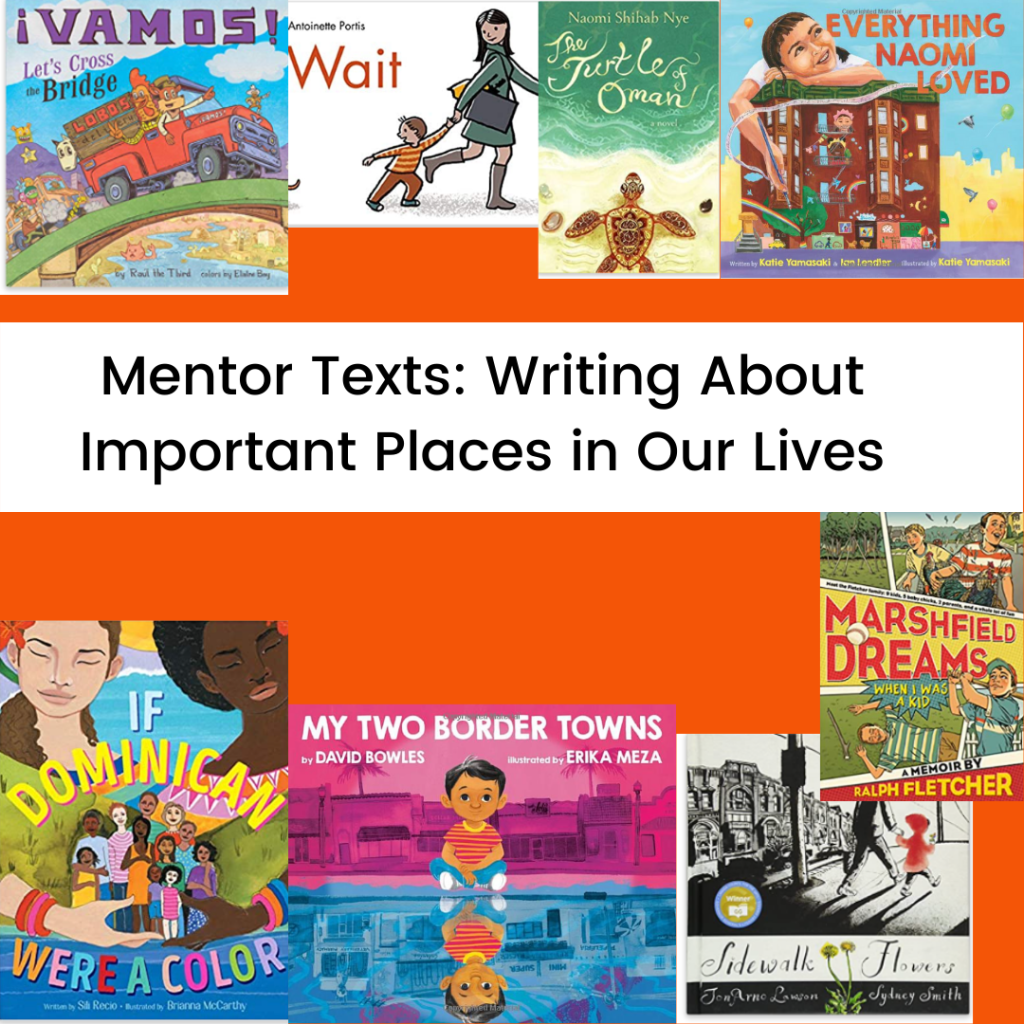
Place is such an important idea in our reading and writing. For our elementary writers, learning various ways to capture all that you love about a place can support writing across units of study. This week’s Text Set will explore books that capture a specific place. These books can be studied as writers to discover new things to try as writers.

I always love starting any mini-cycle of study with wordless or nearly wordless picture books. Sidewalk Flowers and Wait! are similar in that they each follow a young child noticing the little things in a city/neighborhood. The idea of noticing those things that are worth noticing in a place, as writers is a good way to start this cycle.

The language in If Dominican Were a Color is amazing and the rhyming text works well. The thing I love best about this book is the way the author uses colors to describe so many things in the place she loves. The illustrations are amazing and there is so much to learn as a writer and as an artist in this one.

One way to share the joy of a place is to tell stories of the place. I love the book Marshfield Dreams as part of this study because Ralph Fletcher includes so many stories that give readers a sense of the place he grew up. I also love the map at the beginning of the book–this serves as a great mentor for writers –creating a map of a place is often a great way to think about ways to write about it.

Vamos! Let’s Cross the Bridge and My Two Border Towns are two new books about US/Mexico border towns that capture these cities in very different ways. Comparing two ways that two authors captured the joy and stories in different ways will invite great conversations about writing.

Saying goodbye to a place you love is always difficult. Both of these books capture the love of place and the feeling of loss in beautiful ways. Everything Naomi Loved make for an easier mini lesson because of its length, but Turtle of Oman is an incredible quiet read aloud for upper elementary students and almost any page can be studied as a writer. Pairing the two would be powerful.

This week’s books were linked at Bookelicious and/or  Cover to Cover Children’s Bookstore. If you are looking for a fabulous local children’s bookstore to support, Cover to Cover is an amazing one. We are lucky to have them in Central Ohio! If you don’t have an independent children’s bookstore in your town, check out Bookelicious. They are an online independent bookstore for children with an incredible curated collection. 

Poetry Friday: Word Play

The Poetry Sisters’ challenge for this month was to write Word Play poems, introduced to the Poetry Friday community in 2015 by Nikki Grimes as one of Michelle H. Barnes’ (Today’s Little Ditty) Ditty of the Month challenges. Laura Purdie Salas showed how the form might work in a classroom.

I have two poems this month. The first came about because of this conversation on FaceBook with Poetry Sister Kelly:

This second poem was written more in the style of Poetry Sister Laura’s “Freedom is a Word” (one of my all-time favorite poems of hers).

Don’t forget to join the Winter Poem swap…
if you’re so inclined. More info here.

Linda has this week’s Poetry Friday Roundup at TeacherDance, and check out how all the rest of the Poetry Sisters met this month’s challenge:

Tricia @ The Miss Rumphius Effect
Tanita @ {fiction, instead of lies}
Sara @ Read Write Believe
Laura @ Laura Purdie Salas
Liz @ Liz Garton Scanlon
Kelly @ Kelly Ramsdell
Andi @ A Wrung Sponge

You’re invited to join the Poetry Sisters’ challenge for the month of November! We’re writing an Ode to Autumn. An ode is a lyrical poem in the form of an address to a particular subject, often meant to be sung. Whether you choose an irregular ode with no set pattern or rhyme, or the ten-line, three-to-five stanza famed by Homer himself, we hope you’ll join us! You can share your offering with the rest of us on November 26th (the Friday after Thanksgiving, so plan ahead) in a post and/or on social media with the tag #PoetryPals.

Franki’s Weekly Text Set-Phonological and Phonemic Awareness

Texts for this Text Set have been posted daily on Instagram. Follow @TextSets there to get daily updates!

I often get requests for book recommendations for young children that support Phonological and Phonemic Awareness. Both of these skills are anchored in oral language. We want children to be able to focus on and manipulate sounds. We want them to be able to do this with larger chunks (rhymes, word parts, etc.) and to also be able to isolate individual sounds. Songs and stories are often great ways to play with sounds as you work with these skills. This week I’ll share some books that are fun to share with young children (and children of all ages) as they learn to play with and manipulate sounds in words.

I have to start with an oldie, but goodie–Tanka Tanka Skunk! I think we went through at least two copies of this book when my daughter was young. It is such a fun read aloud and it never seems to get old! The rhythm and breaking apart of syllables in words while reading this one make it perfect for young children. The illustrations are great fun and invite lots of good conversation.

I just discovered this new book The Sound Bites at a local bookstore. This is a fun story with lots of sound and word part play throughout. Authored by a Speech Language Pathologist, the book introduces letter sounds and also plays with alliteration and more throughout. The author shares great tips for caregivers at the end of the book.

There are never enough rhyming books to share with young children. One Hug, Cool Cuts and Moo Hoo are three of my recent favorites as the rhymes and rhythm work well for young children. The humor in Moo Hoo is an added bonus! All are great choices for reading aloud to young children–whether at home or in a classroom.

I love discovering new song books to share with young children. Paletero Man is a lively happy song filled with rhyme. It was created by Lucky Diaz. Pairing this book with the song recording would make for a happy day at home or at school! Of course kids will join in!

I just discovered Atticus Caticus and I can’t get over the brilliance and the fun. Readers of all ages will love this one but the play with words, the rhyme, the I just discovered these two books and I can’t get over the brilliance and the fun. Readers of all ages will love Atticus Caticus because the play with words, the rhyme, the multisyllabic nonsense words all make it such fun. I love the way the words and illustrations work together to tell a fun story with such playful language ((and it is almost National Cat Day–THANKS Bookelicious for the reminder!). Look is another fun story of a day at the zoo. And it is told almost exclusively with words with the double o. I can see having fun breaking words apart, replacing the first letter, etc. after reading and enjoying this books. Kids will love these two! . #TextSet #ReadAloud

This week’s books were linked at Bookelicious and/or  Cover to Cover Children’s Bookstore. If you are looking for a fabulous local children’s bookstore to support, Cover to Cover is an amazing one. We are lucky to have them in Central Ohio! If you don’t have an independent children’s bookstore in your town, check out Bookelicious. They are an online independent bookstore for children with an incredible curated collection. 

Poetry Friday: What An Amazing Community!

For her birthday, Linda Baie GAVE the gift of poetry — she handpicked volumes for anyone who sent her their address. I’ll enjoy the David Ignatow book (POEMS 1934-1969) a little at a time, but her pick of CRY OUT: POETS AGAINST THE WAR was magical. From the blurb on the back: “On February 16, 2003, eleven contemporary poets held a reading in Manchester, Vermont, called “A Poetry Reading in Honor of the Right to Protest as a Patriotic and Historical Tradition.” Organized in response to the cancellation of a White House poetry symposium, the reading was sponsored by the Northshire Bookstore and drew a crowd of over seven hundred people. CRY OUT: POETS PROTEST THE WAR gathers together the poems read by the participants, many of them original poems and others poems by…renowned poets…”

We were in Manchester, VT just.last.week!! The Northshire Bookstore is one of our favorite destinations there! Magical! Thank you, Linda!!

Outside Manchester, VT
One of the poems read by Donald Hall

Words that still ring true today.

This image has an empty alt attribute; its file name is winter-poem-swap-2021.png

Laura Shovan and I are helping Tabatha with the Winter Poem Swap. The Winter Poem Swap is a little different than the Summer Swap. In the SummerPoem Swap, poets do up to five swaps, while the Winter Poem Swap is just ONE swap. This time, though, you are asked to send a wee gift along with your poem. If you would like to participate, send Laura an email (laurashovan @ gmail . com) by November 6. Include your full name and mailing address. Let her know if you want to swap with the same person who is sending to you or if it doesn’t matter. Include any allergies your gift giver might need to know about. Laura will send you the name and address of your poem/gift recipient by November 13. Then you have a month to write your poem and put your package together for delivery by December 15, in plenty of time for the winter solstice in the Northern Hemisphere (10:58 AM on December 21, in case you were wondering).

Jama is hosting this week’s Poetry Friday roundup at Jama’s Alphabet Soup. Head over for some October goodness and the rest of the posts by this amazing community! I’m so thankful for all of you, and all you do to make the world a better place, one Friday after another!

Franki’s Weekly Text Set: The Power of Visuals in Fiction and Nonfiction

Texts for this Text Set have been posted daily on Instagram. Follow @TextSets there to get daily updates!

This week, we’ll look at the Power of Visuals in both fiction and nonfiction. This is another study that is important as both readers and writers. More and more of our world is becoming visual and more and more books have embedded visuals that work together WITH the text. Learning to read visuals as part of a text and thinking about being intentional as a writer with the visuals we use are both critical.

If you have not had time to check out Uma Wimple Charts Her House, please do! This is a longer picture book that is full of charts, diagrams and other visuals. The focus of the story is on charting Uma’s house so it is a great book to begin a conversation around visuals to share information, to tell a story, etc. This one is also a great book to connect to math concepts. This is one readers will read and reread, noticing new things each time.

What’s Inside a Flower is one of my favorite new nonfiction books. This can be read from cover to cover or it can be studied based on what a reader wants to learn. Each page has visuals that can be studied. This would be a great book to project on a board to discuss the creation of the various visuals. And the colors in this one are unique which is another layer of thinking when it comes to visuals.

There is something about a graphic novel layout that is often challenging to understand and to create. I love a simple graphic novel that can be studied for design. This early graphic novel, Burt the Beetle Doesn’t Bite, shares lots of facts about insects. And it does so with humor. The layout and the way the text and dialogue are laid out on each page are all worth talking and thinking about. So many design decisions on each page.

How to Make a Book (About My Dog) is a new book by Chris Barton. I love it for thinking about the writing process but I also love the ways the visuals add so much to the text–breaking things down, etc. This is a fun book to read as part of your writing workshop. Then I can see going back to individual pages to really study the visuals that are embedded and how each helps the reader make meaning.

I LOVE everything about both of these books-Juana and Lucas and Make Meatballs Sing . I’d share them over and over with children. The reason I included them in this Text Set is the way that the words themselves are visuals. If you know the art of Corita Kent (which I did not before this book), much of her art is involves words. Words are the visuals in these books and there is so much to learn with this concept. In Juana and Lucas, there are other visuals throughout. I like the pairing of these as ways authors and artists create words in a way that moves them beyond “just text”.

This week’s books were linked at Bookelicious and/or  Cover to Cover Children’s Bookstore. If you are looking for a fabulous local children’s bookstore to support, Cover to Cover is an amazing one. We are lucky to have them in Central Ohio! If you don’t have an independent children’s bookstore in your town, check out Bookelicious. They are an online independent bookstore for children with an incredible curated collection.

Poetry Friday: Retirement and Winter Poem Swap Info

.

.

This poem is a decima. The rhyme scheme is ABBAACCDDC, and there are 8 syllables each line.

Laura Shovan and I are helping Tabatha with the Winter Poem Swap. The Winter Poem Swap is a little different than the Summer Swap. In the Summer Poem Swap, poets do up to five swaps, while the Winter Poem Swap is just ONE swap. This time, though, you are asked to send a wee gift along with your poem. If you would like to participate, send Laura an email (laurashovan @ gmail . com) by November 6. Include your full name and mailing address. Let her know if you want to swap with the same person who is sending to you or if it doesn’t matter. Include any allergies your gift giver might need to know about. Laura will send you the name and address of your poem/gift recipient by November 13. Then you have a month to write your poem and put your package together for delivery by December 15, in plenty of time for the winter solstice in the Northern Hemisphere (10:58 AM on December 21, in case you were wondering).

Bridget has this week’s Poetry Friday roundup at wee words for wee ones. (And remember, I’m taking November 5.)

Franki’s Weekly Text Set–Wordless Picture Books: Invitations Into Conversations and Comprehension

Texts for this Text Set have been posted daily on Instagram. Follow @TextSets there to get daily updates!

This week, we’ll take a look at several wordless picture books that invite amazing conversations. I love sharing wordless picture books with students-especially early in the school year. The focus on visuals invites all readers into the conversation. Plus I can introduce so many reading behaviors and strategies as we ponder through these wordless books.

I want readers to know right away that there is a lot of thinking that happens when we read wordless books. And I also want to share books that they can’t help but talk about. By starting with books that leave you thinking, pondering, wondering and revisiting, readers of all ages can see all that wordless picture books have to offer and then eventually transfer those skills to all types of reading. Spencer’s New Pet and Another are two that I have used with readers of all ages. They are books that invite conversations, changes in thinking, inferring possibilities, rereading and more. A lot of thinking is required in each of these fabulous books!

I love these two wordless picture books-The Midnight Fair and Little Fox in the Forest for several reasons. The illustrations are amazing and there are so many details on each page. Readers can revisit and notice new things each time. Also, they are both fantasy so they are great for introducing the genre of fantasy to readers. I also love the endings to each of the books. There are access points for readers of all ages to experience these fabulous worlds!

There are many wordless picture books that take on more serious topics. Brave Molly, I Walk with Vanessa, and small things are three books that I think are important and they are books that can open important conversations with readers. They also have some details in illustrations (shadow in Brave Molly, shattered pieces in small things) that an be discussed as to what they symbolize. I would definitely read each of these carefully before sharing with children as (in my opinion) they need to be shared with care and conversation with an adult.

The Paper Boat is a newer wordless books that shares the journey of one refugee family. The author’s note is important to this one and revisiting the book after reading the author’s note will help readers see new things in the illustrations. The black and white with a bit of color is also something worth discussion in terms of the meaning.

These are some of my favorite wordless picture books as they all explore ways to make the world better. Sidewalk Flowers, Hank Finds and Egg, One Little Bag and That Neighbor Kid each have a very obvious message but they also have layers of meaning when looking and relooking at some details in the illustrations. These 4 are perfect for mini lesson work and independent reading and I think they work for all ages (PreK-Adult).

This week’s books were linked at Bookelicious and/or  Cover to Cover Children’s Bookstore. If you are looking for a fabulous local children’s bookstore to support, Cover to Cover is an amazing one. We are lucky to have them in Central Ohio! If you don’t have an independent children’s bookstore in your town, check out Bookelicious. They are an online independent bookstore for children with an incredible curated collection. (Warning: You will want to create a bookmoji while you are there. This will be the highlight of your weekend I’m sure! Below is one of mine:-)

Poetry Friday: Garden-Fever

Gratitudes to John Masefield for my mentor text for this poem, Sea-Fever.

Irene has this week’s Poetry Friday Roundup at Live Your Poem. Please note a change in the roundups next month — I will be taking the November 5 roundup to help out Tabatha. Also, a team of PF Peeps are going to be organizing the Winter Poem Swap, so stay tuned for more information about that!

Franki’s Weekly Text Set: Falling in Love with Words and Word Play

Texts for this Text Set have been posted daily on Instagram. Follow @TextSets there to get daily updates!

Early in the school year (all year round, actually. But especially early in the year), I always think it’s a good idea for children to experience joy around word and language. So often we focus on the skills of words and forget to weave in all the joy that goes along with words. I have found that elementary students are much better able to pay attention to the skills of words (vocabulary, parts of speech, spelling patterns, etc.) once they see how amazing words are. This week’s books will invite students to delight in words. This can also serve as a follow-up to the Launching Notebooks Text Set from a few weeks ago–kids will want to try a few of these on their own because they are such fun!

I picked up this GIANT book at Cover to Cover last week. I mean who doesn’t need a GIANT joke book. One that is called Wee Hee Hee? I think jokes are a great way to talk about words with kids. So many jokes and riddles for kids depend on word play. This book is filled with fun jokes and riddles. The size of the book, the colors on the pages and the jokes make this book pure fun!

Words is a fun word play book that children will want to experiment with. The book is a small chunky book (another great fun size!) and each page has a single word and a sketch. Seeing how each book is imagined and then thinking about ways to create an image for a single word takes so much creativity.

Take Away the A and Fruit Cake are two books that provide more fun for readers. They also invite readers to try these things on their own. Take Away the A shows readers how much taking away one letter in a word can change it. Fruit Cake is often out of print so sometimes difficult to find but it is well worth it if you can find it. The theme combined with the play on words make it very unique.

Who doesn’t like a good tongue twister? That’s what you get in Six Sheep Sip Thick Shakes. And Beach is to Fun is the most fun introduction to analogies I’ve ever seen. When I used Beach is to Fun with 4th graders a few years back, everyone wanted to write their own! I wish someone had introduced analogies to me with this book (instead of with multiple choice bubbles…).

The titles alone make both Llamaphones and Yaks Yak fabulous. These two help children start conversations about the discipline specific words we use when we talk about words (Homophones and Homographs, Nouns and Verbs). I mean who could forget what a homophone is if it is introduced as a llamaphone?

This week’s books were linked at Bookelicious and/or  Cover to Cover Children’s Bookstore. If you are looking for a fabulous local children’s bookstore to support, Cover to Cover is an amazing one. We are lucky to have them in Central Ohio! If you don’t have an independent children’s bookstore in your town, check out Bookelicious. They are an online independent bookstore for children with an incredible curated collection. (Warning: You will want to create a bookmoji while you are there. This will be the highlight of your weekend I’m sure! Below is one of mine:-)

Poetry Friday: Form and Function

The Inklings’ challenge this month was mine. I was quite taken with the idea of this book: a book about poetry forms and techniques…written in poems. So I challenged the group to write their own poems about forms or techniques. The more we dug into the book, the more we realized that the author doesn’t always explain a form in that form. For instance, her poem about the sestina follows the form but does not explain it. And one of the flaws of the book is that nowhere is there clear definitions of the techniques and forms. Still and all, I recommend the book, and we all had fun playing around with form and techniques. Here are three of mine.

Enjambment

Writing teachers especially hate
run-ons. Close the gate
so the end of the line can have the pause
that finishes a thought or completes a clause.

.

Haiku

small observation
perhaps elaboration
wry commentary

.

Personification Limerick

I once was a limerick named Sue.
My rhythm was fine. Rhyme was, too.
There was just this one thing
caused my heart not to sing:
my longing to be a haiku.

.

All three poems are ©Mary Lee Hahn, 2021. (I’m not sure what’s up with me sharing multiple poems per Poetry Friday post…this is the third week in a row…)

Catherine has this week’s Poetry Friday roundup at Reading to the Core. Check out the other Inklings’ responses to the challenge here:

Heidi @ My Juicy Little Universe
Linda @ A Word Edgewise
Margaret @ Reflections on the Teche
Molly @ Nix the Comfort Zone