Reading Aloud More Nonfiction

*My posts and reviews focus on books for the classroom and library. I am passionate about sharing books that invite natural conversations and learning and choosing the books we share with intention. I am always looking for books that kids will love AND that will support their growth as readers and writers.

I am definitely one that reads aloud and shares more fiction with students than nonfiction. And I always try to balance that better. I know that kids LOVE nonfiction so building in more time for nonfiction read aloud is important. We know nonfiction builds background knowldge and vocabulary. Plus, the skills for reading nonfiction are a bit different from those needed to read and understand fiction. So I have been looking for informational books that also make great read alouds and are short enough for minilesson work.

I found 3 new picture books that are perfect for elementary readers. I’m not sure these would be categorized as nonfiction but each is based on a true story, information is embedded and each one has backmatter that is nonfiction and tells more of the true story behind the picture book. 

I used to ignore the author’s notes and back matter, but not anymore. When reading aloud and sharing these stories with readers, I’d definitely make time to read the back matter as it is fascinating information and I don’t think the books are complete without it. Geting young readers in the habit of reading the author’s note and back matter helps them read with more depth and understanding.

The Escape Artist: A True Story of Octopus Adventure by Thor Hanson and Galia Bernstein tells the story of Inky, the octopus who escaped from a New Zealand aquarium. The story is told in a way that predicts what Inky might have been thinking and doing. It tells the reader what investigators know and what they wonder. Readers learn not only about Inky but there is a lot of octopus information throughout. 

The True and Lucky Life of a Turtle by Sy Montgomery and Matt Patterson is the story of Fire Chief, a snapping turtle. The story includes information on baby turtles and how they grow and then focuses on the accident that injured Fire Chief and of the Turtle Rescue League that helped in his recovery. Readers can see the real Fire Chief in photo in the backmatter. They can also learn more about snapping turtles. 

Not a Spot to Spot: The True Story of Kipekee, the Giraffe Born without Spots by Elizabeth Weiss Verdick and Zoe Waring is the story about a rare giraffe born without any spots. One thing that is unique to this story is that the backmatter touches on which parts of the story are true and which were changed a bit, as this is a book “inspired by” the true story. 

All three of these books are perfect for elementary readers, whether as read alouds or to read independently. Each may also ignite an interest in a topic they want to read more about.

Poetry Friday: It’s Time

Art by sisters Maizy S. and Marcella S.

I’m here with another poem in conversation with art created by two young and talented artists, the daughters of a talented, passionate maker of a mom. No surprise that these two girls have a wealth of supplies and encouragement from both parents. They are thriving — learning to boldly make their marks and trust their own visions. What a world they will make for us! What a world the ARE making for us! They give me hope for the future, a hope as green as both the heart and the landscape.

Sarah Grace has this week’s Poetry Friday roundup at Sarah Grace Tuttle.

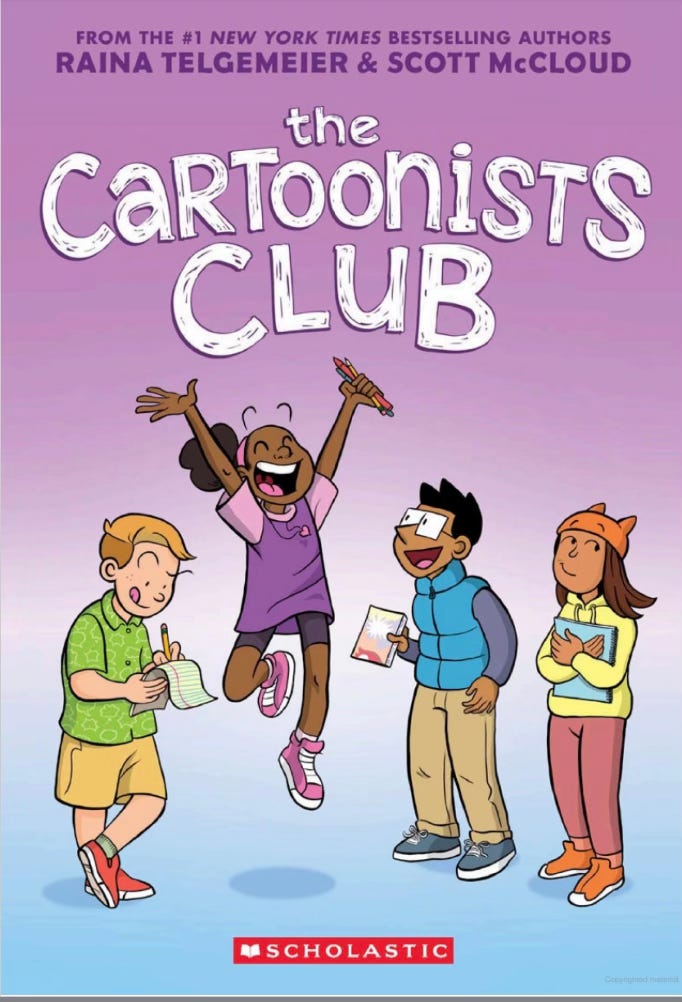
The Cartoonist Club by Raina Telgemeier and Scott McCloud

*My posts and reviews focus on books in the classroom and library. I am passionate about sharing books that invite natural conversations and learning and choosing the books we share with intention. I am always looking for books that kids will love AND that will support their growth as readers and writers.

I am not a natural graphic novel reader. But, as a teacher, it isn’t about what I like or what is easy for me as a reader. So, I’ve worked hard over the years to learning to read and understand graphic novels—really using both words and visuals to create meaning. And in that time, I’ve seen the power of graphic novels in the classroom. 

As a person who is not a reader of graphic novels, I was surprised at the diversity and sophistication of graphic novels available to elementary readers. Once I embraced graphic novels, I saw the powerful stories that are told and I’ve seen readers try a new genre because it’s in graphic novel format. I’ve seen middle grade readers grow in so many ways when graphic novels are part of their reading lives. 

I also think there are readers like me, who don’t really understand how to read a graphic novel. As a 4th and 5th grade teacher, incorporating graphic novels into minilessons and read alouds was important as we could grow together as readers of graphic novels. 

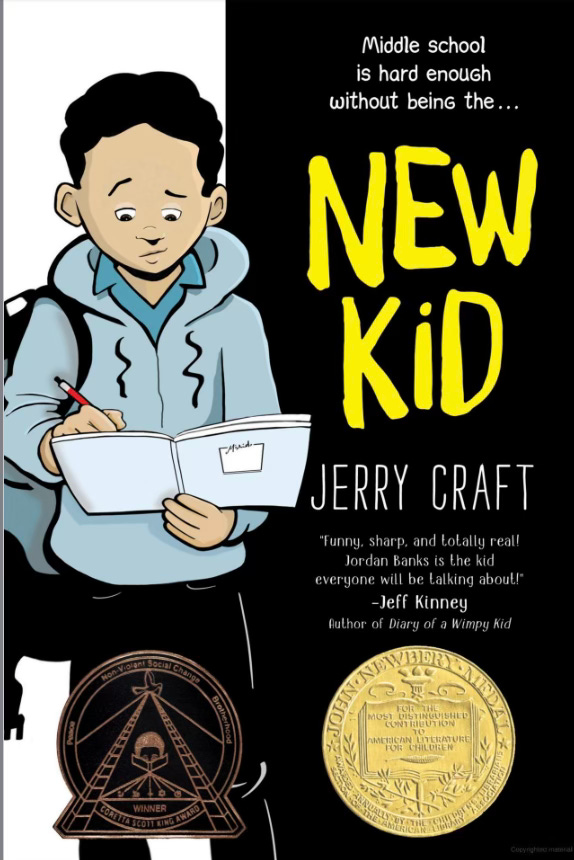
In one of my years teaching 5th grade, I chose New Kid by Jerry Craft as a read aloud. AND instead of reading it myself, I shared the audio version while I projected the ebook on the large board. The read aloud was powerful for so many reasons. The narrator read more than just the words on the page. The narrator narrated the images as part of the audio. We could not only talk about the incredible story and characters, but we could talk about how we navigate a graphic novel and the ways that words and images work together. 

I just discovered a new graphic novel that I think is an important one. It is The Cartoonist Club by Raina Telgemeier and Scott McCloud. This is the story of a group of middle school students who start a club where they write comics and graphic novels. They have an incredible librarian who facilitates the club and teaches them important things about the craft of creating graphic novels. 

I am currently using this book with a small group in a Graphic Novel Writing Club and it is sparking such great conversations and inviting them to try new things as writers. Just this week, one of the students looked back at the section where the club was talking about showing characters’ feelings through facial expressions and she revisited that part of the book to revise the frame she was working on.

I love the book for so many reasons. First of all, for fans of Raina Telgemeier, this is another book and one that is a bit different for her. For readers who. have read all of her books, this book will give them insights into the choices she makes when creating and will invite them to read with more depth. For readers new to graphic novels, this book might help them make sense of how they work and for children who write in this format, this book is a must-have! Our Graphic Novel Club members are already marking pages they want to go back to. I imagine this being a well-worn book for graphic novel writers everywhere!

There are some other backmatter components I love in this book. The “About the Author” page is done visually which is unique and a great invitation for writers. There is an interview with Raina and Scott that lets us know so much about the story behind the story. There is a glossary and a list of jobs that are available to cartoonists. My favorite piece of backmatter is the “How We Made This Book” section that shares the process that the two used to collaboratively create this book. The backmatter alone invites some great conversation and learning.

This is a book I’d definitely have in my classroom library and would possibly read aloud to the whole class or share in a small group setting. It does a lot of teaching naturally and I’ve found that reading aloud a graphic novel lets the entire class know that they are valued and important for readers. There are so many opportunities for conversation about the characters and also about reading and writing graphic novels. 

Check out The Cartoonist Club Book Trailer! and an Interview With the Creators.

Two Books Perfect for Our Youngest Readers

I remember a few years ago when I read Everybody in the Red Brick Building by Anne Wynter and Oge Mora. I read it and thought “What a perfect book for young readers!” It has so much of what I look for when I am looking for books to share with PreK-2nd graders. I have read this book over and over to so many groups of children and I was right. This book is perfect in that it is engaging AND it has so many invitations for young readers to build so many literacy skills-the illustrations, the change of fonts, the repeated phrases and so much more!

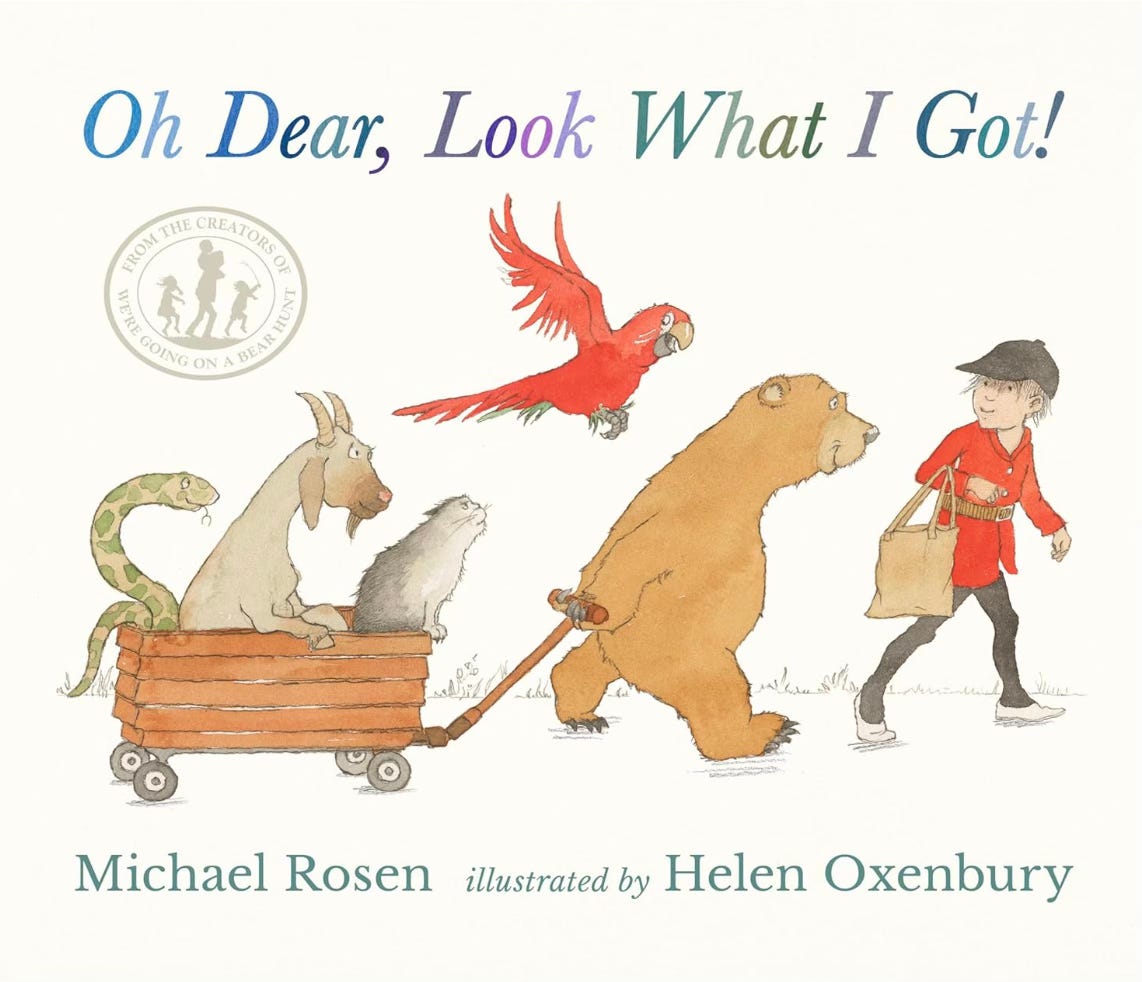
Well, I felt the same way last month when I picked up Oh Dear, Look What I Got! by Michael Rosen and Helen Oxenbury (the team that brought us We’re Going on a Bear Hunt so many years ago!). I’ve had the chance to share this book with a few groups of young readers and I was right—it is PERFECT for so many reasons. When I picked it up, I could not imagine it could possibly compare to We’re Going on a Bear Hunt but I loved it just as much and I think it offers just as much for young readers who are beginning to understand story and print and rhyme.

First of all, the book invites the kind of engagement that young readers need. They are predicting, joining in to the repeated phrase, using rhyme, noticing changes in font and supporting their thinking with evidence in the text and illustrations. It is a book you can’t help but fall in love with —a book you want to read over and over. 

I love the many access points that both of these books provide for young readers. The plot is one that is easy to follow and retell and the ending is definitely worth talking about! Some readers pick up the rhyming words quickly. For those not picking up on rhyme, they may use the illustrations to make predictions instead. Some might recognize the eclipsis at the page break and this invites a discussion about punctuation and the meaning of this. This is a book that young readers can get more of each time they read the book. 

Time is precious and I know teachers choose books they share during read aloud with great care—always looking for a book children will love AND a book that helps them grow as readers. These two books definitely meet that criteria!

*You can watch the author/illustrator team of Oh Dear, Look What I Got! share some of the book here.

Poetry Friday: Double Duty Again

Have you seen Joyce Sidman’s new book? Her clever poems (and Melissa Sweet’s always-fantastic illustrations) just beg for you to write your own Letter Poems To Friends.

So I did!

This is also Inklings Challenge week, and we were given a generously soft challenge from Margaret:

Image Poetry: exchange an image with your partner and write an image poem using a small poem form (15 words, elfchen, haiku, shadorma, etc.).

I traded images with Linda Mitchell. She sent me three from which to choose. Each had so much possibility, but I couldn’t NOT write from this one. I also couldn’t NOT write Letter Poems To Friends, so the “small poem form” part of the challenge got lost, but…THIS PICTURE!! and Joyce Sidman’s mentor texts!!! I know all will be forgiven.

Here’s how the rest of the Inklings met this month’s challenge:

Heidi @my juicy little universe
Margaret @Reflections on the Teche
Linda @A Word Edgewise
Catherine @Reading to the Core
Molly @Nix the Comfort Zone

Matt has this week’s Poetry Friday roundup at Radio, Rhythm & Rhyme.

Back to Writing About Reading, Books and Teaching

Mary Lee and I had lunch last week and I told her how much I miss blogging. I loved the years that we blogged at A Year of Reading and life got busy and I just couldn’t keep up. Lucky for me, Mary Lee has kept up the blog with her incredible poetry. Since retiring, I’ve stayed busy (as I knew that I would!) but I am finally figuring out the ways that I want to spend my days. One thing that has become clear over the last few months is how much I miss writing about books and reading and literacy. So I am going to build back in this thing that I love.

I’ve been reading lots. I don’t get to spend as much time in classrooms as I did when I was teaching full time but I still work with teachers in and out of classrooms and I work with groups of children at OH What a Space so I am always reading and sharing books infomally. 

So, every week, a few times a week, I’ll write about books and reading and children and literacy and learning. And, of course, the occasional random thing. I’ve decided to try Substack because I like the format and I like the community that has grown on Substack. Once I week, I’ll crosspost my writing to A Year of Reading (thanks to Mary Lee:-) because I still love that space so much and am excited to be part of it again. (You can find me on Substack here.) If I post more than once a week, you can find those posts on Substack.

It is an interesting time to be thinking about children and books and reading and education. There are so many challenges at a time when so many incredible books are being published. There are more mandated curriculums and more constraints. But teachers and families are still committed to joyful reading experiences for their children. 

So I’ll share books that I’ve discovered with an eye toward instruction. I’ve always worked to support joyful literacy experiences for children of all ages—the kind that support children in becoming lifelong readers. There is nothing like falling in love with a good book. But as teachers, we also want our readers to grow as readers so our book choice and planning is always intentional. So, I’ll be sharing books with a lens toward instruction that is authentic—grounded in the kinds of conversations that will naturally emerge because of the book. I am looking forward to sharing books through my writing again:-) 

Poetry Friday: Tritina

Art by E.F.

I wrote this poem with two purposes in mind. First of all, my niece sent the beautiful artwork that illustrates my poem. To honor her gift, I wanted to write a poem in response. Secondly, this is Poetry Sister challenge week. So I wrote a tritina. As Cousin Tanita describes, “this less restrictive younger sibling of the sestina uses three repeated words to end three tercets. The order of word-endings for the tercets are 123, 312, 231, with a final line acting as the envoi, featuring all three words in the 1-2-3 order used in the first stanza. Additionally, we’ll continuing with our theme of poetry in conversation, in whatever way that is individually defined.” My poem is in conversation with E’s artwork.

I’m not sure how many of the Sisters will be able to join in this week, but here they are just in case:

Tanita @ {fiction, instead of lies}
Laura @ Laura Purdie Salas
Tricia @ The Miss Rumphius Effect
Sara @ Read Write Believe
Liz @ Liz Garton Scanlon

Amy has this week’s Poetry Friday roundup at The Poem Farm.

Poetry Friday: August

It’s highly ironic that this is the poem I’m sharing today…a cloudy, cool, drizzly-morning day with the windows open all day long. Suffice it to say, this poem is a highly accurate representation of the August we were experiencing when I wrote it!

I’m taking a blog break until September 26 when I’m planning to be back for the Poetry Sisters challenge. Happy September! See you on the other side!

Carol has this week’s Poetry Friday roundup at Beyond LiteracyLink.

Poetry Friday: So Much Shouting

That’s my TED talk for today. I’m over all the shaming that implies that if you’re not doing all the things someone else thinks you should be doing then you’re not doing enough to stop the fascist regime that’s taking over our country. We’re all in the same boat and all the responses are valid, especially the ones that BUILD community instead of creating even more layers of stratification and binary us vs them hoo-hah.

Heidi has this week’s Poetry Friday roundup at my juicy little universe.

Post written on Thursday, but edited now on Friday morning to add:
I support (100%) what Gavin Newsom and other Democratic governors are cooking up right now, which is a bit two-faced of me, since they are DEFINITELY using the “us vs them binary” in quite a powerful, in-your-face way. I guess the difference in my mind is that they are shaming the ones who actually deserve it, while us little folk without the power they wield, need to keep doing what we can with who we are and what we have. And in a way, they are doing what I advocate: building a community of leaders with the hutzpah to fight back.