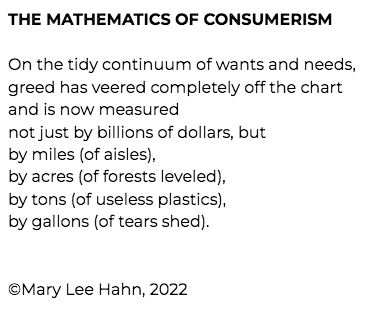
This month, Catherine challenged the Inklings to write a mathematical poem of any kind. Rather than choose a mathematical form, like a Fib or an Equation Poem, I went with a mathematical topic/vocabulary.
On Tuesdays and Thursdays, AJ and volunteer for our local resource center. We take their van and pick up donations from Target, Kroger, and the Pepperidge Farms outlet store. Experiencing retail from the loading dock and storeroom side has been an eye opener. We stand waiting for our cart of donations and ponder all that…STUFF in the back room of one store in one city and when we multiply that by all the stores in all the cities, our minds are blown by what it takes to fill shelves so that consumers can satisfy their every want and need.
Here’s how the rest of the Inklings interpreted Catherine’s challenge:
Texts for this Text Set have been posted daily on Instagram.
Follow @TextSets there to get daily updates!
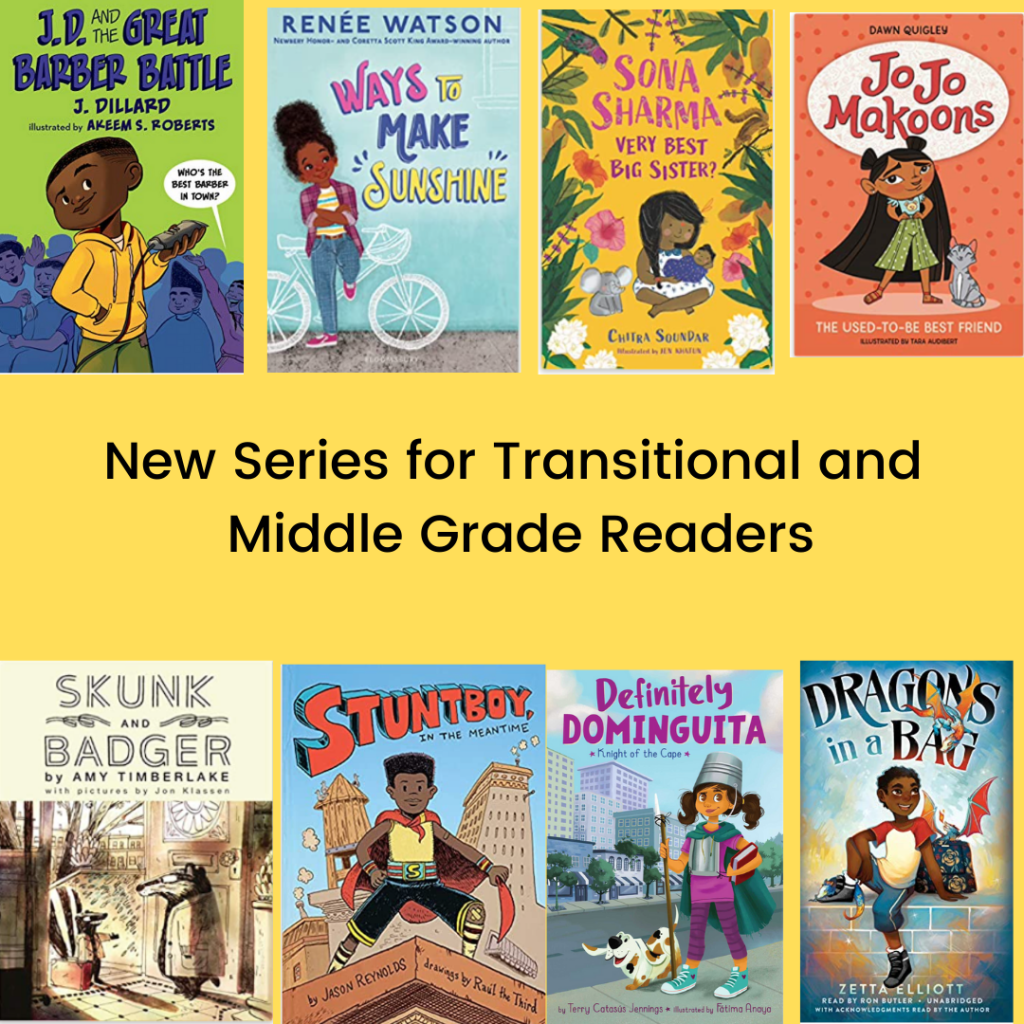
There is nothing like the day when a new book is released that is part of your favorite series. When I was in elementary school it was the Betsy books. Series books are so important for so many readers. And, being in-the-know about a new book by a favorite author or one that features a favorite character is such fun. This week, we’ll take a look at series books that are newish–series that have a few books at most–series that have us already looking forward to the next book. These books are perfect for transitional and middle grade readers.
If you have not read Stuntboy: In the Meantime by Jason Reynolds and Raul the Third, you must read it asap! This is a great new book in a hopefully long series. This is going to be perfect for our Diary of a Wimpy Kid and Captain. Underpants readers to expand a bit in their reading. This book has everything-great story, incredible illustrations, real issues to discuss, strong characters and humor. There is so much to this book and series–I am excited for our middle grade readers!
These three new series (Sona Sharma, JoJo Makoons, and Definitely Dominguita) feature strong girls who bring fun and humor to their stories. I love each of these characters. I also love that the books are all heavily illustrated and are perfect for transitional readers in grades 2-3 especially. I often find it hard, as an adult to fall in love with books for this age but I fell in love with the writing and with these 3 characters. Although perfect for grades 2-3, they are really great stories for all ages. Sona Sharma and JoJo Makoons have 2nd books coming soon and Definitely Dominguita has 3-4 titles available now.
I loved the Ryan Hart series from the start and was so happy to see Renée Watson writing for a younger audience! Ryan Hart is a great character and these books are perfect for 3-5th graders. This series will have wide appeal. I think there are 2 out in the series (Ways to Make Sunshine and Ways to Grow Love) with another coming soon!
Dragons in a Bag is another series I’ve loved from the start. Fantasy is not an easy genre when it comes to transitional series books but this one is perfect. I love the length of these books as well as the characters and the stories. It is a perfect series for readers ready to start some more sophisticated books and who love fantasy. It is brilliantly done for this age. I think there are 3 available now with hopefully lots more to come!
Skunk and Badger and J.D. the Kid Barber are two series full of humor. For our readers who love humor, these are great picks. The humor is different in each but perfect for the age. (I am always amazed at authors who get humor for this age so right!) Just like a few of the others I’ve mentioned, even though they are written for transitional readers, older readers will also enjoy these. I love the characters in both of these series. The J.D. series has 3 books available now and Skunk and Badger has 2.
This week’s books were linked at Bookelicious. If you don’t know Bookelicious, check it out today. It is an online independent children’s bookstore with an incredible selection of children’s books and many supports for young readers. Lots of great free events for teachers coming up that you can check out and register here.
Follow @TextSets on Instagram for daily books/weekly text sets!
Early this month, I had the good fortune to attend a Zoom session hosted by Georgia Heard, with George Ella Lyon as the special guest. I jotted PAGES of “George Ella Gems,” then typed them up and cut them apart. I had a draft I liked, but then this morning, I didn’t like it. Easy enough to create a new draft! An unspoken sub-challenge this month was to put your poem into Canva. Here’s my draft for now:
Irene has this week’s Poetry Friday Roundup at Live Your Poem, where you can “overhear” lots of poetry talk!
In February, the Poetry Sisters are going to try one or more Exquisite Corpse poems. We’re not sure exactly how we’re going to do them, and there’s a lot of wiggle room. Read about them, and then figure out how YOU’D like to use or be inspired by the game. We’ll share our poems on Feb. 25th, and you can, too! If you share on social media, use the hashtag #PoetryPals. We can’t wait to see what you (and we?) do with this! Have fun!
Texts for this Text Set have been posted daily on Instagram.
Follow @TextSets there to get daily updates!
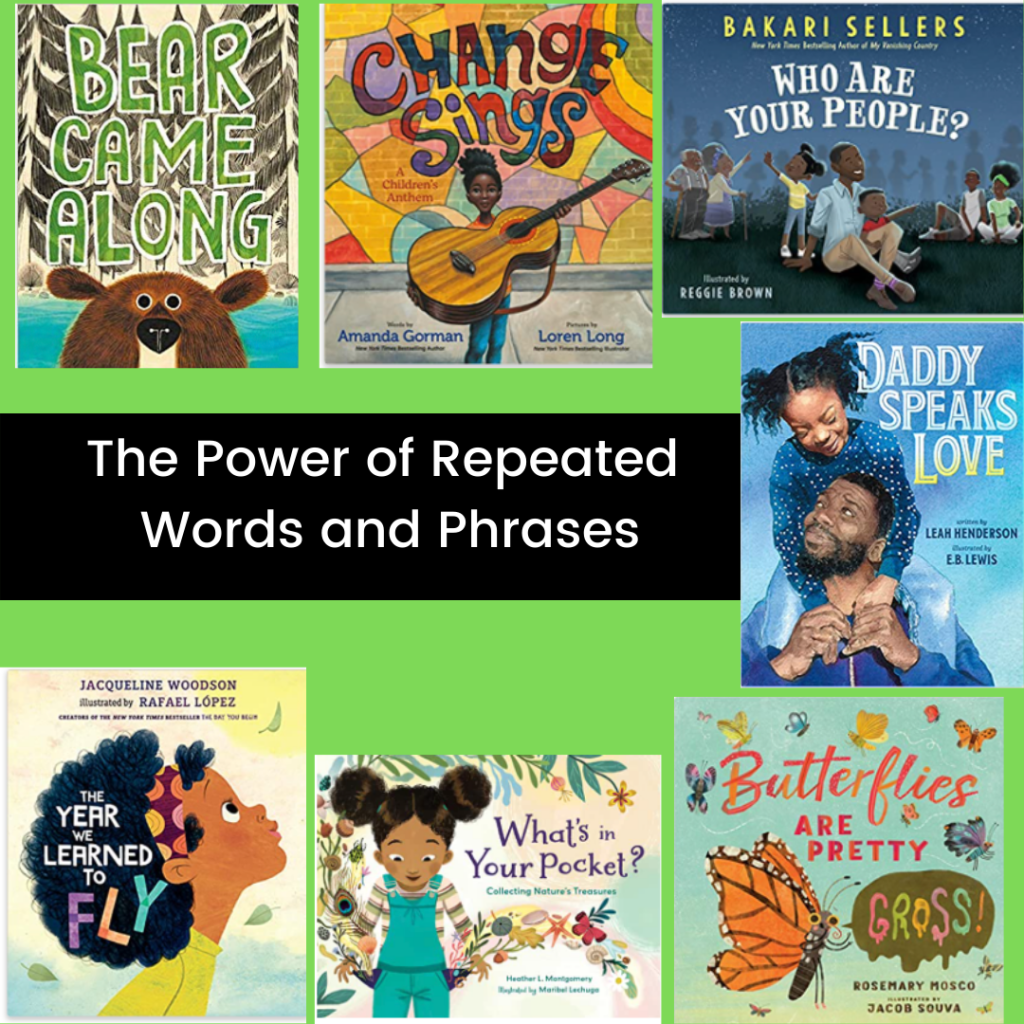
This week, we take a close look at the ways writers use repeated words or phrases for a variety of reasons. Repeated words give readers a clue that the words are important and an invitation to think about how. Writers use repeated words and phrases in a variety of ways to make sure their message comes through. The books shared this week can serve as invitations for these kinds of conversations with young readers and writers. Readers will have new strategies for deeper understanding. Writers will have lots of new ideas to try in their own writing.
Who Are Your People by Bakari Sellers is anchored on two phrases–“Your people were..” and “You are from…”. Each spread finishes one of these phrases. I’d start with a book like this because the repeated phrase is easily visible to readers because it is on every single page. This book invites readers to think about the meaning the phrases have the first time they hear them in the book and then how the meaning expands as they continue to read it over and over in new contexts. Often a writer repeats a phrase that we can think more deeply about every time it is used.
Butterflies are Pretty…Gross! is another book that has very obvious repeated phrases. So this shows the same idea in a nonfiction book. The phrase “some butterflies”/”some caterpillars” is repeated to let us know some “top secret” information about caterpillars. The repeated phrase reinforces that what we thought we knew about butterflies isn’t always complete. Each time the phrase is used, we learn something new. This book is humorous so the humor that goes along with the repeated phrase is worth studying too.
This newest book by Jacqueline Woodson, The Year We Learned to Fly is gorgeous and important. It is one that belongs in every classroom and library. Often a phrase is repeated by an older relative or friend and often that advice has meaning that is beyond literal. In this book, the characters’ grandmother repeats a phrase that begins “Lift your arms, close your eyes.” during difficult times. Each time she shares this wisdom, the children learn and grow. Through the children’s eyes, we can learn the bigger meaning of these words. The author’s note at the end is also important. This poetic book is filled with beautiful language and powerful words that can be studied as readers and writers.
Sometimes writers use repeated phrases throughout a book to give the reader a clue about what is coming next. Writers do this in both fiction and nonfiction. In What’s In Your Pocket? the author uses the phrase “Nobody knew…” to transition from each scientist’s childhood to their adult contributions and passions. In Bear Came Along, the word “until…” appears at the end of a spread letting us predict what is coming next. I like to show young writers how this move can be used in both fiction and nonfiction in different ways, but for similar purposes.
I just discovered Daddy Speaks Love and it is a new favorite. The repeated phrase Daddy speaks is followed by a word and an experience children have with their daddies. In poetic language the phrase plus the word says so much. The word speak is uses in a way beyond literal and each word choice is critical to the meaning of the book. Change Sings repeats a phrase “There is _ where my change sings” or something very similar throughout. Each single words adds new meaning to the whole. I think both of these phrases can be studied within the context of the text and can also be studied when thinking about theme and overall message of each book. These are more sophisticated uses of repeated phrases.
This week’s books were linked at Bookelicious. If you don’t know Bookelicious, check it out today. It is an online independent children’s bookstore with an incredible selection of children’s books and many supports for young readers. Lots of great free events for teachers coming up that you can check out and register here.
Follow @TextSets on Instagram for daily books/weekly text sets!
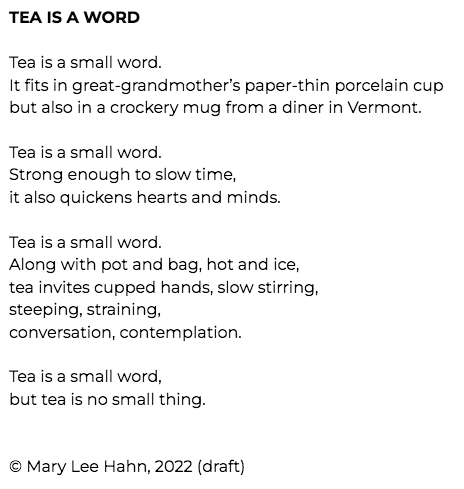
I sipped my morning tea today while dunking a just-made-yesterday spicy gingerbread biscotti. As the book title in the Unsplash photo by lilartsy says, “Life is good.”
Tabatha has this week’s Poetry Friday roundup at her blog with the fantastic name: The Opposite of Indifference.
Texts for this Text Set have been posted daily on Instagram.
Follow @TextSets there to get daily updates!
Happy New Year! This year, when I know lots of classrooms are getting ready to start thinking about informational reading and writing, I decided to kick off 2022 with some of my favorite nonfiction poetry books. I think there is so much that informational poetry can do for us as readers and writers. Poetry invites us in to think about important topics in new ways. And it gives our students new ways to think about how to write informational pieces. I love the books that combine poetry with other forms of writing too,
The books in this series (Where in the Wild, Where Else in the Wild, What in the Wild) were some of the first informational poetry books I discovered. These are great for introducing nonfiction poetry to children because of the “I Spy/Look and Find” feature of each page. The poems in this book give information and the word choice and descriptions are incredible. As a reader, lots of inferring happens. As a writer, so much to learn!
I am so not a fan of chapter book biographies for elementary students. I prefer picture book biographies because our students can read across texts, learn about lots of people and do more in-depth work when they aren’t reading a chapter book series biography. I put biography poetry right up there with picture books. I love what books like Bravo and Shaking Things Up provide. Not only do we learn about several different people and their impacts but we learn about how an anthology works as it is around one topic or idea. The writing in both of these are incredible and many readers will find a person or two who they’d like to research further. And books like this also tend to have great author’s notes with more info. I hope we can all rethink whatever work we do with biographies and think about the goals and the types of books that best meet the goals biography reading. #biographies
No Voice Too Small and Voices of Justice would be great follow-up reads to yesterday’s titles. Both of these books focuses on people working toward justices. The writing style is different and the focus is a bit different in each so these would invite many conversations. So many pieces beyond the main poem on each page. Both of these books would be great to study in-depth.
In the Spirit of a Dream is my newest favorite poetry book. This book celebrates 13 American Immigrants. I loved reading about people I knew and people whose stories were new to me. The illustrations in this book are worthy of study as well. This is one of those books that I see being in every K-12+ classroom as there are so many entry points for readers, writers and illustrators.
The Last Straw has been on a few #TextSets because I love it. The way Susan Hood combines poetry and information is brilliant and there is so much packed into this one book, with poetry as the anchor. And this would invite an interesting discussion on the ways the poems were put together, the overarching topic and theme of the whole, etc. This book can be studied as a whole or individual spreads can be looked at individually.
This week’s books were linked at Bookelicious and/or Cover to Cover Children’s Bookstore. If you are looking for a fabulous local children’s bookstore to support, Cover to Cover is an amazing one. We are lucky to have them in Central Ohio! If you don’t have an independent children’s bookstore in your town, check out Bookelicious. They are an online independent bookstore for children with an incredible curated collection.
Follow @TextSets on Instagram for daily books/weekly text sets!
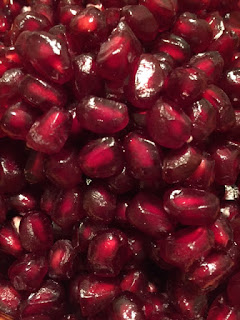
Pomegranates are one of my very favorite fruits. Mom was an adventurous eater, and she did everything she could to pass this along to my brother and me. Whenever an unusual fruit or vegetable showed up in our small-town Safeway grocery store, she would buy it for us to try. Good memories.
Now it’s time to savor this week’s poetry offerings! Click here to add your link, and enjoy all the goodies! (EDITED TO ADD: Please forgive the messy, ad-filled link up. I could not for the LIFE of me get Mr. Linky to cooperate. I should have just gone old school.)
EDITED TO ADD: I can’t stand this linkup. Here are the links without you having to wait five seconds to see the blog post. Ugh.
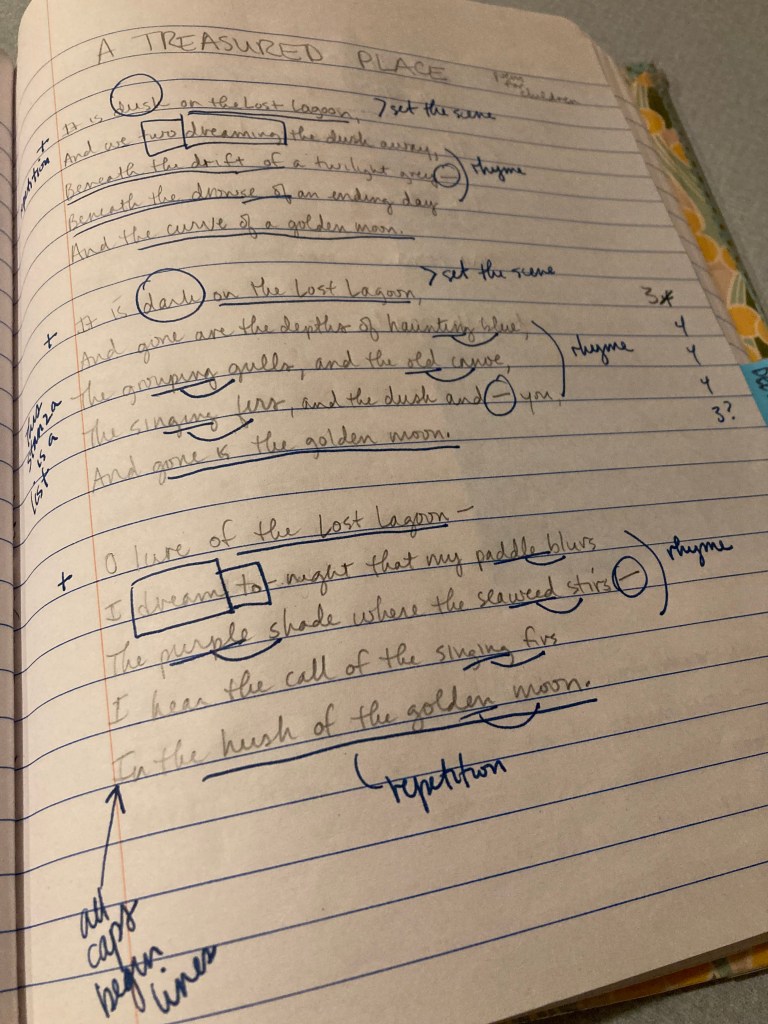
Heidi gave the Inklings a tough challenge this month. She suggested that we use the “The Lost Lagoon” by Mohawk poet, Emily Pauline Johnson (d. 1913) “to build your own poem FOR CHILDREN about a treasured place that you return to again and again (geographical or metaphorical).”
The first thing I did was copy the poem into my notebook and “unpack” the poem the way we used to do weekly in my classroom. As you can see, there’s a LOT going on in this poem!
What wasn’t hard was picking my topic — the swimming pool. What WAS hard was writing a poem “FOR CHILDREN.”
Here’s how the rest of the Inklings interpreted Heidi’s challenge:
There are my favorite bells in music, “The Bells of St. Geneviève”…
…and my favorite bells in film…
…and my favorite classic bell poem which contains my favorite bell word: tintinnabulation. (I so wanted to include that word in my own bell poem, but it was not to be.)
I was all over the place trying to write my bell poem this month, but my drafts kept getting closer and closer to my heart, until this memory emerged:
Carol Wilcox, at Carol’s Corner, has this week’s final Poetry Friday roundup. Let’s hold her, and all of those in the Denver area who are reeling from the recent wildfires, close in our hearts.
There are bound to be lots of bell poems around the roundup, ringing in the New Year. I can’t wait to read them all! Check out what the other Poetry Sisters came up with:
Buffy Silverman has the Christmas Eve edition of the Poetry Friday roundup. Thanks, Buffy! Merry Christmas to all who celebrate, and to those who don’t, Happy Solstice!
Next Friday, the Poetry Sisters will be showcasing our poems that feature bells. Do join us, please!
Photo credit: Martin LaBar, Creative Commons photo on Flickr












 A(nother) Year of Reading