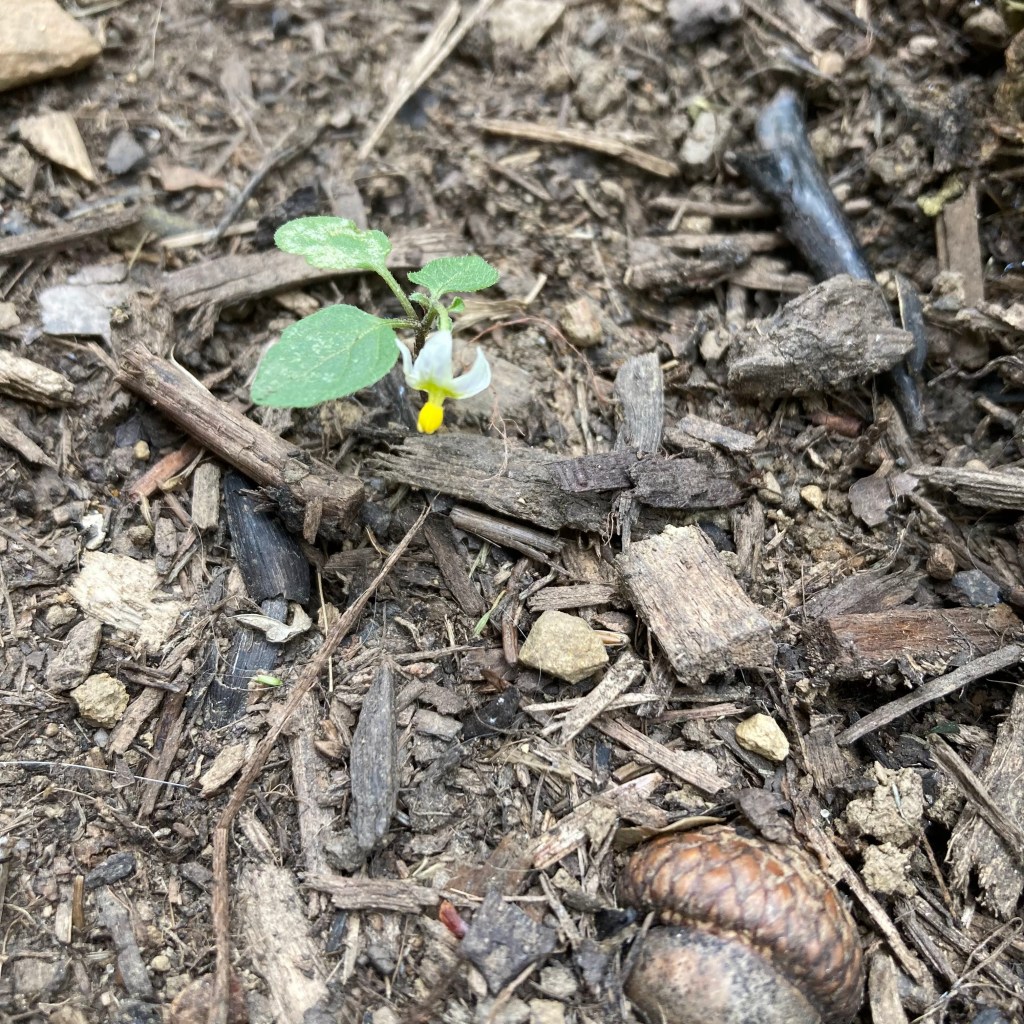
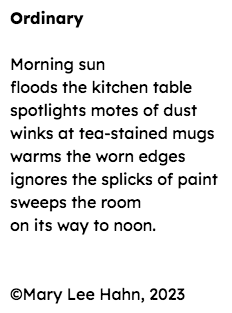
This is my prayer for the world: may you have a day or at least a moment of ordinary. In the midst of cleaning acorns out from under the cranberry viburnum, may you find the smallest flower ever. Sitting at your kitchen table, may you have a moment to notice the way the sun moves through the room and perhaps write about it. May the cat wake you up way too early, just like usual, but may you get another hour of sleep before the alarm goes off.
For the people of Ukraine, Afghanistan, Palestine, Israel: I see your unimaginable suffering, and from my place of privilege I offer the most humble prayer from one human heart to another: today may you have at least a moment of ordinary. And may someone in your life bring you the love and caring I’m feeling for you now.
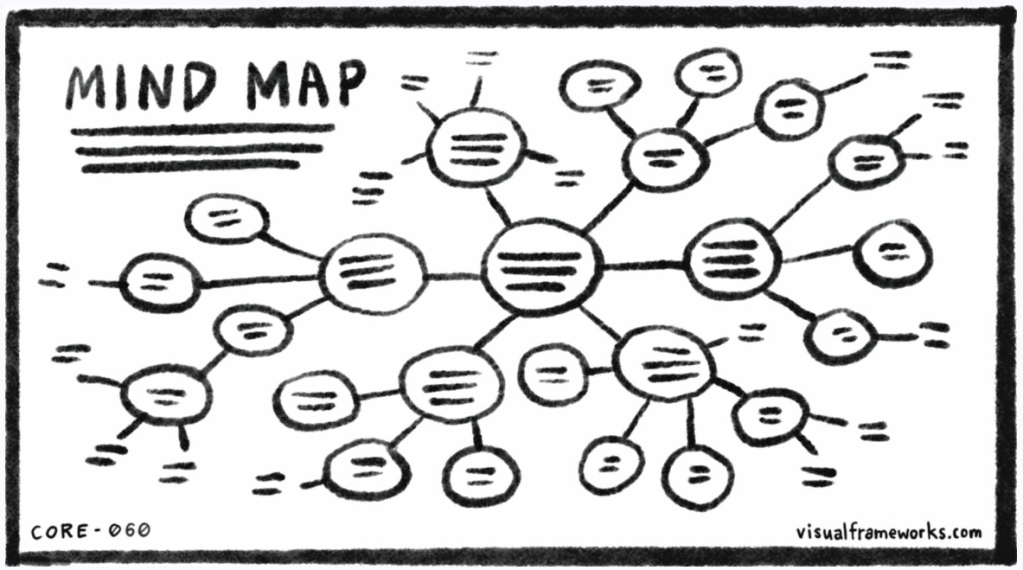
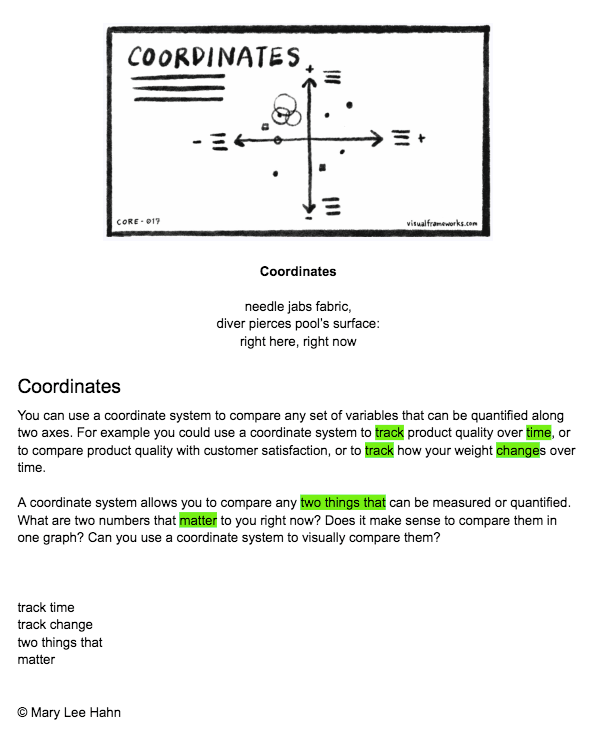
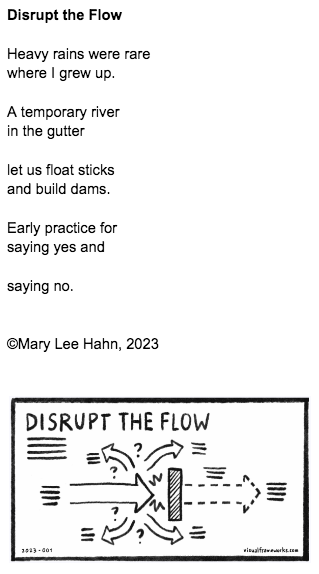
When I ran across the Visual Frameworks site, I immediately added it to my list of possible prompts for the Inklings. Not only are the visuals compelling, the text that follows each is thought-provoking.
My first drafts explored all the possible ways to use a framework. For Coordinates, I wrote a haiku based on the image, then an erasure poem from the text.
Matt has this week’s Poetry Friday Roundup at Radio, Rhythm & Rhyme. And there’s been a change for next week. On October 13, Catherine will be hosting at Reading to the Core.
The Poetry Sisters wrote diminishing verse poems this month. Thank goodness I got started early fiddling with drafts and studying mentor texts because the last couple of weeks have been a lot. In all good ways.
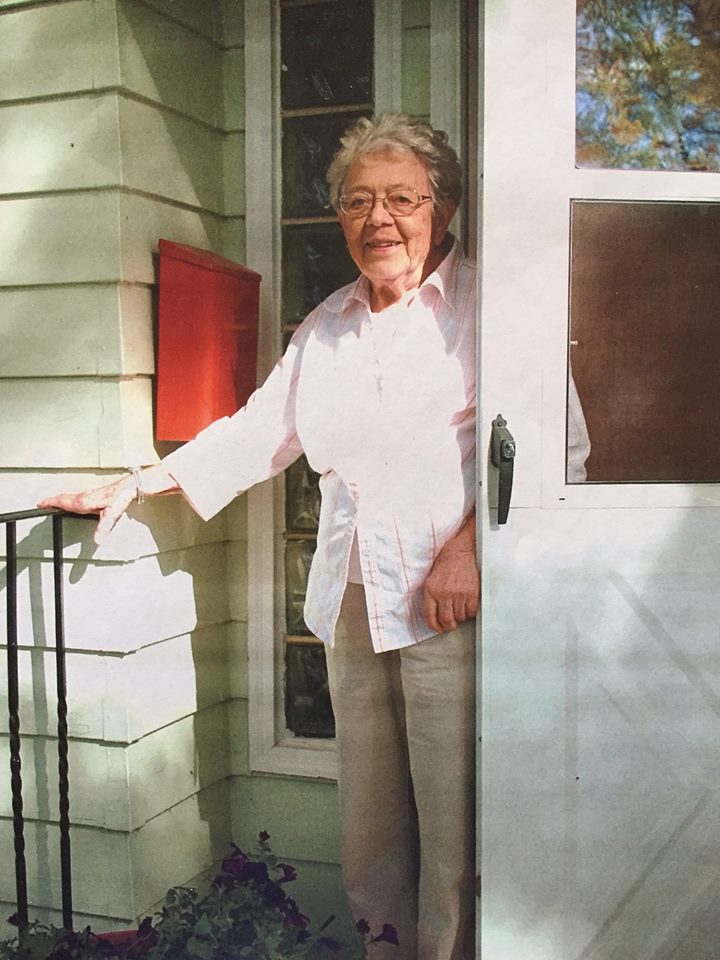
Seamstress is the first word that comes to mind. She sewed so many clothes: Easter dresses, guitar recital outfits, twirling competition costumes, matching Western shirts for Dad and David for the fair, doll clothes. All of this on a Singer Featherweight.
She was no chef, though she was a foodie through and through. I remember the smell of scorched lima beans, and the macadamia nuts she secreted away on a top shelf. For a treat, we had broiled spare ribs. I know now that “spare” is the word for “this is a treat even though there’s hardly any meat on the bone.”
She was a saver. A collector. Almost a hoarder. Miniatures, Hallmark house ornaments, glass boxes. And scissors. If I could turn back time, I would ask her – why so many pairs of scissors? Shears (sewing and pinking), embroidery, children’s, vintage, modern plastic-handled Fiskars, and so many manicure scissors.
She was a reader. Mostly mysteries, she bought books at the library sale by the sackful. A secret code in the back cover let her know if she’d already read the book and donated it back to the library.
She gave up salt when she was pregnant with me. I don’t think I can fully appreciate this sacrifice.
She bought me private swimming lessons when I was four because I wasn’t old enough for Red Cross lessons, but I was ready to swim.
She bought me private sewing lessons so we wouldn’t squabble (she the perfectionist, me the good-enough-ionist).
I don’t remember being swatted or spanked, but there was one memorable slap when I disobeyed and walked home from school in my good shoes and was sassy about what the big deal could possibly have been.
One winter, she drove with me out into the country to escape the lights of town so we could see the Ursid meteor shower. We lay on a blanket on the hood of the ‘60 Ford Falcon and watched shooting stars as the car’s engine warmed us, then cooled off until we had seen enough and were shivering.
By the end of her life, her body was covered in scars: hysterectomy, knee/hip/shoulder replacements, double mastectomy. Her soul was scarred by a hateful father and the early loss of her mother. She had a high pain threshold for all the kinds of pain she carried. She wanted for us the childhood she never had, failing to see us as individuals who needed our own childhoods, not hers.
I remember her standing at the kitchen sink, admiring the sunset, often calling me to come and see.
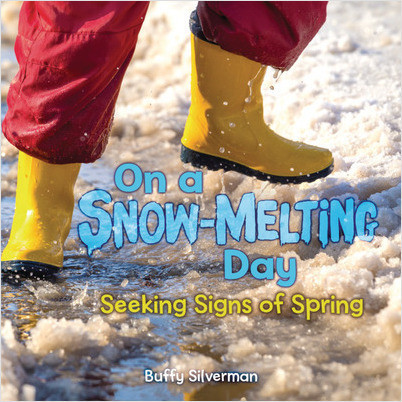
In 2020, Buffy Silverman took readers “puddle-sploshing” in On A Snow-Melting Day: Seeking Signs of Spring. Vivid photographs and a snappy rhyming text earned this book recognition as an NCTE Notable Poetry Book for 2021.
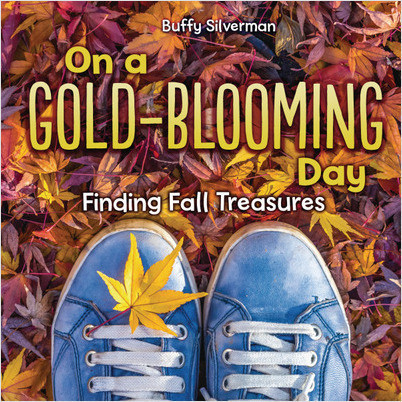
Then last fall, we wandered through forests and meadows, pausing at ponds to witness animals and plants in On a Gold-Blooming Day: Finding Fall Treasures, a 2023 CLA/NCTE Notable Children’s Books in the Language Arts, and a Children’s Book Committee at Bank Street College of Education Best Children’s Books of the Year for 2023.
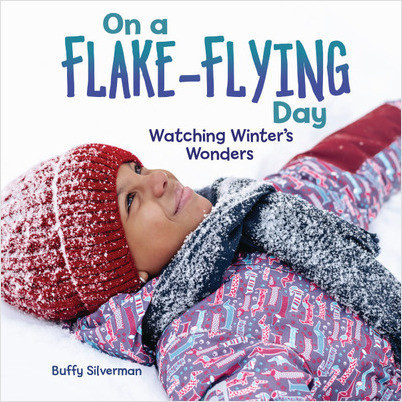
I missed getting to share “Snow-Melting” with students in 2020, but every one of my after-school kiddos loved “Gold-Blooming” last fall. I can’t wait to share “Flake-Flying” in a few months! Reading these books with small groups gathered close allows for time to study and talk about the photographs, to track the rhymes, and, when a question comes up, verify facts or vocabulary with the informational back matter and/or glossary. In a regular classroom setting, teachers could create a seasonal text set for each book using the titles listed for “Further Reading.” And in writing workshop, the books would make fantastic mentor texts for studying creative ways to hyphenate words as well as ways to craft leads and endings.
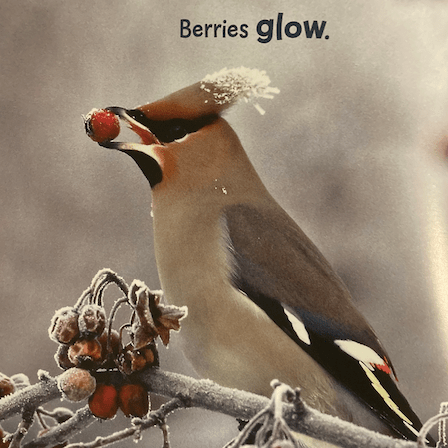
My favorite rhymes in ON A FLAKE-FLYING DAY are the ones that start the book off: “On a feather-fluffing, seed-stuffing, cloud-puffing day…” My favorite photo is the frosty-topped cedar waxwing practically posing with a berry in its beak:
And my favorite fact is that dragonfly nymphs prowl for minnows and other aquatic insects below the frozen surfaces of winter waters. (Dragonflies are amazing in all the stages of their lives!)
I asked Buffy to tell us a little bit about her process. I wondered if the photos came first, or the words. Here’s what she had to say:
Although I enjoy taking photographs, I’m really not a visual thinker. The words always come first for me–and then I hope that there will be a way to illustrate them! With this book I followed the pattern from ON A SNOW-MELTING DAY and ON A GOLD-BLOOMING DAY. In each of the books there are four sets of refrains (On a feather-fluffing, seed-stuffing, cloud-puffing day…) followed by three pairs of rhyming sentences (Weasel whitens. Cardinal brightens…) In each of the books I included sights and sounds from a field, a wetland, and a forest, and ended with a child outside, enjoying the season. Basically the books are the nature walks I would want to take with a child or other reader!
Lots of us in the Northern Hemisphere are looking forward to winter’s relief from this summer’s heat. Pre-order ON A FLAKE-FLYING DAY now so that come October 3, you will be guaranteed snow, ice, and frost…if only between the pages of Buffy’s newest (fantastic-as-the-other-two) book! Thank you, Buffy, for giving me this opportunity to help you spread the word, and thank you, Millbrook Press, for the review copy!
Amy has this week’s Poetry Friday roundup at The Poem Farm.
Those of you who were curious about what I had in mind for my poem last week, it was a combination of literal (a traffic jam of cars) but also metaphorical (life changes following retirement). I had loads of fun hearing what pictures the poem made in your minds and I’m SO glad I chose not to add an image!
I struggled with an image to pair with my poem. I didn’t want to activate in your imagination any particular situation. So I’m curious to know, what is this poem about…for you? Who is the “I”?
Margaret challenged the Inklings to study enjambment this month. This poem got started with the sneaky way I included in-jam-meant. Then I noticed I was writing in three-syllable lines, which sort of forced the issue of enjambment. So I cheated a little, but it was still interesting to notice which lines DO have a natural pause/stop and which lines are enjambed.
I found myself noticing enjambment as I finished the Sealey Challenge. This year, I discovered a new favorite poet, Kate Baer, thanks to the recommendation of I can’t remember which one of you. I am in AWE of the way she used enjambment in this poem:
Speaking of the Sealey Challenge, here are the books I read this past week: THE RED EAR BLOWS ITS NOSE by Robert Schechter (2 days), WHAT KIND OF WOMAN by Kate Baer, WHAT HAVE YOU LOST? ed. Naomi Shihab Nye, THE PARTING PRESENT by Manuel Iris (2 days), I HOPE THIS FINDS YOU WELL by Kate Baer, AND YET by Kate Baer (still in progress).
Speaking of enjambment and the Inklings, here’s what the rest of the crew came up with this month:
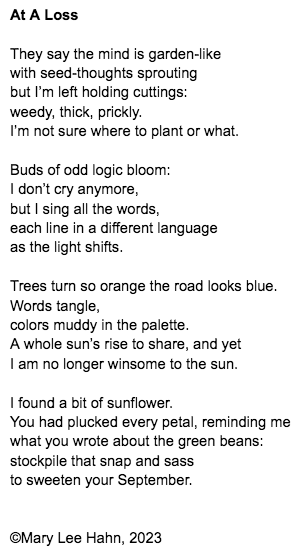
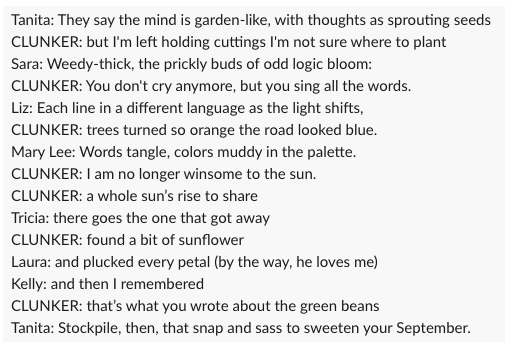
This month, the Poetry Sisters created an Exquisite Corpse poem. We wrote an original line, then chose a second line from Linda Mitchell’s clunkers. Tanita started us off, and then each poet saw only the lines written by the person before them in the process as she crafter her two lines. Only her two lines were sent to the next person. Tanita brought the process full circle with the final line of the poem. At our monthly meeting, we all typed our lines into the zoom chat, one at a time, and watched our poem unfold, amazed at how well it held together.
Sun and light, gardening and seasons weave their way throughout our lines. And any of those could be topics for poems I would write. But the poem I found within our lines is not a poem I would have written any other way. This is not my experience, not my feelings. And yet, it feels so true. I am left wondering how I can write more poems like this on my own, pushing myself out of the comfort zone of writing about the world in front of me and the feelings inside of me. A good challenge.
Here’s what the rest of the Poetry Sisters came up with this month. I’m excited to see how each of them kept/modified/jumbled/reimagined our original lines:
Linda B. has this week’s Poetry Friday roundup at TeacherDance.
Here’s what I read this week for the Sealey Challenge: WHAT IS A FRIEND and WHAT IS A FAMILY ed. Vardell and Wong, CHAMPION CHOMPERS, SUPER STINKERS by Linda Ashman, ANIMALS IN SURPRISING SHADES by Susan J. Taylor, POETRY BY CHANCE ed. Taylor Mali, TWO TRUTHS AND A FIB ed. Bridget Magee.
Next month, the Poetry Sisters are writing Diminishing Verse poems, aka Pruning Poems. There are some mentor text poems out there if you use your favorite search engine. Here’s our best suggestion: start gathering word possibilities NOW!
Last month, we went to the Japanese Festival at Dawes Arboretum east of Columbus. Their Japanese gardens are fabulous. I learned the difference between the dry garden shown above, and the wet garden. (Which really did have a turtle popping up its head!) I was honored when Margaret used this picture for This Photo Wants to Be a Poem.
Edited to add my Sealey reading for this past week: SINCE THE BABY CAME by Kathleen Long Bostrom, MY HEAD HAS A BELLY ACHE by Chris Harris, BLACK GIRL, CALL HOME by Jasmine Mans, TREE WHISPERS by Mandy Ross, BUGS by Shirley Raines, and two days with SOME GLAD MORNING by Barbara Crooker.
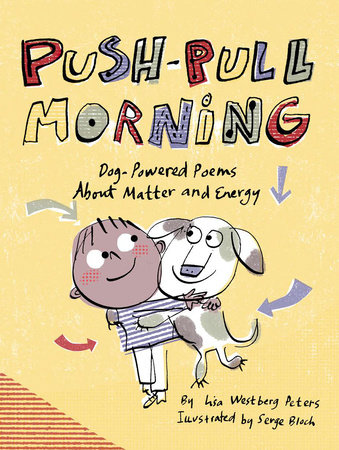
Search the Next Generation Science Standards and you will see that physical science concepts are taught beginning in kindergarten. Therefore, every elementary school teacher needs a copy of this book!
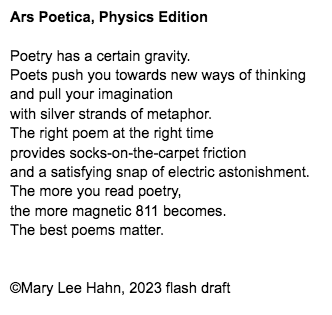
All of the basics of your physics science curriculum can be found between these covers, explained by a kid, a dog, and poetry: matter, phases of matter, motion, sound, force, inertia (both kinds), gravity, magnetism, energy, electricity, friction, relative motion, reflection of light, and even a paradox with which to end the book. The notes at the end of the book contain scientific language to explain each concept. Nineteen poems. A poem a week. Sweet (and FUN!) nibbles of physics for half the school year. Abstract concepts presented in a kid-friendly way, for effortless retention. Need I say more?
Tabatha has this week’s Poetry Friday roundup at The Opposite of Indifference (one of the most perfect blog titles EVER).
And here’s a quick update on this week’s Sealey Challenge books. Day 4: MUSICAL TABLES by Billy Collins, Day 5: COURAGE OUT LOUD by Joseph Coelho and PEEK-A-BOO HAIKU: A LIFT-THE-FLAP BOOK by Danna Smith, Day 6: ANIMAL ARK by Kwame Alexander, Day 7: PUSH-PULL MORNING by Lisa Peters, Day 8: worked the polls for the Ohio special election, Day 9: SOCCER QUEENS by Charles R. Smith, Jr., Day 10: WELCOME TO THE WONDER HOUSE by Rebecca Dotlich and Georgia Heard.
Catherine’s challenge for the Inklings this month struck a deep chord with me:
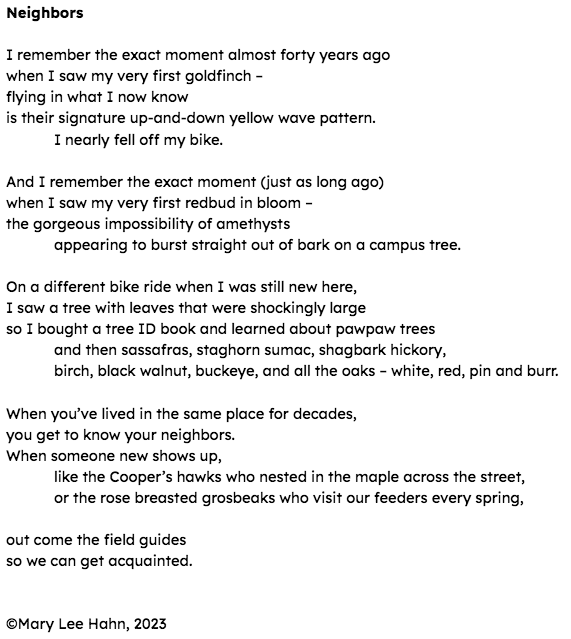
Robin Wall Kimmerer teaches us that “It’s a sign of respect and connection to learn the name of someone else, a sign of disrespect to ignore it…Learning the names of plants and animals is a powerful act of support for them. When we learn their names and their gifts, it opens the door to reciprocity.” Look closely at the flowers, birds, trees, or other natural features in your neighborhood (or if you’re traveling, a new-to-you species) and write a poem about your chosen species.
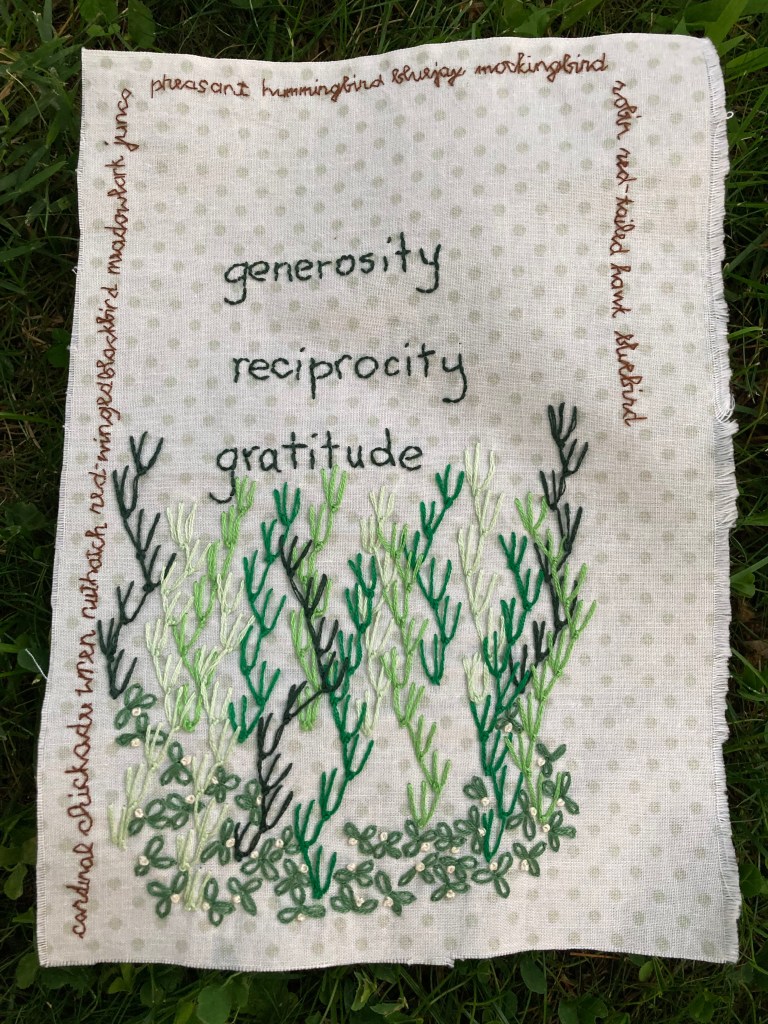
The in-progress embroidery piece illustrating this post will be part of a larger textile piece exploring Robin Wall Kimmerer’s ideas about what it means to be indigenous vs. an immigrant, and ultimately, the importance of naturalization, of “becoming indigenous to place.” (Read the chapter “In the Footsteps of Nanabozho: Becoming Indigenous to Place” in BRAIDING SWEETGRASS for more eloquent details on these ideas.) I hope my poem not only expresses my love for Earth and all her beings, but also the recognition that Earth loves me back, and expresses that love in the glorious diversity of plants and animals that she’s give me to know by name and to care for and about.
Here’s what the other Inklings came up with this month:
And here’s this week’s Poetry Friday Roundup! Add your link and enjoy the generous offerings of others!
PS: A quick Sealey Challenge update. Day 1: A WREATH FOR EMMETT TILL by Marilyn Nelson, Day 2: FELICITY by Mary Oliver, Day 3: TODAY I AM A RIVER by Kate Coombs.




 A(nother) Year of Reading