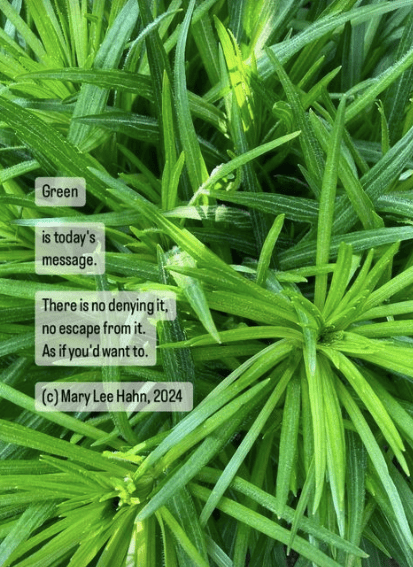
Molly gave the Inklings our June challenge — a quote from a talk by Pádraig Ó Tuama. Molly reported that essentially he said, “Write something narrative and by narrative I mean something that has story and observation to it…write about the first time you saw somebody who’s become a you to you…a you that you love to say…detail what else could be seen”… and let those other things convey what it all meant to you.
After listing all the YOUs in my life and writing about a bajillion drafts, I decided that my YOU for this poem would be the process of figuring out what to write about. My YOU is inspiration itself.
I’m scheduling this post on Tuesday because on Wednesday I leave for a week spent with family. I won’t be able to comment until it’s almost time for another Poetry Friday, but I still can’t wait to see what the other Inklings do with this challenge.
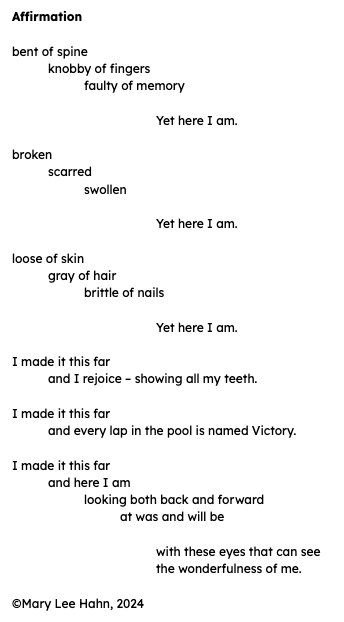
The Poetry Sisters’ challenge this month was to write in the style of Lucille Clifton’s homage to my hips, and choose our own body parts to pay homage to.
Listen and watch as she reads her poem. That grin (almost a smirk) tricks you into thinking she’s poking fun at herself, but nothing could be further from the truth. She writes against ageism and sexism and racism. Her phrase “I like to celebrate the wonderfulness that I am” became my battle cry. I am who I am who I was who I will be, but I AM HERE! Against all odds, I have come this far, and I’m going to carry on singing at the top of my voice…well, insofar as an introvert can manage, at least.
Here’s what body parts the rest of the Poetry Sisters are celebrating:
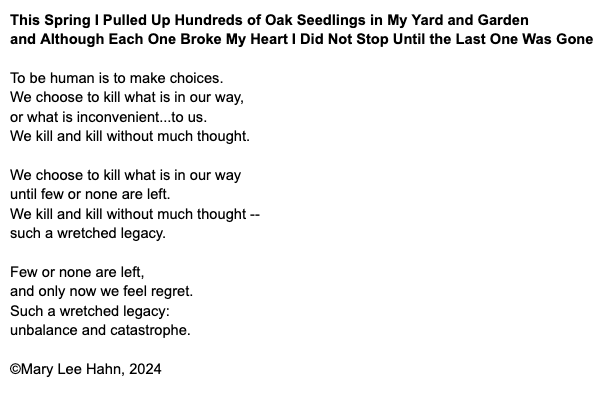
I am conflicted by what it means to be human. Some days more than others, but this month is one of those days. And wouldn’t you know it, my poem of the day today from Jane Hirshfield is “Let Them Not Say,” which just serves to reinforce these feelings. I am also listening the The Anthropocene Reviewed by John Green which probably fuels this conflict as well. Not probably, certainly.
We have done so much harm, and yet we do so much good.
We kill and kill and kill, and yet there are five no longer invisibly small black swallowtail caterpillars sprinkling frass on our kitchen table from atop the fennel in the drinking glass.
We break so much, and yet we can dedicate ourselves to repair, and gather around picnic tables in a community garden to form a mending circle so we can repair beloved articles of clothing and dream other forms of repair into being.
I am an animal, an omnivore, and therefore other plants and animals have died so that I can live.
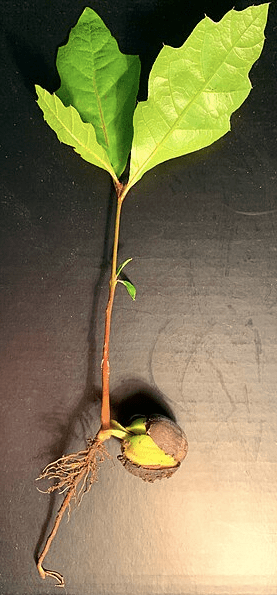
I know that our oak and our neighbors’ oaks send way more acorns out into the world than could ever possibly survive (even if this were a forest and not a neighborhood). I do not mourn all the possible oak trees that were eaten by squirrels and deer or that fell on pavement and rolled away down the street. But I do mourn the ones whose brief lives I ended with my weeding fork.
What to do about this existential conundrum? I guess the only thing to do is to go on. And to do the best we can in spite of what we, as an individual and as a species, are and have been. Do the best we can do. Which Kate DiCamillo would say is to have a “capacious heart.”
Michelle has a capaciously generous Poetry Friday roundup post that is bound to fill you with way more hope and joy than mine!
Thank you to Two Writing Teachers for creating an amazing community of writers and a safe, welcoming space to write and share.
I have this thing for books that make me cry. When I was in middle school, Sunday afternoons were for kicking back on my bed and rereading LITTLE BRITCHES or WHERE THE RED FERN GROWS or OLD YELLER or LOVE STORY or CHARLOTTE’S WEB and letting the tears roll down my cheeks and into my ears even though I knew what was going to happen. Maybe especially because I knew what was going to happen.
I recently listened again to Krista Tippet interview Kate DiCamillo (On Nurturing Capacious Hearts) and Kate (in a response to an essay by Matt de la Peña) gave me the words for why I love books that make me cry:
“My childhood best friend read Charlotte’s Web over and over again as a kid. She would read the last page, turn the book over, and begin again. A few years ago, I asked her why.
“‘What was it that made you read and reread that book?’” I asked her. “‘Did you think that if you read it again, things would turn out differently, better? That Charlotte wouldn’t die?’
“‘No,’” she said. “‘It wasn’t that. I kept reading it not because I wanted it to turn out differently or thought that it would turn out differently, but because I knew for a fact that it wasn’t going to turn out differently. I knew that a terrible thing was going to happen, and I also knew that it was going to be okay somehow. I thought that I couldn’t bear it, but then when I read it again, it was all so beautiful. And I found out that I could bear it. That was what the story told me. That was what I needed to hear. That I could bear it somehow.’”
Go listen to the whole interview. Both Kate and Krista are wise and funny and generous.
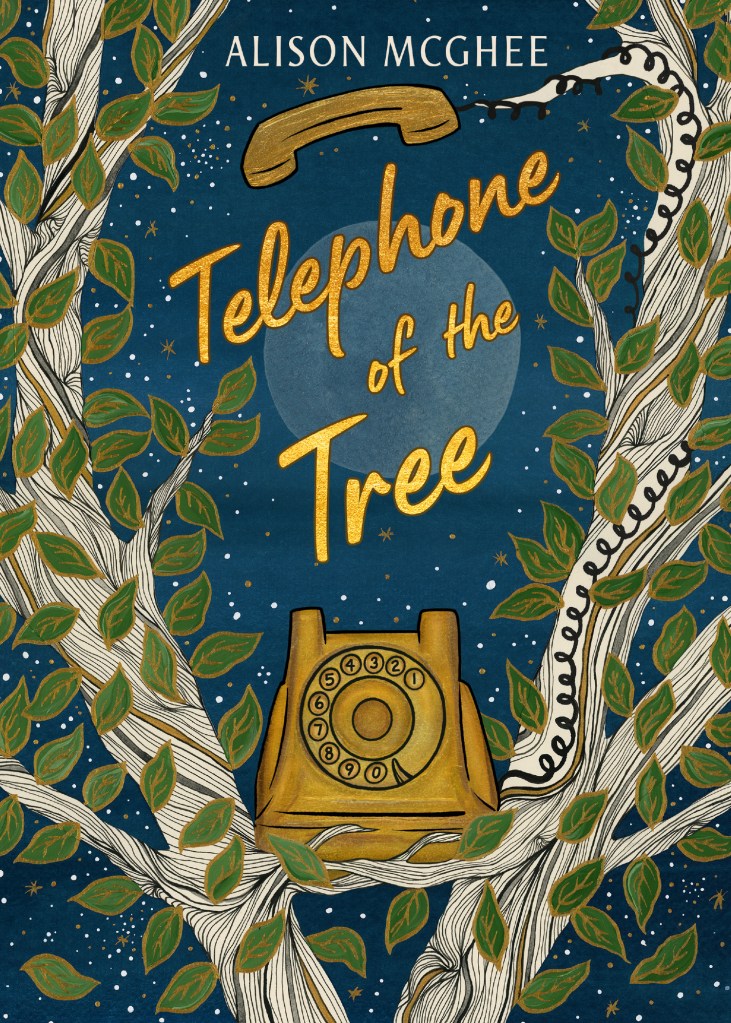
And if you wonder why the world needs TELEPHONE OF THE TREE, a book about a grief so palpable I dare you not to feel it and weep, it’s so that every reader has access to what Ursula Le Guin calls our Operating Instructions and what Rudine Sims Bishop called windows, mirrors, and sliding glass doors.
Here’s more about Ursula Le Guin’s essay “Operating Instructions” from which Kate quotes “The reason literacy is important is that literature is the operating instructions. The best manual we have. The most useful guide to the country we’re visiting, life.”
Here is Matt de la Peña’s essay in Time Magazine, and here is Kate DiCamillo’s response (although you can, alternatively, read it in the transcript of the interview with Krista and not be bothered by the ads).
Thank you to Two Writing Teachers for creating an amazing community of writers and a safe, welcoming space to write and share.
The rose-breasted grosbeaks are back.
I checked back in the current five-year diary (I’m in year two) and in the ten-year volume that came before and found that last year the rose-breasted grosbeaks appeared on May 9, and their first appearance ever was six years ago in May of 2018. (Reading back through my snippets from May of 2021, the end of my last year of teaching, was a bit of a rabbit hole…)
You’ve noticed that there are no rose-breasted grosbeaks in the photo. They seem to be more wild than our usual visitors. They came several times while I stood there waiting with my camera, but just the sight of my outline through the glass door was enough to send them winging right away.
While I stood there, I was thinking of Famous, by Naomi Shihab Nye, and what a privilege it is to be famous to these gorgeous birds for our suet feeder. And to the early hummingbirds who come to the coral bells you can see peeking in the left side of the picture. Also to the black swallowtails who know they can find fennel, the monarchs who know they can find milkweed, and the lightning bugs who can thrive in a chemical-free yard.
Linda gave us our May challenge. After spinning the wheel of chance that paired us up with another Inkling, we sent off a poem and received a poem. Then, we were tasked to “Fiddle with, play with, tinker, tear-apart, be inspired or stumped by the poem.”
Here’s what Heidi sent me:
Every day I see or hear something that more or less kills me with delight, that leaves me like a needle in the haystack of light. ~Mary Oliver
Golden Haystack
It’s not common, it’s not every day I come across words in which I see sparks or hear a sounding something that opens the locked box of a poem. This one more or less demands that I pry at buried boxes, more or less kills me. This year delight will not stay with me. I can see it, hear it, feel the gauze of delight that surrounds me; I try to hold it but it leaves me like a pin dropping, like a coin rolling, like a sharp momentary needle in my arm. I am vaccinated against joy. I search the haystack daily for shine, ordinary evening stealing the keys of light.
Heidi Mordhorst 2021
Is that not the most perfect encapsulation of what The COVID Year was like? How our creativity was muffled and elusive?
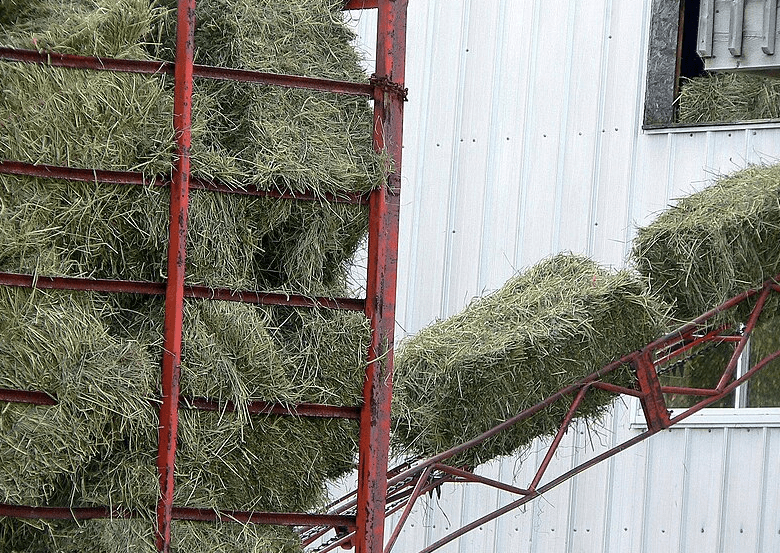
I chose to respond to Heidi’s Haystack with some hay bales (a bit like last week’s pebbles), created from handfuls of straw, first from her poem, and then from the Mary Oliver quote.
Golden Hay Bales
There will always be this – even in a year devoid of delight, when hope will hide its face behind a mask, not letting me remember to cup my hand around its flame – I can stay as malleable as the candle with wax dripping, flowing, creating a new me.
.
a loaded paintbrush, a sharpened pencil, a threaded needle – all poised in the hand of the maker – her thoughts a loosely massed haystack of hope, an undulation of light.
.
Stymied by introspective search, brushing off the chaff from life’s haystack of daily human indignities, I head for the garden and its abundance of hopeful shine.
.
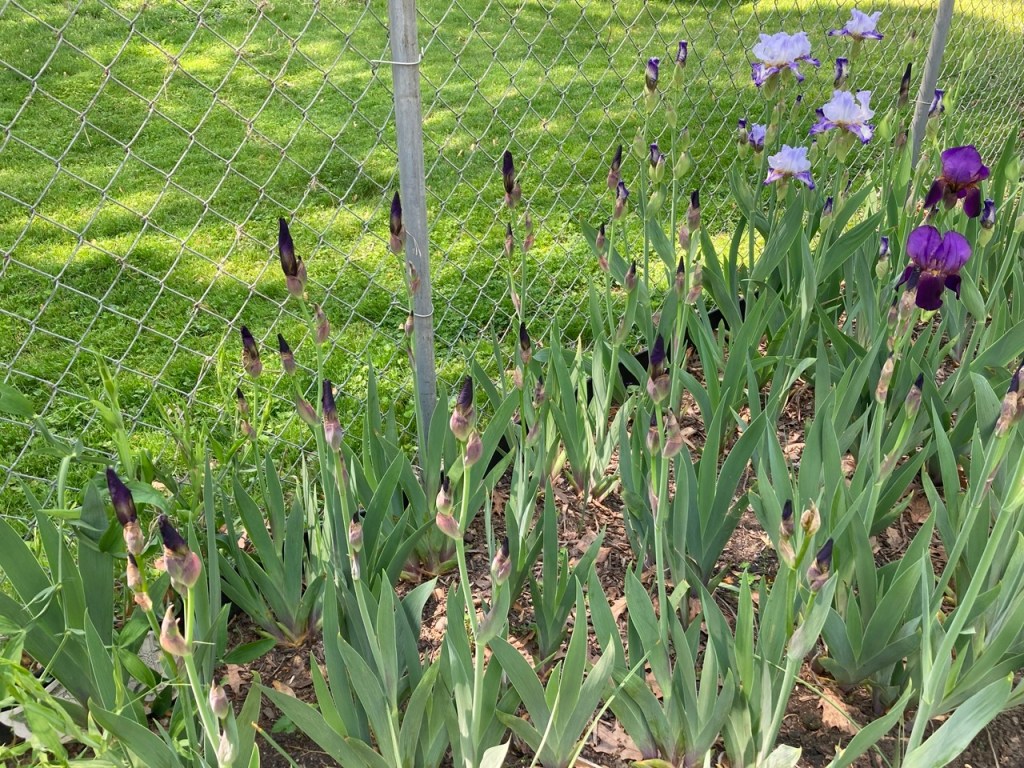
Like a crowd bearing purple-flamed torches, every iris in the bed is poised to bloom. Any day now I will wake to see the torches flaring open like firework explosions or a hopeful chorus of purple joy I can and yet cannot hear.
Buffy Silverman has this week’s Poetry Friday roundup. And because I had a small brain lapse when I put out the call for roundup hosts last December, leaving off June, here is the call for roundup hosts June – December 2024.
The hay bale image is from Wikimedia Commons. (Do you know how hard it is to find pictures of old-school rectangular hay bales? They’re all round now!)
* * *
Edited on Thursday evening to add…a bunch of the torches have flared open. I wish this photo had smell-o-vision!
It’s that time again. Six-ish months have passed since last we queued up to host the Poetry Friday roundups.
What is the Poetry Friday roundup? A gathering of links to posts featuring original or shared poems, or reviews of poetry books. A carnival of poetry posts. Here is an explanation that Rene LaTulippe shared on her blog, No Water River, and here is an article Susan Thomsen wrote for the Poetry Foundation.
Who can do the Poetry Friday roundup? Anyone who is willing to gather the links in some way, shape, or form (Mr. Linky, “old school” in the comments, or ???) on the Friday of your choice. If you are new to the Poetry Friday community, jump right in, but perhaps choose a date later on so that we can spend some time getting to know each other.
How do you do a Poetry Friday roundup? If you’re not sure, stick around for a couple of weeks and watch…and learn! One thing we’re finding out is that folks who schedule their posts, or who live in a different time zone than you, appreciate it when the roundup post goes live sometime on Thursday.
How do I get the code for the PF Roundup Schedule for the sidebar of my blog? You can grab the list from the sidebar here at A(nother) Year of Reading, or I’d be happy to send it to you if you leave me your email address.
Why would I do a Poetry Friday Roundup? Community, community, community. It’s like hosting a poetry party on your blog!
Put your request in the comments (blog URL is appreciated) and I’ll update the calendar frequently. Feel free to share this post on all the various socials.
Thank you to Two Writing Teachers for creating an amazing community of writers and a safe, welcoming space to write and share.
My job title for the after school program is “Reading Specialist,” but I much prefer “Reading Enricher” or “Lead Reader.” I am blessed with the freedom to be creative and to choose the books I share (and ostensibly, the lessons I teach.)
We spent National Poetry Month immersed in poetry. I chose matching pairs of poems by two of my favorite children’s poets, Douglas Florian and David Elliott. Their poems are similar: usually funny, often with puns or word play, and short enough to be just the right size for the small amount of time I have at each of my sites. I created a tournament bracket that pitted Hummingbird against Hummingbird, Barn Cat against Persian, Giraffe against Giraffe and Stegosaurus against Stegosaurus.
As we read and discussed the poems before voting, the lessons of the children’s classroom teachers shone through their comments. The children identified and celebrated rhythm and rhyme. A third grader compared simile to metaphor. A fifth grade boy praised one poem’s hyperbole. Two fifth grade girls traded lines as they recited William Carlos Williams’ “The Red Wheelbarrow.” Kindergarteners identified (and preferred) the more positive message in Elliott’s “Stegosaurus:”
“…there’s some- thing more to life than just intelligence.”
In the end, “Barn Cat” by David Elliott won the first side of the bracket, and Douglas Florian’s “Stegosaurus” won the second side. So it was
The Barn Cat by David Elliott
Mice had better think twice.
versus
Stegosaurus by Douglas Florian
Ste-go-SAUR-us Her-bi-VOR-ous Dined on plants inside the forest. Bony plates grew on its back, Perhaps to guard it from attack. Or to help identify A Stegosaurus girl or guy. Its brain was smaller than a plum. Stegosaurus was quite DUMᗺ.
A group of older students at one of the sites helped me brainstorm a list of the qualities of poems to guide the final voting away from choice based on a favorite animal or illustration and towards rhythm, rhyme, word choice, details, and message: poems that make you think, poems that surprise you.
By a vote of 25 to 19, “Stegosaurus” by Douglas Florian won. It was valued most for its rhythm and rhyme, and for the humor in the surprising word choice at the end. “Barn Cat” owed its strong showing to the rhyme, the realism, and the way the reader has to think in order to understand the poem and its humor.
all those years walking in early-morning dark — does Orion miss me?
* * *
I tend the trillium — oak’s companions since forest-time — do they know me?
* * *
insect on the car — we’ve never met before now — did you choose me?
* * *
leaf-footed bug — Leptoglossus oppositus — what name do you call yourself?
* * *
full moon wakes me — my face, briefly bathed in moonbeams — do iris buds feel it, too?
(c) draft, Mary Lee Hahn, 2024
.
The Poetry Sisters’ challenge for this month was inspired by Rebecca Kai Dotlich and Georgia Heard’s, Welcome to the Wonder House. Our mission was to write about “unanswerable questions.” And though life seems often to be one unanswerable question (or unfathomable event) after another, I found it INCREDIBLY hard to write to this prompt. Luckily, Jane Hirschfield was able to offer assistance. In her new book, The Asking, she has several collections of small poems she calls “pebbles.” I’ve found these “pebbles” in several sections of the book, and it must have been more than coincidence that when I turned the page for today’s reading, there was [THIRTEEN PEBBLES]. Thank you, Jane.
Here’s what the rest of the Poetry Sisters are wondering about: