
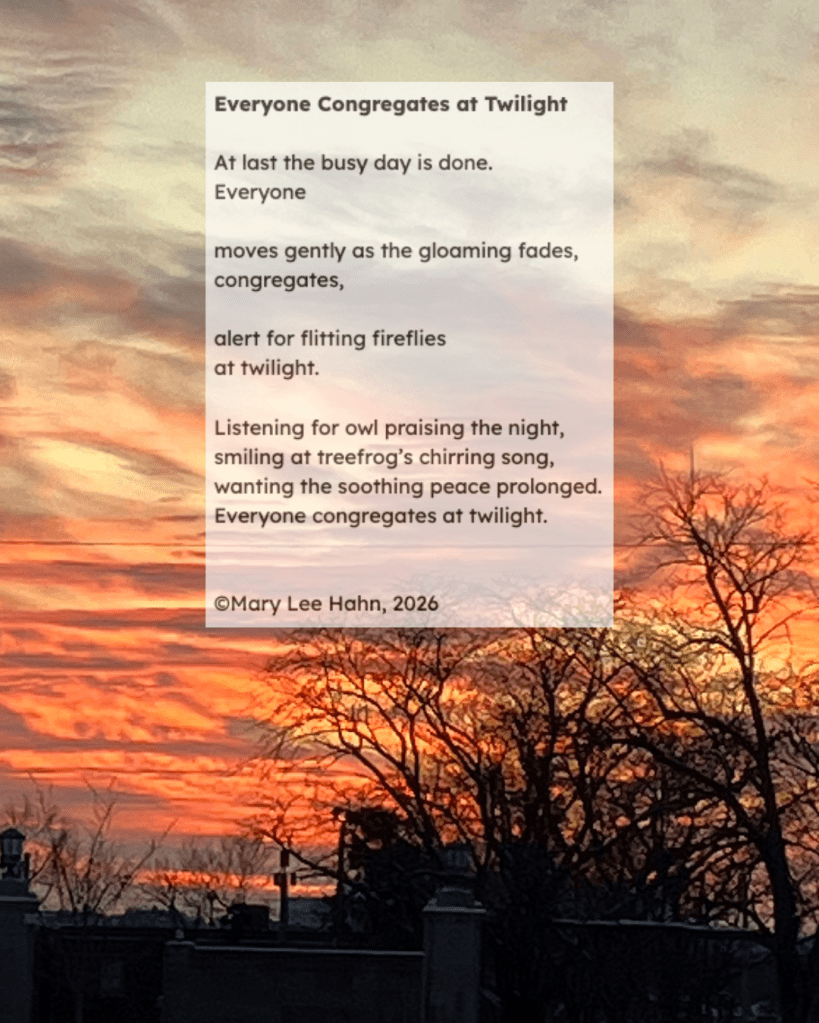
This is a double-duty poem. First, it celebrates the Book Birthday of Marcie Flinchum Atkins’ new release, WHEN TWILIGHT COMES. Congratulations, Marcie!
Second, it’s a Poetry Sister challenge poem. This month we tried our hands at Ovillejos. According to Writer’s Digest, “The ovillejo is an old Spanish form popularized by Miguel de Cervantes (1547-1616). This 10-line poem is comprised of 3 rhyming couplets (or 2-line stanzas) and a quatrain (or 4-line stanza).” Easy, right? Oh…there’s more: “The first line of each couplet is 8 syllables long and presents a question to which the second line responds in 3 to 4 syllables–either as an answer or an echo.” (I think we mostly ignored that part…but there’s still more!) “The quatrain is also referred to as a redondilla (which is usually a quatrain written in trochaic tetrameter) with an abba rhyme pattern. The final line of the quatrain also combines lines 2, 4, and 6 together.” WHEW!
I pretty quickly discovered that in order to have a final line that made sense, I would need to start there and reverse engineer the whole poem. It felt like part puzzle, part fill-in-the-blanks. But I’m not sad about how mine turned out in the end!
Marcie has this week’s Poetry Friday roundup at Marcie Flinchum Atkins, and I can’t wait to see all the ways the community is lighting up the twilight skies in honor of her new book!
Here’s what the rest of the Poetry Sisters came up with this month:
Laura @ Laura Purdie Salas
Liz @ Liz Garton Scanlon
Sara @ Read Write Believe
Tanita @ {fiction, instead of lies}
Tricia @ The Miss Rumphius Effect
 A(nother) Year of Reading
Chirring! A new word to me, and now I want to use it all the time. And you’re so right about wanting to extend that peace of twilight…if only, if only.
LikeLike
Mary Lee, great tip to start at the end and work backwards. I was pondering how you all were tackling this form. Thank you! And your poem is the perfect pairing!
LikeLike
Clever of you to combine the prompts. What a lovely poem you crafted. I also had to do some reverse work once I got to that final line, but I enjoyed the process.
LikeLike
WHEW, indeed! Way to go with the double duty. Impressive! xo
LikeLike
Lovely and evocative. Wonderful to see the word “gloaming” in your poem. You captured the feeling of twilight so well. Peaceful . . .
LikeLike
What a brilliant use of the short lines to make your final line. I didn’t think somehow to simply make it a whole sentence – but this. worked. so. well. I am trying to set up my little courtyard to make the twilight lingering work even more beautifully this year, and we can sit and hear the owls. I’m planning on some night-blooming flowers so the moths will come…
LikeLike
I am agog — how did enjambment NEVER EVEN OCCUR TO ME this time around??? This is the most natural (and beautiful) final line, Mary Lee. Wow…
LikeLike
I love that you did a 2-in-1. So gorgeous! (And “gloaming” is in my book 🙂 )
LikeLike
I’m glad you’re not sad because it’s wonderful! And such deft double-duty!
LikeLike
ooooooh! I like how it turned out in the end, too! “moves gently as the gloaming fades” is really beautiful. Well done.
LikeLike
Mary Lee, the word gloaming is an excellent choice for your poem. Thank you for the word chirring. I never heard of it before. Bringing two prompts together in one poem desires an applause.
LikeLike
Ooh…hope you’re turning this one into a poetry comic! That last line will be marvelous in your art!
LikeLike
Love how your poem addresses so many senses, Mary Lee. Beautiful!
LikeLike
How wonderful to combine both challenges, Mary Lee! I love “wanting the soothing peace prolonged”, and like others, the word “gloaming” always brings the memories! Happy weekend!
LikeLike
*gloaming* – sigh.
Well done, Mary Lee – I read through first without trying to figure out if you were doing the form challenge, and I had to read your post to see; it’s one of the smoothest ones I’ve seen this week. Kudos to all of you for tackling with such originality!!
LikeLike
I love the idea of everyone congregating at twilight. It happens now that I think of it. You make this ovillejo form look easy.
LikeLike
We are all congregating at twilight to celebrate Marcie’s book. Love the poem and the photo, Mary Lee!
LikeLike
Your poem offers a momentary place of solace, with words, “soothing peace prolonged” and gorgeous image, thanks for this respite!
LikeLike
Your last line if lovely, as is this poem about twilight. I didn’t know about Marcie’s book launch, so when I saw the title of your post, my mind immediately went to vampires, and I wondered what the heck you were writing about. This is so much better than what I thought I was going to read!
This is a form that begs for emjambment. You’ve used it well here.
LikeLike
So many fun words: chirring, gloaming, flitting. It is amazing what a difference your word choice makes. The formula for this format is a puzzler. I can see how you need to work backwards. Well done!
LikeLike
Oh, gosh. Mary Lee, this evening prayer fills me with peace, which is in short supply right now. You took this tight and tricky form and managed to give it a flow that feels so natural!
LikeLike