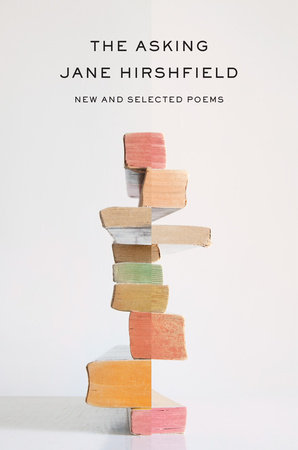
I’m reading a poem or two a day from Jane Hirshfield’s new (2023) collection. I was initially thrilled, but then stumped by yesterday’s poem, so I thought I’d dig into it and see if I could make it make more sense.
I found a faint and blurry but printable copy on Google Books and went at it with colored pencils. Red is for questions, green is for words and phrases that seemed to resonate or repeat, and black is research notes.
If we’re going to do this the way Pádraig Ó Tuama does on Poetry Unbound, you should go to Google Books and read the poem for yourself before I start nattering on about what I think it might mean. I’ll wait.
Okay. Ready? You’ll see all my notes all at once, but I’ll try to recreate my thinking as I combed through the poem over and over again, doing more and more research about what happened in February 1991.
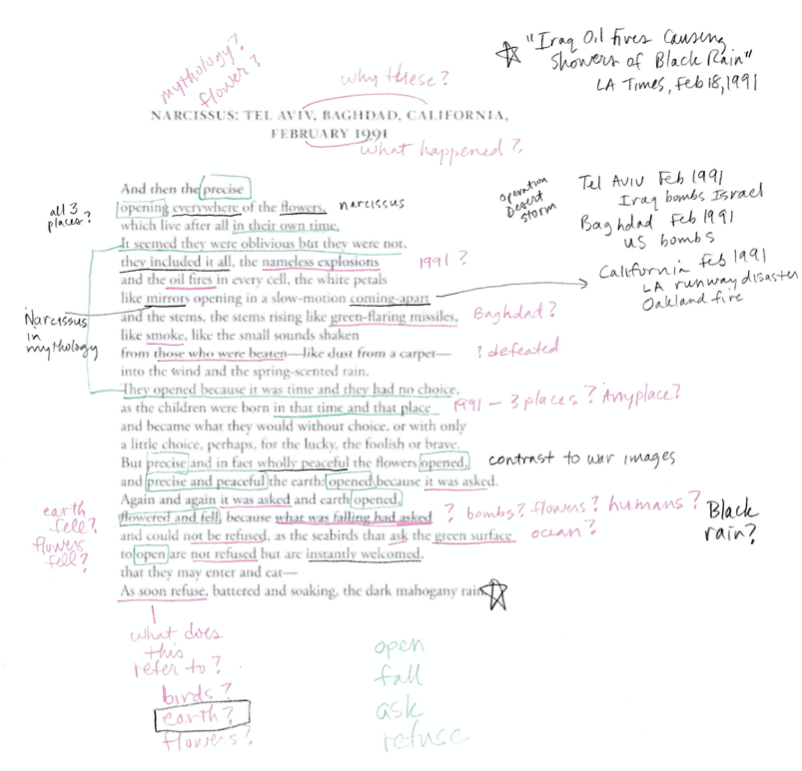
Even though I wasn’t sure about Tel Aviv, Baghdad, California or 1991, I was drawn into this poem because it is February right now and the narcissus (daffodils) are pushing up with great determination. So I started with the delight of spring happening and flowers opening all over the world “in their own time.” But fairly quickly, the poem opened up to include “nameless explosions,” “oil fires,” “missiles,” and “smoke.” These images were clearly referring to Tel Aviv and Baghdad, but they could just as well be from Gaza in 2023-24. Ouch. I read on, and the flowers were compared to children born “in that time and place” who would become “…what they would without choice, or with only / a little choice, perhaps…” (A stab in my heart with the connection to Palestinian children.) Then I was back to the flowers opening peacefully, but now Hirshfield added the earth opening “…because it was asked.” This line: “Again and again it was asked and earth opened” made me think of all the ways we’ve taken from the earth — mining, damming, paving, plowing, deforesting. And the earth cannot refuse. Hirshfield compares this to seabirds diving into the ocean, not refused, but rather welcomed so they can eat, and there was another stab in my heart: we take and take and take from the earth and she keeps giving and giving for our survival. And then Hirshfield lost me with that last line. So many questions!
After this first read-through, I did some research (notes in pencil at the top right, except for the starred note…that came later). Clearly, this poem is speaking to the Gulf War (specifically, Operation Desert Storm). So that explained Tel Aviv and Baghdad in the title. I wasn’t so sure about California in February 1991. There was the LA runway disaster but the Oakland fire I noted turned out to be in October. Maybe California was included for the local blooming of the narcissus.
I kept reading through and noting the contrast between spring / flowering / the inevitable rising of life versus violence / destruction / falling. I kept getting stuck on that last line. What did “As soon refuse” refer to? What was “battered and soaking?” Where did that rain come from? I went back to Google one more time, and…bingo. The headline from the LA Times on February 19, 1991 was the key that unlocked the ending: “Iraq Oil Fires Causing Showers of Black Rain.”
Now I understand that “As soon refuse” refers to the earth. The earth, with its own precise timing and its gifts of life, with its mirroring of human evils in the very flowers that bloom in spring, can as soon refuse our destruction of it, can as soon refuse to soak the “dark mahogany rain” of oil fires into its battered surface, as the ocean can refuse to allow seabirds to dive in.
What do you think? Would Jane Hirshfield agree with my thinking? Do you?
Margaret has this week’s post-Mardi Gras Poetry Friday roundup at Reflections on the Teche.
 A(nother) Year of Reading
Marylee, this is such an insightful analysis. I am glad that you put the effort into deciphering the levels of meaning here. Thank you so much for sharing your thought process and discoveries! I certainly did not gather all of that from my first read. The earth not being able to refuse is heartbreaking.
LikeLike
Hey, Mary Lee. Yeah, this one is a little tough. But beautiful. And open-ended poems are the best ones to talk about with a group, so yay! I read it as the “everything all at once” nature of modern life. The “refuse” in the last line brings to mind not only “deny” but also “trash.” “As soon refuse” could refer to all of it, the birds, the flowers, us. Maybe it’s hopeful: the flowers are going to refuse the black rain and the war and grow anyway.
LikeLike
Ah…the double meaning of refuse! I (obviously) totally missed that. Interesting how that shifts the meaning. I definitely think it’s hopeful, at least on the part of the earth — nothing we do has prevented the flowers from blooming. They will definitely go on without us.
LikeLike
Thank you for sharing your process, Mary Lee. Your research and thinking helped me put everything in perspective.
LikeLike
I learned so much from your deep analysis of this poem. After reading your analysis, I read the poem, not when you suggested to before, and it guided me to an understanding that I would not have had. You could be the next Padraig. I love that this work brings you delight.
LikeLike
Be still my research-loving heart. This is digging IN to a poem. I can’t quite read this blurry version…so I’m going out to find it. I adore how O’Touma gently pulls a poem apart and puts it back again. I have wondered…could I do that? He’s so smart. You give me the nudge to try. Thank you.
LikeLike
I linked the poem in the words Google Books in the second paragraph so you wouldn’t have to go looking.
LikeLike
Karen, I’m so glad you shared the poem, the process…I hope to dig in to the analysis later this week, but I am enamored with the poem…it seems to be trying very hard to locate peace and normalcy within the chaos going on in the world… like me.
LikeLike
It’s so satisfying to read a poem this way. So often lately I just buzz through and don’t give it the extra time I used to as a lit student way back when. Thank you – I really enjoyed this!
LikeLike
What a deep dive, Mary Lee! I’m not sure I have the skill to do what you’ve done here, but I thoroughly enjoyed reading your process. (I do love me some colored pencils with different purposes. 🙂 )
LikeLike
I love that you love digging in like this, Mary Lee. Brava! And also…I am not the reader for this kind of poem. I want a poem to inspire me to see something in a different way, but I don’t want to have to do research just to understand the bare bones of it. I’m glad there are poems for all of us!
LikeLike
What a poem. I did go and read it ahead, and I first thought I remembered that there’s a Bag(h)dad in California, scene of the film Bagdad Cafe–so there was that. Narcissus and the mirroring flowers came easily; I took it on faith that there was going to be, from the beginning, some Gulf War associations. I did not have trouble with the last line on first read because my brain just went and substituted “emerge” for “refuse”–crazy, right? I think you probably did work it all out (as Jane may or may not have wanted you to do with your ropes and hoses and bare lightbulb 😉), but what really strikes me is that YOU wanted to do all that. I just laid back and let it wash me, and kind of ended up in the same place, only much more general. Which is not to say better, but different ways of approaching what a poem wants to say. I think you miss 5th grade Poetry Friday, don’t you? And I LOVE your post about the “parents will be parents” book!
LikeLike
Mary Lee, your process was meticulously executed to the point that the poem sheds more light now. I also stopped at the word refuse and pondered but not to the extent you did. Thank you for this analysis that provides insight into your thinking.
LikeLike
I really love how you are doing a deep dive into this poem and annotating it!
LikeLike
Oh, wow, what a poem! And I so appreciate your analysis, research, and commentary. I read it as the persistent and inevitable co-existence/cycles of peace and pain, beauty and destruction, and a couple of related phrases came to mind: I haven’t seen the movie EVERYTHING EVERYWHERE ALL AT ONCE but I love the title and the deft way it evokes the surreal feeling of living in the world at this moment. And I thought of the sad final line of Gatsby, “So we beat on, boats against the current, borne back ceaselessly into the past,” because we keep repeating these destructive cycles (in contrast to, as you noted, the repeated cycles of beauty in nature.) And I like your observation of all the ways we take from the earth, when the earth, in all her generosity, can’t say no. I’ll need to sit with this one for a while. Thank you.
LikeLike