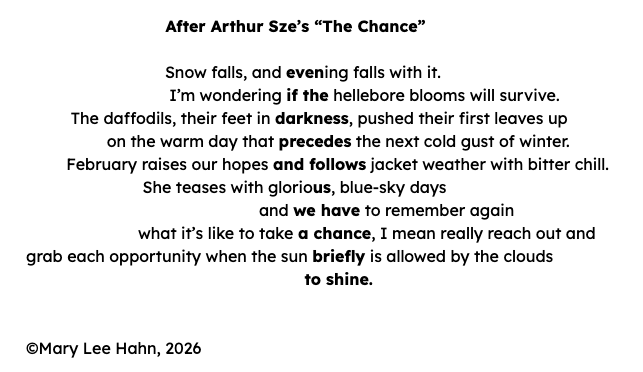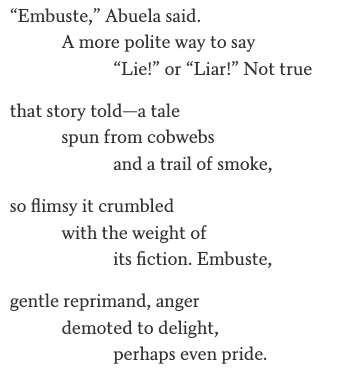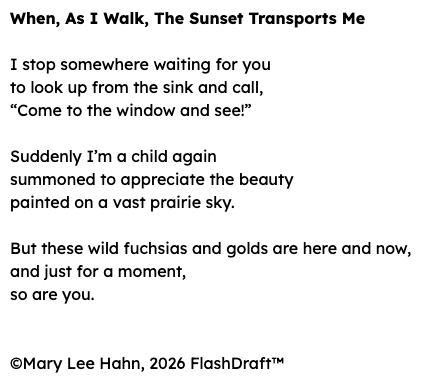
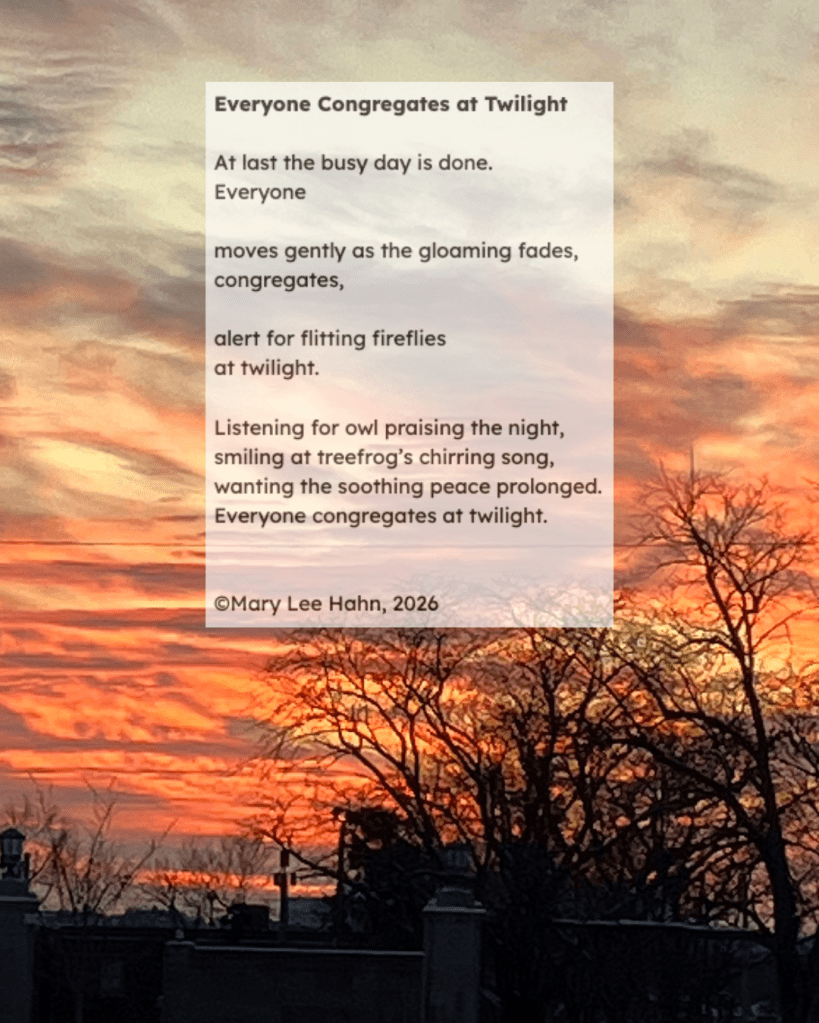
Gratitudes to all who signed up to host Poetry Friday roundups in the first six months of 2026. It was a bit nip-and-tuck to fill the last few slots (thanks for the help, Irene!), but you poets always come through! The complete roundup can be found in the sidebar here, and if you’d like for me to send you the code so you can have the list on your blog, just let me know.
This month, the Poetry Sisters are in conversation with the theme of light, hope, and peace. No form requirements, no length rules.
When we chatted last Sunday, Sara mentioned that she might write a limerick. Not necessarily poetry on the theme of light, but definitely light poetry (heh heh).
I snagged her idea and combined it with a core memory from a past Solstice celebration. Unearthing a photo from that long ago celebration resulted in a fun conversation with the head engineer and fudge-maker. He reminded me that our Fudgehenge was built pretty close to scale. And…it was so very yummy!
Here’s what what the other Poetry Sisters created:
I know that many of the Poetry Friday regulars get the same array of daily poetry newsletters and so this poem landed in your inbox too. But it has stuck with me and compelled me to read it over and over again.
It is a love letter to terror.
It elaborates on all the wonders of life that would not exist without the darkness of terror. Here on the brink of the winter solstice in the northern hemisphere, the coexistence of darkness and light are played out right outside our windows. Here in the United States, the coexistence of darkness and light are played out in the graft of politics and the care of neighbors for each other.
Last night in a conversation with like-minded folks, we talked about the importance of inviting grief or depression or negative thoughts to come in for a cup of cocoa; the importance of letting those visitors have their say and then kindly showing them to the door. I feel like this poem does just that, treating terror with merciful respect, while celebrating all the positive that exists because of terror.
The (Palestinian) poet writes
“I wrote this poem because I was thinking about security—how, in its name, we wage wars, round up political activists, install surveillance cameras, build walls, carry more weapons. How we cross to the other side of the street when we see someone approaching, avoid love, suspect kindness, and villainize the stranger.” —Dalia Taha
and the translator writes
“While translating Dalia Taha’s ‘Enter Terror,’ I kept looking over my shoulder to check that ‘terror’ was, in fact, what was being so tenderly addressed—and not something much less sinister. The speaker in this poem cannot imagine a world without terror. If this poem acts subversively, it does so by repurposing the worst shape of fear—terror—as companion; like love, it keeps us restlessly awake to the world’s beauty and ruin.” —Sara Elkamel
Here are a couple of my favorite parts of Enter Terror:
Without you, no one would read the same sentence a second time, breathless, before setting the book aside to pace from one room to the next. And without you, there would be no lines to draw under striking lines in the books of poetry and philosophy that now rest serenely by your bed, after having moved universes; after changing worlds.
.
…without you people would not gather on pitch black nights; they would not light candles or invent lullabies. Without you, no one would ever know that stories told in whispers are the only way to contend with night.
Which lines resonated with you?
Michelle has this week’s Poetry Friday round up at MoreArt4All.
Interested in hosting a Poetry Friday roundup in January – June 2026? There are still spaces available! The signup is here.
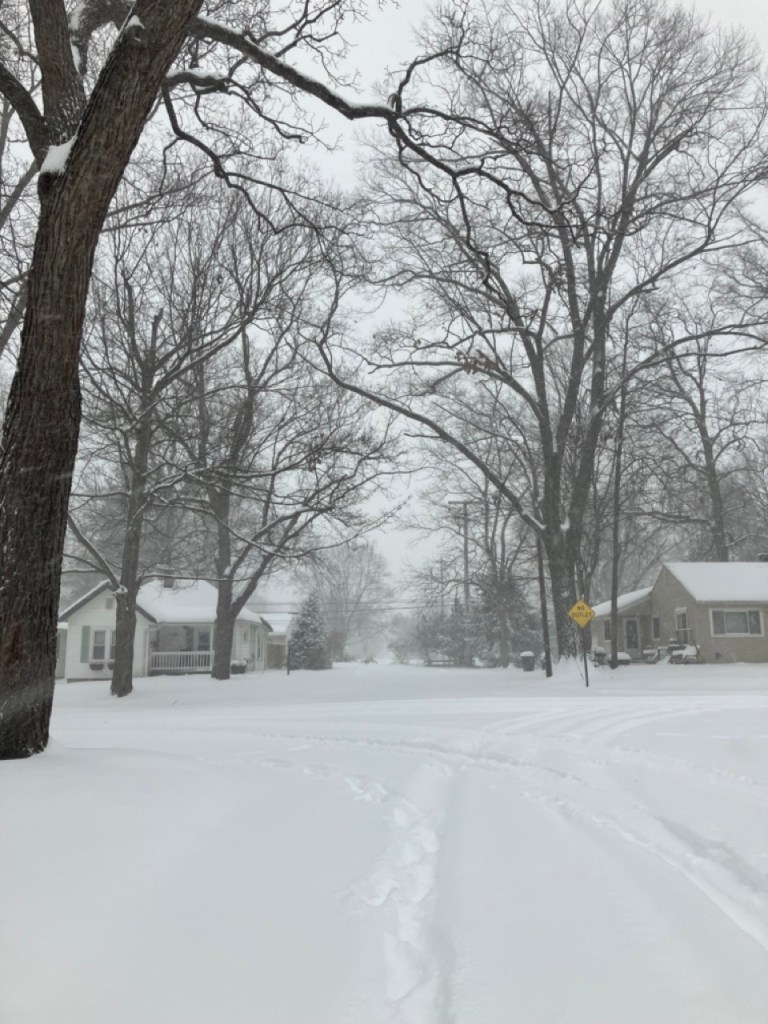
This is December, as much or more than decorations and presents. This, plus oak leaves scuttling across a crust of snow, the dark silhouettes of winter trees, and heavy purple clouds hinting at the possibility of more snow later.
Linda has this week’s Poetry Friday roundup at A Word Edgewise.
Interested in hosting a Poetry Friday roundup in January – June 2026? There are still spaces available! The signup is here.
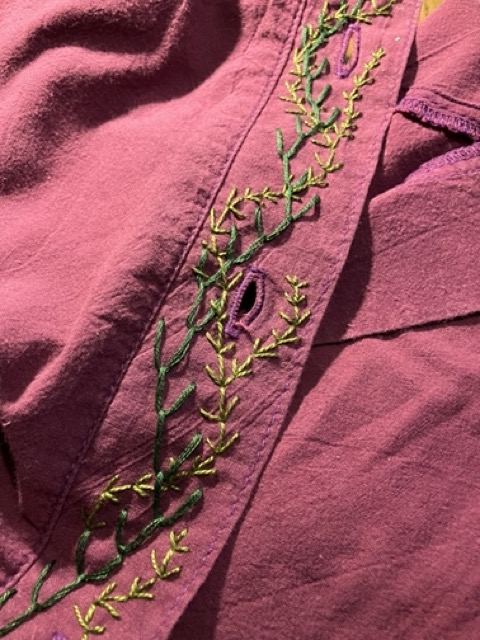
The Inklings challenge for this month came from Heidi, who encouraged us to write a poem of address to an article of clothing. After auditioning several ideas, I settled on my old friend Barn Coat. We’ve been through many winters together, and I know we’ve got many more yet to go.
Here’s how the rest of the Inklings met this month’s challenge:
It’s that time again. Six-ish months have passed since last we queued up to host the Poetry Friday roundups.
What is the Poetry Friday roundup? A gathering of links to posts featuring original or shared poems, or reviews of poetry books. A carnival of poetry posts. Here is an explanation that Rene LaTulippe shared on her blog, No Water River, and here is an article Susan Thomsen wrote for the Poetry Foundation.
Who can do the Poetry Friday roundup? Anyone who is willing to gather the links in some way, shape, or form (Mr. Linky, “old school” in the comments, or ???) on the Friday of your choice. If you are new to the Poetry Friday community, jump right in, but perhaps choose a date later on so that we can spend some time getting to know each other.
How do you do a Poetry Friday roundup? If you’re not sure, stick around for a couple of weeks and watch…and learn! One thing we’re finding out is that folks who schedule their posts, or who live in a different time zone than you, appreciate it when the roundup post goes live sometime on Thursday.
How do I get the code for the PF Roundup Schedule for the sidebar of my blog? You can grab the list from the sidebar here at A(nother) Year of Reading, or I’d be happy to send it to you if you leave me your email address.
Why would I do a Poetry Friday Roundup? Community, community, community. It’s like hosting a poetry party on your blog!
Put your request in the comments (blog URL is appreciated) and I’ll update the calendar frequently. Feel free to share this post on all the various socials. And if WordPress is not playing nice, feel free to email me: marylee.hahn at gmail dot com.
Linda’s prompt for the Inkings challenge this month comes from Ethical ELA’s September Open Write by Kelsey Bigelow: “What is the happiest thing you’ve ever tasted?”
In brainstorming for the poem, I unearthed a memory of racing to the DQ to get a cone for Dad, and making it home before it melted. Being able to make him happy was sweeter than my own butterscotch dip cone.
Same thing with the good luck dumplings Nai Nai serves before I fly back to Ohio from San Diego. They are so SO yummy, but the best part is her happiness.
Three or four elections ago I brought some Nerds Gummy Clusters to snack on through the long day and to share with my fellow roster judges. This has become a tradition which we were delighted to share with a new member of our team on Tuesday. He had never had them. The look on his face was priceless.
Today I went for a long walk and brainstormed ideas for this poem. I drank in the delicious blue of the sky and savored the crispy crunch under my feet as I walked. Pure Fall happiness! (And that MOON last night!)
Here’s how the rest of the Inklings met this month’s challenge:
A child pyro with easy access to ashtrays. Smell of smoke ubiquitous. Mesmerized by flare and sulphurous flash. Burning matches held until fingers sting. Child pyro grows up in a world that burns, the sting now an ache, an ache of how and why that burns from the inside out while outside the smell of wet wood fire pit smoke pools in the low spot in the neighborhood and every breath brings an acrid blackness to lungs, even the trees forced to breathe the last gasp of their kin. Child pyro orphaned by lung cancers, never addicted, planting for possibility in a future free from fire.
A child mesmerized by flare and flash grows up outside in the neighborhood, the trees their kin, possibility a future fire.
A burning haibun must be composed of three (or more) parts—an initial prose poem, an erasure of that prose poem, and an erasure of the previous erasure down to a haiku. Additional segments of erasure may be integrated, but keep in mind the continuity of the piece.
The erasures are intended to be sequential and persistent. Once a piece of text has been blacked out, or burned away, it should not return. Furthermore, each erasure should represent some form of reorientation from the previous section, altering the meaning, tone, etcetera.
The focus of a burning haibun—in contrast to traditional haibun—should be on an interior landscape, by which I mean the landscape of memory. Though the form emerged from a meditation upon the contours of traumatic memory, you should by no means feel confined to writing within that space.
Somewhere within the poem’s text, something must burn.
What the Poetry Foundation doesn’t state is how tricky these are to write! Do you start with a mind-dump that becomes some kind of prose poem (whatever that is) that gets burned up as sequentially as the above quote would have you believe? Or do you start with a haiku and reverse-engineer the whole thing? Or do you write a paragraph, make it as weird as possible so as to seem like a prose poem, then pull a haiku out, go back and burn up the middle section, only to realize when you go to make the images for your post that you have broken the rules by using words you burned in the middle section for your haiku and have to start over again with the second two parts? (You might infer which of these processes was mine…)
I can’t wait to see what the other Poetry Sisters created!
Do you subscribe to George Bilgere’s poem-a-day newsletter? I’m a big fan of Bilgere’s poetry. I even wrote a poem after hearing him speak in 2012. (Gads, that’s a long time ago now…and the link will probably tell you that Poetrepository is not a secure site. I won’t be offended if you don’t click through.)
Back to the newsletter. I’m a big fan of George Bilgere’s poetry, and, as it turns out, I quite like most every poem he chooses for his newsletter. His small musing that comes with each poem often makes me chuckle and sometimes makes me go back to the poem and read again.
Today, George wrote, “Sometimes you just feel like reading a Billy Collins poem, in the same way that sometimes it’s nice to take a walk in the woods on a glorious fall day.” And he was right. May we all live with our heart
“propped up in a field on its tripod, ready for the next arrow.“
.
Aimless Love by Billy Collins
This morning as I walked along the lake shore, I fell in love with a wren and later in the day with a mouse the cat had dropped under the dining room table.
In the shadows of an autumn evening, I fell for a seamstress still at her machine in the tailor’s window, and later for a bowl of broth, steam rising like smoke from a naval battle.
This is the best kind of love, I thought, without recompense, without gifts, or unkind words, without suspicion, or silence on the telephone.