Poetry Friday: The Ones That Resonate

I know that many of the Poetry Friday regulars get the same array of daily poetry newsletters and so this poem landed in your inbox too. But it has stuck with me and compelled me to read it over and over again.

It is a love letter to terror.

It elaborates on all the wonders of life that would not exist without the darkness of terror. Here on the brink of the winter solstice in the northern hemisphere, the coexistence of darkness and light are played out right outside our windows. Here in the United States, the coexistence of darkness and light are played out in the graft of politics and the care of neighbors for each other.

Last night in a conversation with like-minded folks, we talked about the importance of inviting grief or depression or negative thoughts to come in for a cup of cocoa; the importance of letting those visitors have their say and then kindly showing them to the door. I feel like this poem does just that, treating terror with merciful respect, while celebrating all the positive that exists because of terror.

The (Palestinian) poet writes

“I wrote this poem because I was thinking about security—how, in its name, we wage wars, round up political activists, install surveillance cameras, build walls, carry more weapons. How we cross to the other side of the street when we see someone approaching, avoid love, suspect kindness, and villainize the stranger.”
—Dalia Taha

and the translator writes

“While translating Dalia Taha’s ‘Enter Terror,’ I kept looking over my shoulder to check that ‘terror’ was, in fact, what was being so tenderly addressed—and not something much less sinister. The speaker in this poem cannot imagine a world without terror. If this poem acts subversively, it does so by repurposing the worst shape of fear—terror—as companion; like love, it keeps us restlessly awake to the world’s beauty and ruin.”
—Sara Elkamel

Here are a couple of my favorite parts of Enter Terror:

Without you, no one would read the same sentence  
a second time, breathless, 
before setting the book aside 
to pace from one room to the next. 
And without you, there would be no lines to draw 
under striking lines in the books of poetry and philosophy  
that now rest serenely by your bed, 
after having moved universes;  
after changing worlds. 

…without you 
people would not gather on pitch black nights;  
they would not light candles or invent lullabies. 
Without you, no one would ever know  
that stories told in whispers 
are the only way to contend with night. 

Michelle has this week’s Poetry Friday round up at MoreArt4All.

Interested in hosting a Poetry Friday roundup in January – June 2026? There are still spaces available! The signup is here.

(stack of books photo via Unsplash)
Poetry Friday: Poem Observation

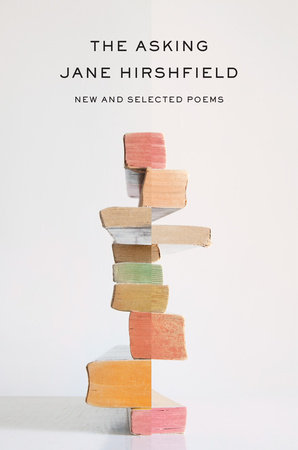
I’m reading a poem or two a day from Jane Hirshfield’s new (2023) collection. I was initially thrilled, but then stumped by yesterday’s poem, so I thought I’d dig into it and see if I could make it make more sense.

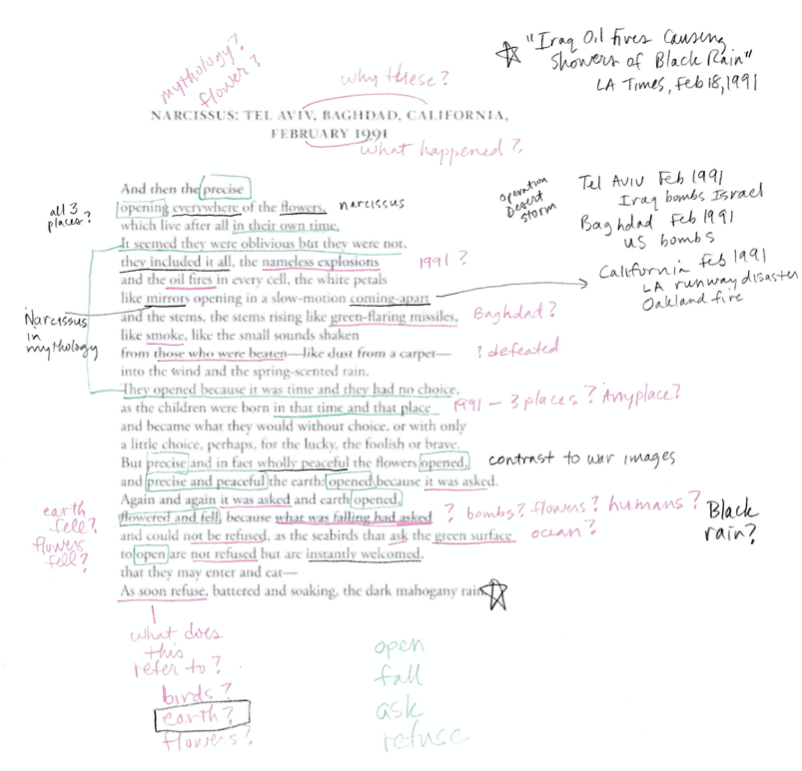
I found a faint and blurry but printable copy on Google Books and went at it with colored pencils. Red is for questions, green is for words and phrases that seemed to resonate or repeat, and black is research notes.

If we’re going to do this the way Pádraig Ó Tuama does on Poetry Unbound, you should go to Google Books and read the poem for yourself before I start nattering on about what I think it might mean. I’ll wait.

Okay. Ready? You’ll see all my notes all at once, but I’ll try to recreate my thinking as I combed through the poem over and over again, doing more and more research about what happened in February 1991.

Even though I wasn’t sure about Tel Aviv, Baghdad, California or 1991, I was drawn into this poem because it is February right now and the narcissus (daffodils) are pushing up with great determination. So I started with the delight of spring happening and flowers opening all over the world “in their own time.” But fairly quickly, the poem opened up to include “nameless explosions,” “oil fires,” “missiles,” and “smoke.” These images were clearly referring to Tel Aviv and Baghdad, but they could just as well be from Gaza in 2023-24. Ouch. I read on, and the flowers were compared to children born “in that time and place” who would become “…what they would without choice, or with only / a little choice, perhaps…” (A stab in my heart with the connection to Palestinian children.) Then I was back to the flowers opening peacefully, but now Hirshfield added the earth opening “…because it was asked.” This line: “Again and again it was asked and earth opened” made me think of all the ways we’ve taken from the earth — mining, damming, paving, plowing, deforesting. And the earth cannot refuse. Hirshfield compares this to seabirds diving into the ocean, not refused, but rather welcomed so they can eat, and there was another stab in my heart: we take and take and take from the earth and she keeps giving and giving for our survival. And then Hirshfield lost me with that last line. So many questions!

After this first read-through, I did some research (notes in pencil at the top right, except for the starred note…that came later). Clearly, this poem is speaking to the Gulf War (specifically, Operation Desert Storm). So that explained Tel Aviv and Baghdad in the title. I wasn’t so sure about California in February 1991. There was the LA runway disaster but the Oakland fire I noted turned out to be in October. Maybe California was included for the local blooming of the narcissus.

I kept reading through and noting the contrast between spring / flowering / the inevitable rising of life versus violence / destruction / falling. I kept getting stuck on that last line. What did “As soon refuse” refer to? What was “battered and soaking?” Where did that rain come from? I went back to Google one more time, and…bingo. The headline from the LA Times on February 19, 1991 was the key that unlocked the ending: “Iraq Oil Fires Causing Showers of Black Rain.”

Now I understand that “As soon refuse” refers to the earth. The earth, with its own precise timing and its gifts of life, with its mirroring of human evils in the very flowers that bloom in spring, can as soon refuse our destruction of it, can as soon refuse to soak the “dark mahogany rain” of oil fires into its battered surface, as the ocean can refuse to allow seabirds to dive in.

What do you think? Would Jane Hirshfield agree with my thinking? Do you?

Margaret has this week’s post-Mardi Gras Poetry Friday roundup at Reflections on the Teche.

Poetry Friday: Chores

You might want to go the the Poetry Foundation and read “Chores” by Maxine Kumin before you read on. I’ll wait.

After an intense month of writing and going “public” with a poem a day in February, I intended to keep that habit going through March and into Poetry Month (aka April). Instead, I have (mostly) recovered my morning exercise habit that was lost to writing, commenting, and icy weather/walkways. (Yes, I know I could have gone to the health club and exercised in spite of the weather. But I didn’t.)

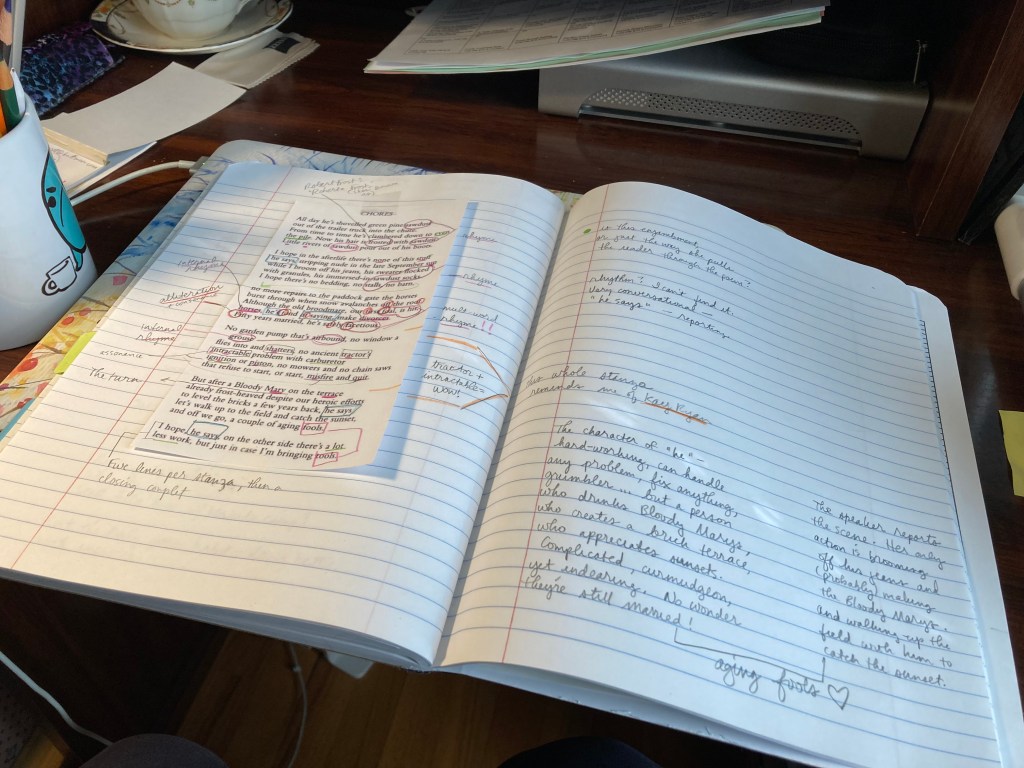
So in the absence of an original poem, I decided to dig into a poem with a Poem Observation. I chose Maxine Kumin, looked her up on the Poetry Foundation site, and picked a poem with what seemed to be a promising title, “Chores.” Here’s what happened:

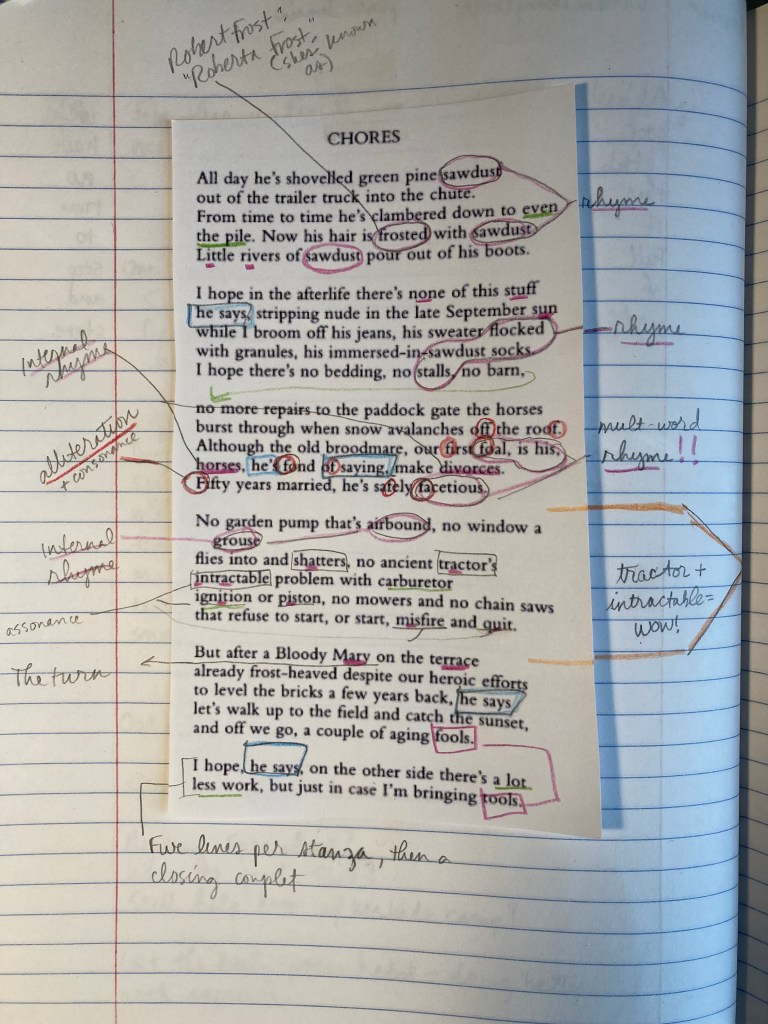
Like I did in my classroom, I read and reread and reread, first with just my pencil in hand, then with some color coding. The more I read, the more I found to admire about the language and storytelling in this poem. There’s the obvious story in the poem about the sawdust and the sunset, but aren’t you curious for more about the paddock gate, the airbound garden pump, the broken window? And then there’s that little aside, mid-poem, about horses making divorces.

But the language! Kumin packs this poem with end rhyme, internal rhyme, assonance, consonance, and alliteration…but none of it is terribly obvious on your first read. I love that. If you read this poem aloud, especially that fourth stanza, you can’t help but be reminded of the way Kay Ryan plays with the sounds of words.

By the end of the poem (especially after multiple reads) you kind of fall in love with these “aging fools” whose work reminds us of Marge Piercy’s “To be of use.”

Sylvia Vardell and Janet Wong are hosting this week’s Poetry Friday roundup at Poetry For Children with a YUMMY unveiling of their DELICIOUS newest book (I’m proud to have a poem in it!), THINGS WE EAT.