Franki’s Weekly Text Set-The Power of Repeated Words and Phrases

Texts for this Text Set have been posted daily on Instagram. 

Follow @TextSets there to get daily updates!
This week, we take a close look at the ways writers use repeated words or phrases for a variety of reasons. Repeated words give readers a clue that the words are important and an invitation to think about how. Writers use repeated words and phrases in a variety of ways to make sure their message comes through. The books shared this week can serve as invitations for these kinds of conversations with young readers and writers. Readers will have new strategies for deeper understanding. Writers will have lots of new ideas to try in their own writing.

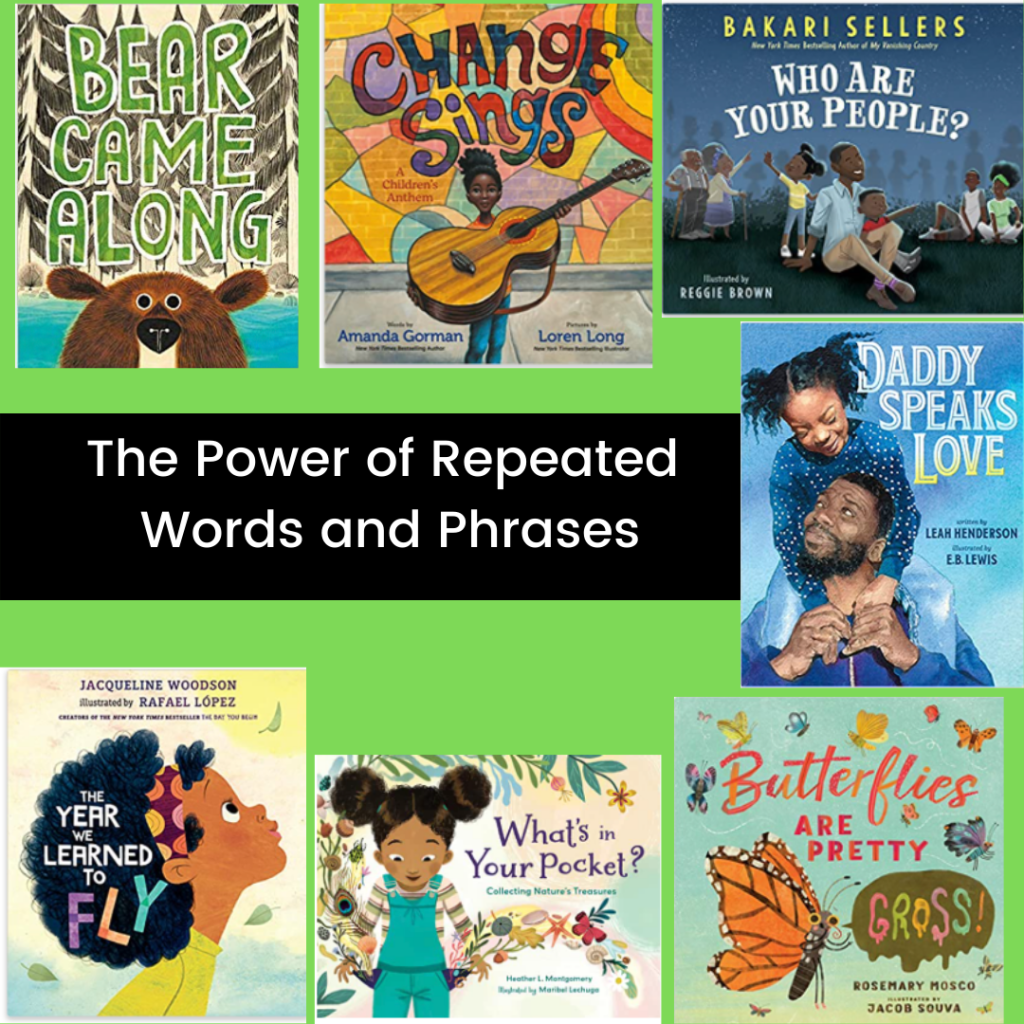
Who Are Your People by Bakari Sellers is anchored on two phrases–“Your people were..” and “You are from…”. Each spread finishes one of these phrases. I’d start with a book like this because the repeated phrase is easily visible to readers because it is on every single page. This book invites readers to think about the meaning the phrases have the first time they hear them in the book and then how the meaning expands as they continue to read it over and over in new contexts. Often a writer repeats a phrase that we can think more deeply about every time it is used.

Butterflies are Pretty…Gross! is another book that has very obvious repeated phrases. So this shows the same idea in a nonfiction book. The phrase “some butterflies”/”some caterpillars” is repeated to let us know some “top secret” information about caterpillars. The repeated phrase reinforces that what we thought we knew about butterflies isn’t always complete. Each time the phrase is used, we learn something new. This book is humorous so the humor that goes along with the repeated phrase is worth studying too.

This newest book by Jacqueline Woodson, The Year We Learned to Fly is gorgeous and important. It is one that belongs in every classroom and library. Often a phrase is repeated by an older relative or friend and often that advice has meaning that is beyond literal. In this book, the characters’ grandmother repeats a phrase that begins “Lift your arms, close your eyes.” during difficult times. Each time she shares this wisdom, the children learn and grow. Through the children’s eyes, we can learn the bigger meaning of these words. The author’s note at the end is also important. This poetic book is filled with beautiful language and powerful words that can be studied as readers and writers.

Sometimes writers use repeated phrases throughout a book to give the reader a clue about what is coming next. Writers do this in both fiction and nonfiction. In What’s In Your Pocket? the author uses the phrase “Nobody knew…” to transition from each scientist’s childhood to their adult contributions and passions. In Bear Came Along, the word “until…” appears at the end of a spread letting us predict what is coming next. I like to show young writers how this move can be used in both fiction and nonfiction in different ways, but for similar purposes.

I just discovered Daddy Speaks Love and it is a new favorite. The repeated phrase Daddy speaks is followed by a word and an experience children have with their daddies. In poetic language the phrase plus the word says so much. The word speak is uses in a way beyond literal and each word choice is critical to the meaning of the book. Change Sings repeats a phrase “There is _ where my change sings” or something very similar throughout. Each single words adds new meaning to the whole. I think both of these phrases can be studied within the context of the text and can also be studied when thinking about theme and overall message of each book. These are more sophisticated uses of repeated phrases.

This week’s books were linked at Bookelicious. If you don’t know Bookelicious, check it out today. It is an online independent children’s bookstore with an incredible selection of children’s books and many supports for young readers. Lots of great free events for teachers coming up that you can check out and register here

Follow @TextSets on Instagram for daily books/weekly text sets!

Franki’s Weekly Text Set: Nonfiction Poetry

Texts for this Text Set have been posted daily on Instagram. 

Follow @TextSets there to get daily updates!

Happy New Year! This year, when I know lots of classrooms are getting ready to start thinking about informational reading and writing, I decided to kick off 2022 with some of my favorite nonfiction poetry books. I think there is so much that informational poetry can do for us as readers and writers. Poetry invites us in to think about important topics in new ways. And it gives our students new ways to think about how to write informational pieces. I love the books that combine poetry with other forms of writing too,

The books in this series (Where in the Wild, Where Else in the Wild, What in the Wild) were some of the first informational poetry books I discovered. These are great for introducing nonfiction poetry to children because of the “I Spy/Look and Find” feature of each page. The poems in this book give information and the word choice and descriptions are incredible. As a reader, lots of inferring happens. As a writer, so much to learn!

I am so not a fan of chapter book biographies for elementary students. I prefer picture book biographies because our students can read across texts, learn about lots of people and do more in-depth work when they aren’t reading a chapter book series biography. I put biography poetry right up there with picture books. I love what books like Bravo and Shaking Things Up provide. Not only do we learn about several different people and their impacts but we learn about how an anthology works as it is around one topic or idea. The writing in both of these are incredible and many readers will find a person or two who they’d like to research further. And books like this also tend to have great author’s notes with more info. I hope we can all rethink whatever work we do with biographies and think about the goals and the types of books that best meet the goals biography reading. #biographies

No Voice Too Small and Voices of Justice would be great follow-up reads to yesterday’s titles. Both of these books focuses on people working toward justices. The writing style is different and the focus is a bit different in each so these would invite many conversations. So many pieces beyond the main poem on each page. Both of these books would be great to study in-depth.

In the Spirit of a Dream is my newest favorite poetry book. This book celebrates 13 American Immigrants. I loved reading about people I knew and people whose stories were new to me. The illustrations in this book are worthy of study as well. This is one of those books that I see being in every K-12+ classroom as there are so many entry points for readers, writers and illustrators.

The Last Straw has been on a few #TextSets because I love it. The way Susan Hood combines poetry and information is brilliant and there is so much packed into this one book, with poetry as the anchor. And this would invite an interesting discussion on the ways the poems were put together, the overarching topic and theme of the whole, etc. This book can be studied as a whole or individual spreads can be looked at individually.

This week’s books were linked at Bookelicious and/or  Cover to Cover Children’s Bookstore. If you are looking for a fabulous local children’s bookstore to support, Cover to Cover is an amazing one. We are lucky to have them in Central Ohio! If you don’t have an independent children’s bookstore in your town, check out Bookelicious. They are an online independent bookstore for children with an incredible curated collection. 

Follow @TextSets on Instagram for daily books/weekly text sets!
Franki’s Weekly Text Set-Word Study and Vocabulary: Thinking Beyond a Simple Definition

Texts for this Text Set have been posted daily on Instagram. 

Follow @TextSets there to get daily updates!

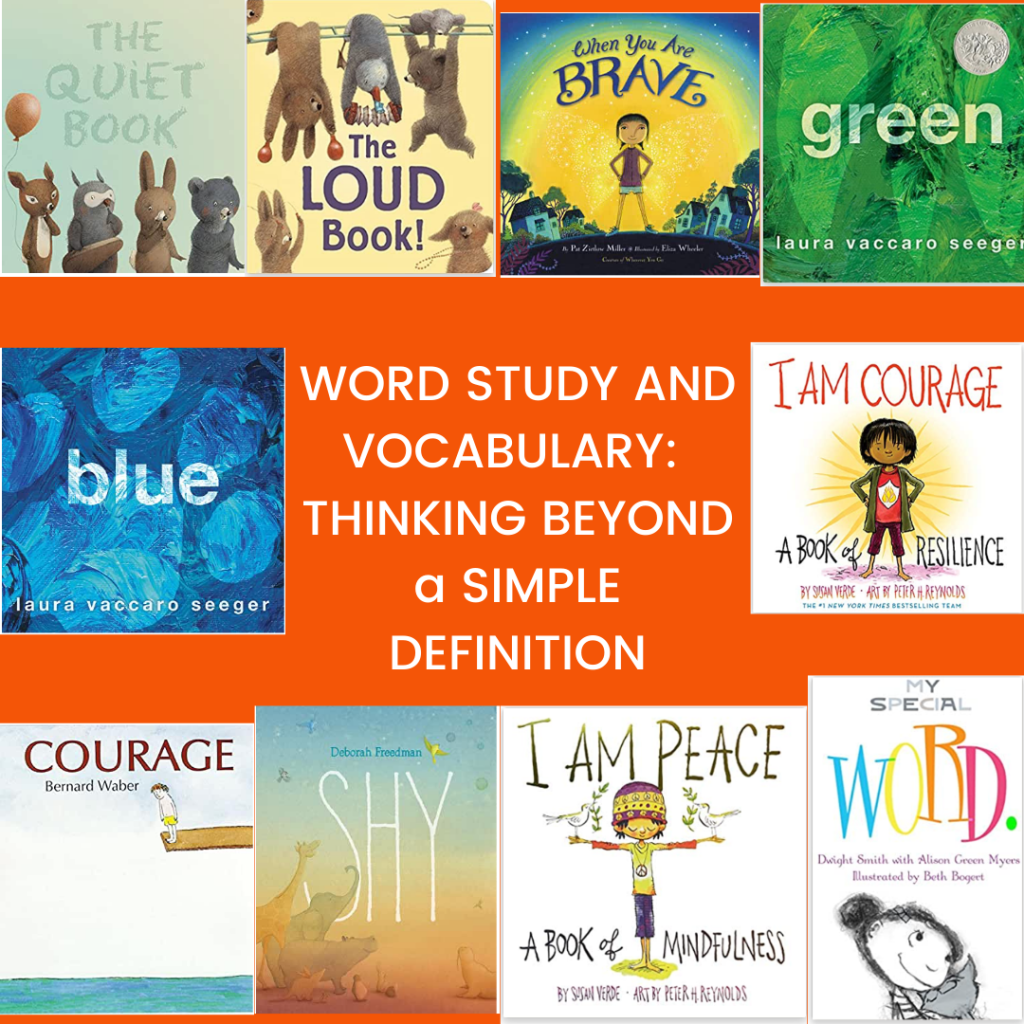
When I think about word study and vocabulary, I always wonder how we can expand the ways our children think about words. I want them to think about words in complex ways. I know that to really understand a word, it is not simply about a definition. The books in this week’s Text Set are books that focus on looking at a single words with depth. Each author does this in a unique way and a week of sharing books like this can help students think more deeply about words and all that they can mean.

The Quiet Book and The Loud Book! are pure joy. I love them both for so many reasons. They are fun to just read aloud for enjoyment, but there is so much to each one of these. We think we know what the words quiet and loud mean until we read these books. Then we realize that there are so many different kinds of quiet and and so many different kinds of loud. These books explore this idea in such a joyful way. I imagine once children read these books, they might think of other words in new ways!

I have loved Courage by Bernard Waber for years. I love how it gives so many scenes of courage. Now I am happy that I can pair the book with the newer I Am Courage by Susan Verde. Thinking about the different ways that two authors approach a book focused on one word will start incredible conversations. Both of these have repeated lines and both do something a bit different in exploring the word courage.

These two picture books–When You are Brave and Shy each focus on a word that can mean so much. By embedding the words in experience and story, we come to think more deeply about all that the word could mean. The illustrations in each add to the meaning which is another angle to explore.

This set of books from Laura Vaccro Seeger-Blue, Green and Red– makes for more fascinating conversation as readers think about how the same and different a color can be–as well as all that the color encompasses and symbolizes. The literal meanings as well as some metaphorical meanings of these color will be naturally explored when reading and discussing these books.

There is something about choosing a word as a goal or a reminder. Often we do this on New Year’s Day as a way to set our intentions for the coming year. My Special Word is a book that can help young readers think about words and the ways they can influence who we are–you might want to check out the whole initiative when you are on the site. Choosing a word (one that remains the same or changes daily) is a concept that is written about so well for young children in My Special Word. And the newish series from Susan Verde helps readers understand this concept of “being” as connected to a specific word. I Am Peace is one of my favorite in the series.

This week’s books were linked at Bookelicious and/or  Cover to Cover Children’s Bookstore. If you are looking for a fabulous local children’s bookstore to support, Cover to Cover is an amazing one. We are lucky to have them in Central Ohio! If you don’t have an independent children’s bookstore in your town, check out Bookelicious. They are an online independent bookstore for children with an incredible curated collection. 

Franki’s Weekly Text Set–Talking Bubbles in Informational Books

Texts for this Text Set have been posted daily on Instagram. 

Follow @TextSets there to get daily updates!

Young writers love to use talking bubbles and to play around with humor and graphics in their writing. But there are a lot of craft moves that go along with doing that well. Young readers love informational books with humor and lots of text features but the format often makes it challenging to navigate without some instruction and practice. A focus on talking bubbles in informational text will help students focus in on a few ways talking bubbles can be used and how they enhance the book. By focusing in on this one small way talking bubbles are used effectively, readers and writers will approach them in new ways. This is a great mini-unit to do before winter break as it is focused and short but will also carry into other units later because of the close study of something so specific. And I am thinking most of these books are more in the category of informational than true nonfiction although the field of nonfiction is changing a bit.

There is so. much to learn about as readers and writers from this series. The format of the pages are filled with various text and features and navigating the page takes some intentionality. In The Truth About Bears, talking bubbles are used for both sharing important information AND to add side comments as humor. The author embeds both of these types of talking bubbles throughout the text. So you can’t ignore the talking bubbles and still get all of the information in the book. So much of the new information is being told to us by the animals themselves.

Arlo and Pips: King of the Birds is a great model for sharing information embedded in story. This entire story is told through a conversation between two birds. There is text other than talking bubbles but the dialogue tells most of the story with information embedded throughout. Sometimes the information is shared by one of the characters. At other times, we enjoy a story and realize we learned something about crows from the story. Lots of great craft moves in this one!

This is a favorite series for readers K-5. Such a fun way to share information. In each of these books, we get to know a bug or animal. We are introduced through text but the creature (The Cockroach in this example) interacts with us, the reader, thorough dialogue. It is a fun way to use dialogue and talking bubbles and this book makes this craft move visible for young writers so they can try it in their own writing. Since this is the 2nd book/series they will look at by author Elise Gravel, comparing what she does with dialogue would also be interesting.

There is a lot to study in Except Antarctica! The narrative is told through regular narrative and dialogue (and the talking bubbles are not actually in bubbles but talking is designated by a specific font which makes for a good discussion). The author uses these in a way to enhance the story, to give the characters personality. But not a lot of information happens in the dialogue–most happens in the main text. The humor is well done in this and children hoping to try humor can learn a lot from how this is done.

If you don’t know Look Up! Bird-Watching in Your Own Backyard, it is one that reader could spend hours with. There is so much information packed into this gem of a book and each page is worth study. I like this one because talking bubbles are used for so many reasons and in so many ways. Creating a chart of the ways and reasons the writer embedded talking bubbles and how each impacts the reading would be a great study. Then writers can decide if any of these ways make sense for their own writing. The combination of humans and birds that talk in this books is also worth exploring.

This week’s books were linked at Bookelicious and/or  Cover to Cover Children’s Bookstore. If you are looking for a fabulous local children’s bookstore to support, Cover to Cover is an amazing one. We are lucky to have them in Central Ohio! If you don’t have an independent children’s bookstore in your town, check out Bookelicious. They are an online independent bookstore for children with an incredible curated collection. 

Franki’s Weekly Text Set-Reading and Writing: Question and Answer Format

Texts for this Text Set have been posted daily on Instagram. 

Follow @TextSets there to get daily updates!

I was thinking about how much elementary students love the Who Would Win? series. I never really looked closely at it but when I did, I realized what a great mentor it is. There is more to each segment than I realized and there is lots there for both readers and writers. So I’ve started to take a look at other nonfiction books with a Question and Answer format, thinking critically about these books for both readers and writers. There is no set way a Q/A book is written so when we study them, we can learn so much about craft moves, layout, organization, etc. This week’s Text Set will take a look at informational books that have a Question/Answer format.

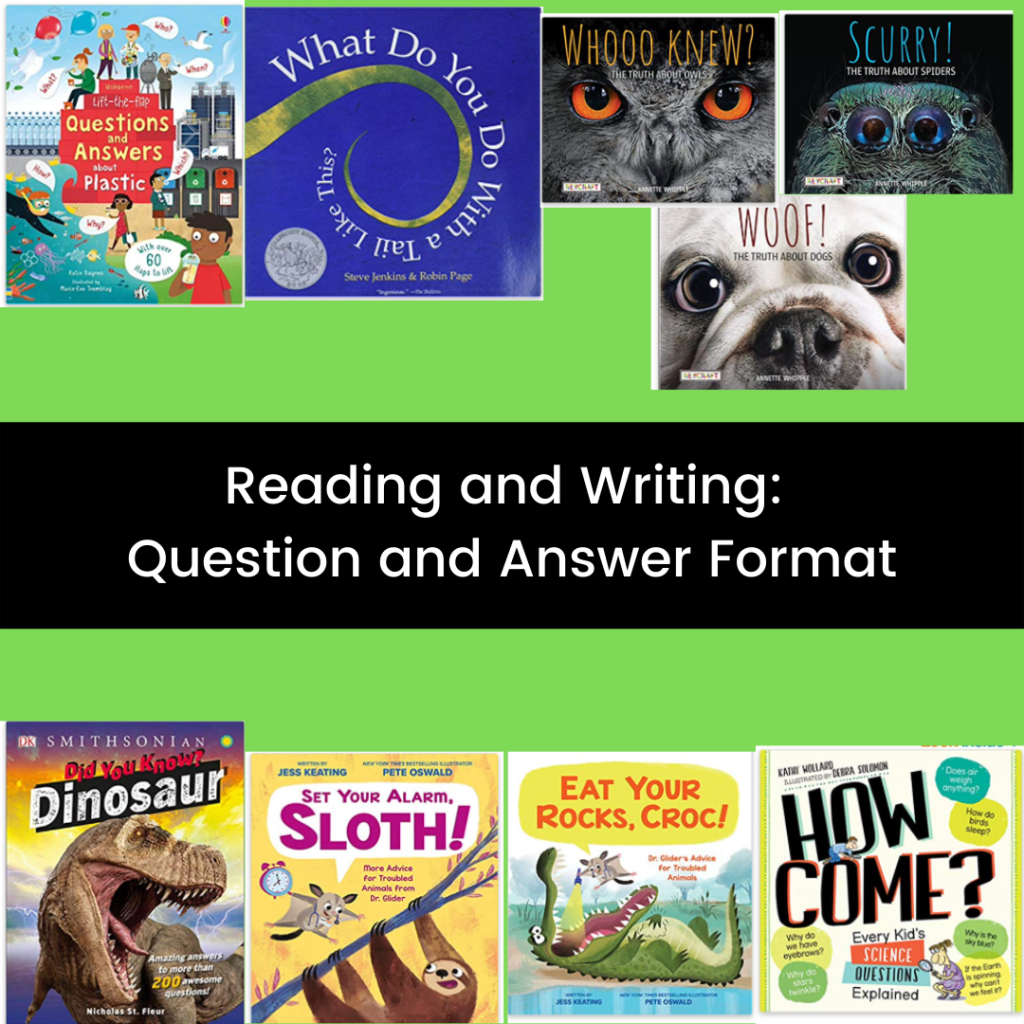
The Truth About…series is one of my favorite new nonfiction series. I discovered Whooo Knew? last year and was thrilled to see two more books in the series. Each of these books focuses on a different animal/living creature. Each two page spread answers a question about the topic such as “Do Dogs Sweat?”. The question is then answered in 2-3 short paragraphs followed by some extra details, photos and information. Each book also includes a glossary, extra information and an activity. This is a great series to begin a Q/A format study as they are very engaging, there is a lot to each page and there are a variety of access points for readers. And this author gives writers lots of new things to try!

These two books What Do You Do With a Tail Like This? and Lift-the-Flap Questions and Answers about Plastic give pages of questions on a topic. Even though the answers are quick, each page is worth studying for the ways the questions work together under a common topic. Part of writing good Q/A nonfiction is the ways in which the questions connect and fit under a bigger umbrella. These books are perfect to think more about that as both readers and writers. Sometimes I worry that kids love these books to just read facts but don’t do the deeper thinking of the umbrella ideas being shared. Both skills are so important. (Plus, what is more fun than a lift-the-flap informational book?)

I love the work of Nicholas St. Fleur (he does some kids informational infographic work in NY Times). His work is such a great mentor for the ways information can be organized to support reader understanding. His book. Did You Know ?Dinosaur is perfect to study… Young readers often love to spend lots of times with books like this but it is critical that we teach them how to navigate all that is on the page. As writers, thinking about ways to organize information on a 2 page spread is critical whether you are writing Q/A or some other format. Lots to learn from this one!

How Come? Every Kid’s Science Questions Explained gives readers and writers much longer answers to the questions posed. It’s important for our readers to see that most questions can’t be answered with a single sentence and this book helps to see how explanations give deep understanding to a concept. It will take stamina and strategy to read these and some would make great read aloud. As writers, there is lots to learn from these–great leads, solid explanations, intentional language and more. These are short texts that can also be used in small group work.

Writers are always trying to add humor to their books and this series by Jess Keating is a great model for thinking about ways to do that effectively. Keating shares so much interesting information but also embeds humor in a way that adds to the experience in Eat Your Rocks, Crocs and Set Your Alarm, Sloth.

This week’s books were linked at Bookelicious and/or  Cover to Cover Children’s Bookstore. If you are looking for a fabulous local children’s bookstore to support, Cover to Cover is an amazing one. We are lucky to have them in Central Ohio! If you don’t have an independent children’s bookstore in your town, check out Bookelicious. They are an online independent bookstore for children with an incredible curated collection. 

Franki’s Weekly Text Set: Indigenous People-Authentic Representations

Texts for this Text Set have been posted daily on Instagram.

Follow @TextSets there to get daily updates!

It is almost November and I’ve already seen horrible misrepresentations of Indigenous People as we near the Thanksgiving holiday. Our children learn harmful and incorrect stories of “Pilgrims and Indians” as early as preschool. Along with correct history, it is so important that our children learn about contemporary Indigenous People and see authentic representations in contemporary settings. This week’s text set focuses on books that feature lives of Indigenous people who are members of various nations today. I rely so much on the work of Dr. Debbie Reese and her blog American Indians in Children’s Literature and each of the books on this list have been reviewed on her blog. Please visit her blog to learn more about each of her books. And follow her daily on Twitter and commit to stop putting harmful misrepresentations of Indigenous People in front of our children.

We Are Still Here and Go Show the World are two books that have been instrumental for my own learning and two books that have helped me unlearn a great deal. Both books are both historical and contemporary. Both belong in every school and classroom library. We Are Still Here looks at history and helps us begin to unlearn and relearn what we thought we knew. And Go Show the World features several historic and modern-day Indigenous heroes. These are great for elementary age children as well as high school classrooms.

I love a good picture book biography and Sharice’s Big Voice and Mission to Space are two must-haves. Both tell the story of the impact of two heroes. The added bonus is that they are both autobiographies. Making sure we read biographies of present-day people making a difference is critical and making sure readers see a full and authentic representations of those people is just as critical.

Fry Bread has won so many awards! It is another modern day look at a Native American family and the ways Fry Bread bring family and friends together. Again, I love the connection between history and today as well as the diversity within the community shown in this book. Every detail of this book is brilliant–the end papers, the cover under the dust jacket, all of it!

A look at the tradition of the powwow, Bowwow Powwow is a must-have. This book packs so much information in while also seeing the powwow from a child’s eyes. The history and tradition of the powwow is embedded within a great story. This is another one that connects history to present-day.

First Laugh-Welcome Baby! is one of my new favorite books and this is one of the favorite celebrations I’ve learned about recently. In Navajo families, the first person to make a baby laugh, hosts a celebration. This book honors that celebration as well as the diversity within the family and community. The illustrations are incredible–so many details to notice.

This week’s books were linked at Bookelicious and/or  Cover to Cover Children’s Bookstore. If you are looking for a fabulous local children’s bookstore to support, Cover to Cover is an amazing one. We are lucky to have them in Central Ohio! If you don’t have an independent children’s bookstore in your town, check out Bookelicious. They are an online independent bookstore for children with an incredible curated collection. 

Franki’s Weekly Text Set–Wordless Picture Books: Invitations Into Conversations and Comprehension

Texts for this Text Set have been posted daily on Instagram. Follow @TextSets there to get daily updates!

This week, we’ll take a look at several wordless picture books that invite amazing conversations. I love sharing wordless picture books with students-especially early in the school year. The focus on visuals invites all readers into the conversation. Plus I can introduce so many reading behaviors and strategies as we ponder through these wordless books.

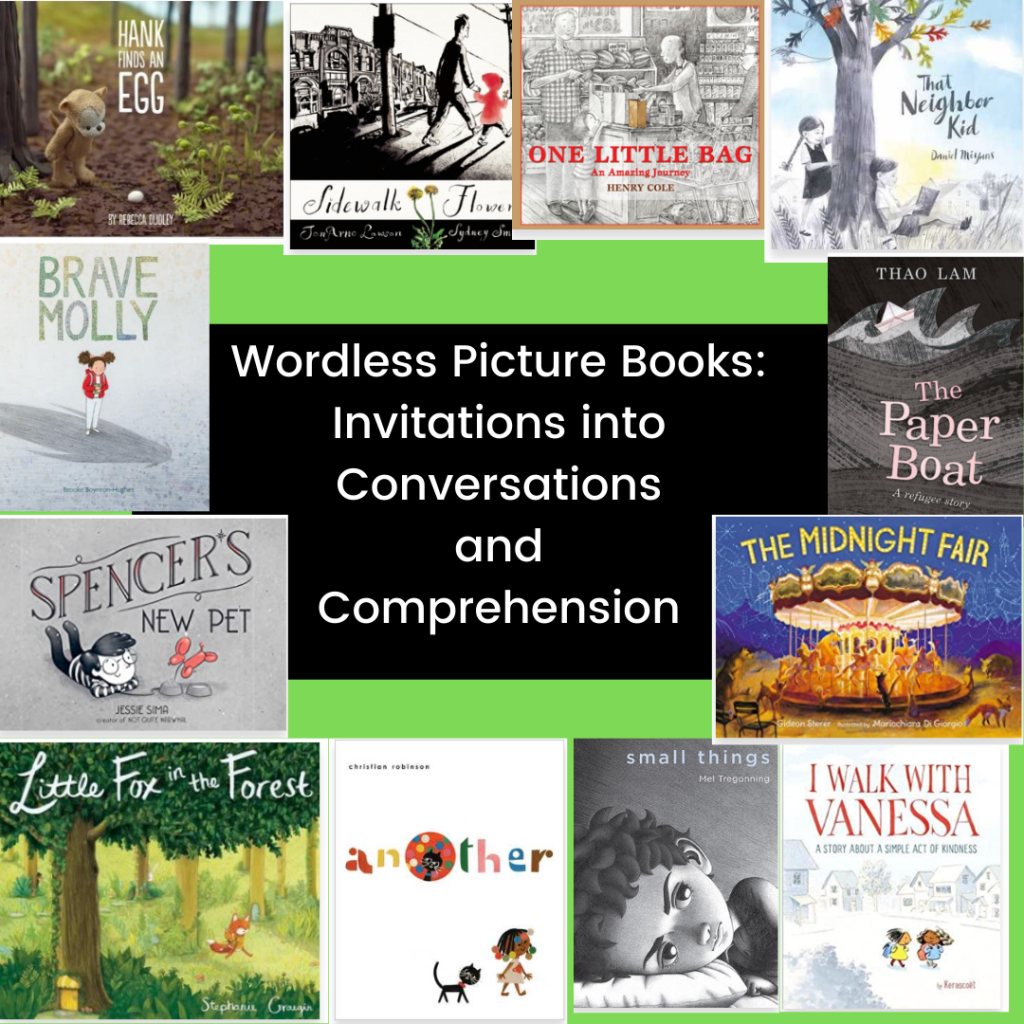
I want readers to know right away that there is a lot of thinking that happens when we read wordless books. And I also want to share books that they can’t help but talk about. By starting with books that leave you thinking, pondering, wondering and revisiting, readers of all ages can see all that wordless picture books have to offer and then eventually transfer those skills to all types of reading. Spencer’s New Pet and Another are two that I have used with readers of all ages. They are books that invite conversations, changes in thinking, inferring possibilities, rereading and more. A lot of thinking is required in each of these fabulous books!

I love these two wordless picture books-The Midnight Fair and Little Fox in the Forest for several reasons. The illustrations are amazing and there are so many details on each page. Readers can revisit and notice new things each time. Also, they are both fantasy so they are great for introducing the genre of fantasy to readers. I also love the endings to each of the books. There are access points for readers of all ages to experience these fabulous worlds!

There are many wordless picture books that take on more serious topics. Brave Molly, I Walk with Vanessa, and small things are three books that I think are important and they are books that can open important conversations with readers. They also have some details in illustrations (shadow in Brave Molly, shattered pieces in small things) that an be discussed as to what they symbolize. I would definitely read each of these carefully before sharing with children as (in my opinion) they need to be shared with care and conversation with an adult.

The Paper Boat is a newer wordless books that shares the journey of one refugee family. The author’s note is important to this one and revisiting the book after reading the author’s note will help readers see new things in the illustrations. The black and white with a bit of color is also something worth discussion in terms of the meaning.

These are some of my favorite wordless picture books as they all explore ways to make the world better. Sidewalk Flowers, Hank Finds and Egg, One Little Bag and That Neighbor Kid each have a very obvious message but they also have layers of meaning when looking and relooking at some details in the illustrations. These 4 are perfect for mini lesson work and independent reading and I think they work for all ages (PreK-Adult).

This week’s books were linked at Bookelicious and/or  Cover to Cover Children’s Bookstore. If you are looking for a fabulous local children’s bookstore to support, Cover to Cover is an amazing one. We are lucky to have them in Central Ohio! If you don’t have an independent children’s bookstore in your town, check out Bookelicious. They are an online independent bookstore for children with an incredible curated collection. (Warning: You will want to create a bookmoji while you are there. This will be the highlight of your weekend I’m sure! Below is one of mine:-)

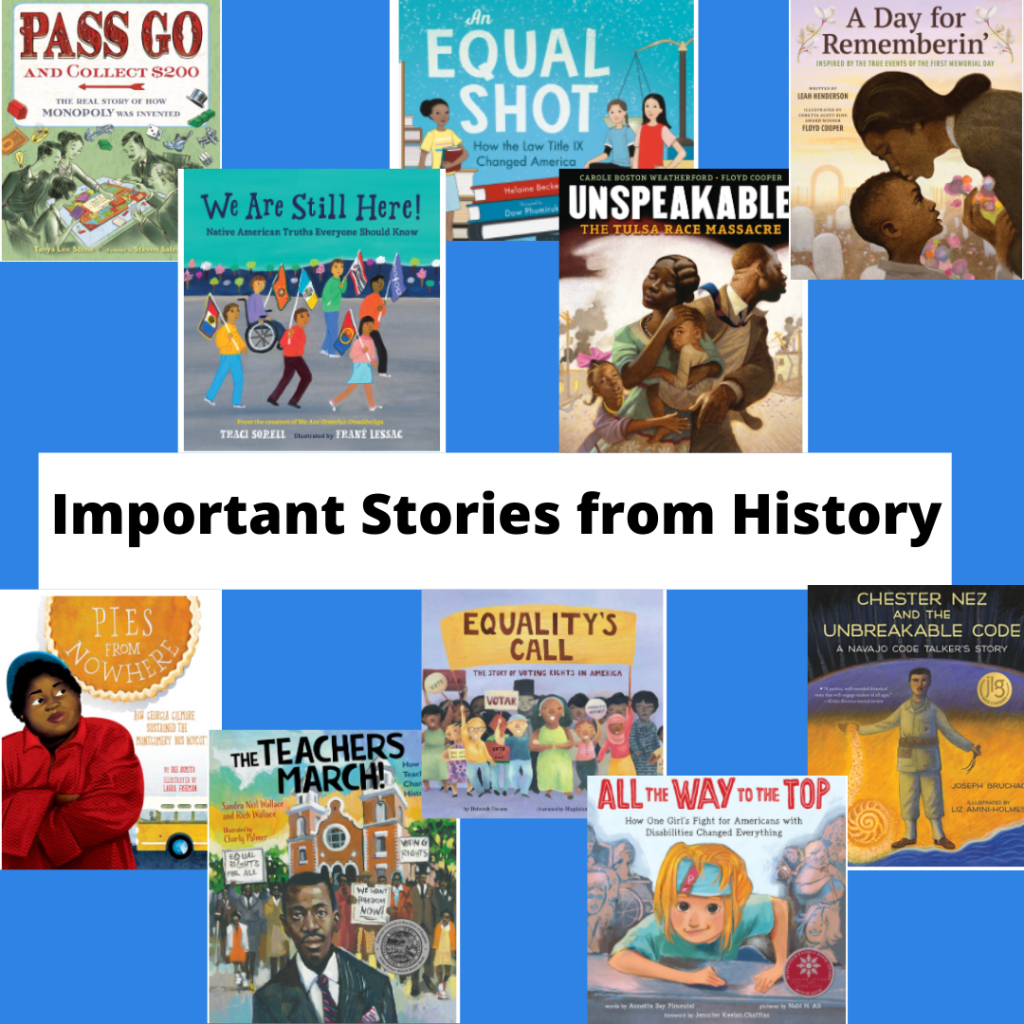
#PB10for10: Important Stories from History

It’s August 10 so you know what that means–time for Mandy Robek’s and Cathy Mere’s incredible #PB10for10. A day to find lots of great new books from so many people! This year’s posts are being curated at the blog Reflect and Refine so make sure to visit several times today so that you don’t miss a post. Also follow the hashtag #PB10for10 on social media.

This year, my 10 picture books are books that helped me learn about some story or piece of history that I didn’t know about. Thanks to Dr. Laura Jiménez, I have realized how much history I have not learned and how important it is for us to learn the history we missed. So much of this history was not taught when I went to school and with these great picture books, we can learn important history ourselves and we have great books to share with our students so they don’t miss this history. I’ve learned so much from each of these books and they are all perfect for elementary classrooms. This is certainly not a comprehensive list but it’s a good place to start.

Pass Go and Collect $200: The Real Story of How Monopoly Was Invented by Tanya Lee Stone

We Are Still Here: Native American Truths Everyone Should Know by Traci Sorell

Equal Shot: How the Law Title IX Changed America by Helaine Becker

Unspeakable: The Tulsa Race Massacre by Carole Boston Weatherford

A Day for Rememberin’: The First Memorial Day by Leah Henderson

Pies from Nowhere: How Georgia Gilmore Sustained the Montgomery Bus Boycott by Dee Romito

The Teachers March: How Selma’s Teachers Changed History by Sandra Neil Wallace and Rich Wallace

Equality’s Call: The Story of Voting Rights in America by Deborah Diesen

All the Way to the Top: How One Girl’s Fight for Americans with Disabilities Changed Everything by Annette Bay Pimentel

Chester Nez and the Unbreakable Code: A Navajo Code Talker’s Story by Joseph Bruchac