Read Aloud and Text Complexity

Read Aloud is one of the most important parts of the school day. For one, it is joyful-there is nothing like sharing a story as a community. Secondly, it is a time in the school day that supports growing readers in so many ways. For readers in Grades 2-5, read aloud can do so much to support growing readers in understanding the complexities in text. 

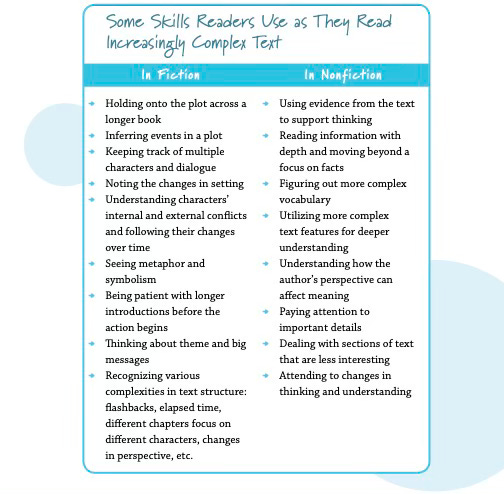
When we wrote In Community With Readers: Transforming Reading Instruction with Read Alouds and Minilessons, we identified several skill that are important as children move from picture books that you can read in one sitting to chapter books. This list is in no way comprehensive, but it does help us think about the experiences children need with text as they become more independent with complex texts.
So, I am always reading with an eye toward read aloud, asking myself, “How can this book support readers, especially those who are new or semi-new to longer chapter books?” When I am reading with this lens, I know I want some features that may be new to readers, but I don’t want a read aloud that is so complex that I have to do the thinking for readers. I’m always looking for a book that can become a really good scaffold for growth and with many access points for the variety of readers in a classroom. This summer I found a book that I think is a perfect read aloud for grades 3 and 4—Growing Home by Beth Ferry, with art from The Fan Brothers.
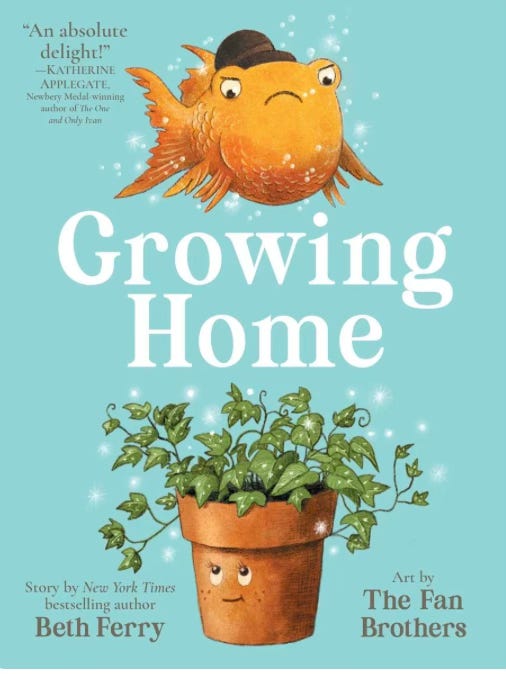
I picked the book up because I love everything I’ve read by The Fan Brothers. But I had no idea what to expect. This book is the perfect illustrated chapter book and I found so many reasons it would make a great read aloud as I read. It has:

  • a plot that is accessible to young readers
  • an accessible theme
  • strong characters
  • endpapers worth talking about
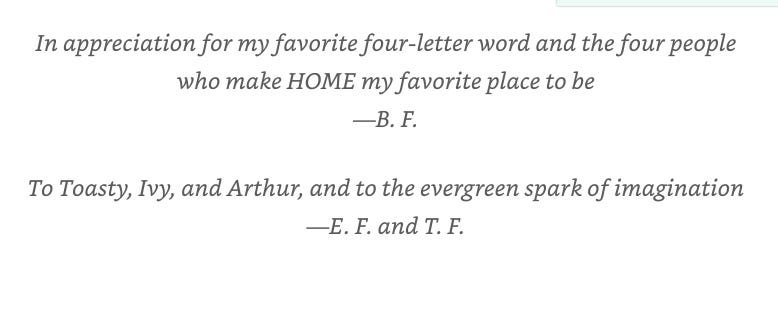
  • a dedication that adds meaning
  • a Prologue, which might be a new feature for middle grade readers
  • Back Matter: “Letters from Toasty”, which adds a bit to understanding the character
  • Foreshadowing that is accessible

I like that the book is an accessible fantasy. So many middle grade readers love fantasy adn this one is anchored in realism so the setting (a home) is not one they have to imagine. 

I like the dedication page for several reasons. Readers often skip these, but when we teach kids that the author often gives clues about the theme, etc. in the dedication, it adds some depth to the reading. These dedications will definitely give readers some angles to think about through the story.
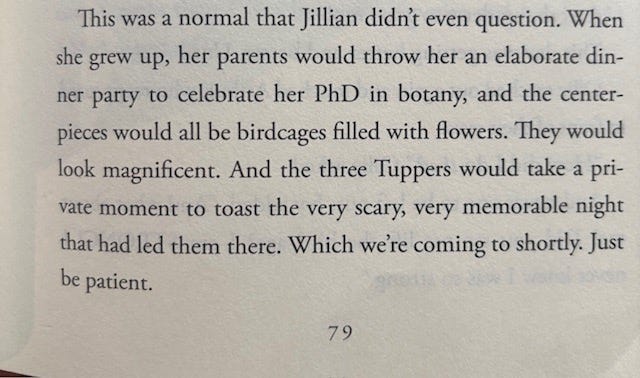
I also love what the author does with foreshadowing. Foreshadowing is such a common literacy technique but often young readers miss the foreshadowing. Luckily, in this book, the author adds a bit to make the foreshadowing a bit accessible. She adds a sentence after the foreshadowing in case readers missed it. She writes, “We’re coming to that shortly. Just be patient.”
I think Growing Home is a book middle grade readers will LOVE and one that will help them grow as readers. The characters are fabulous, the theme is accessible and there is so much to talk about as you read. And for readers who don’t know this author or these illustrators, this book is a great introduction that might inspire them to read more of their work. Enjoy!
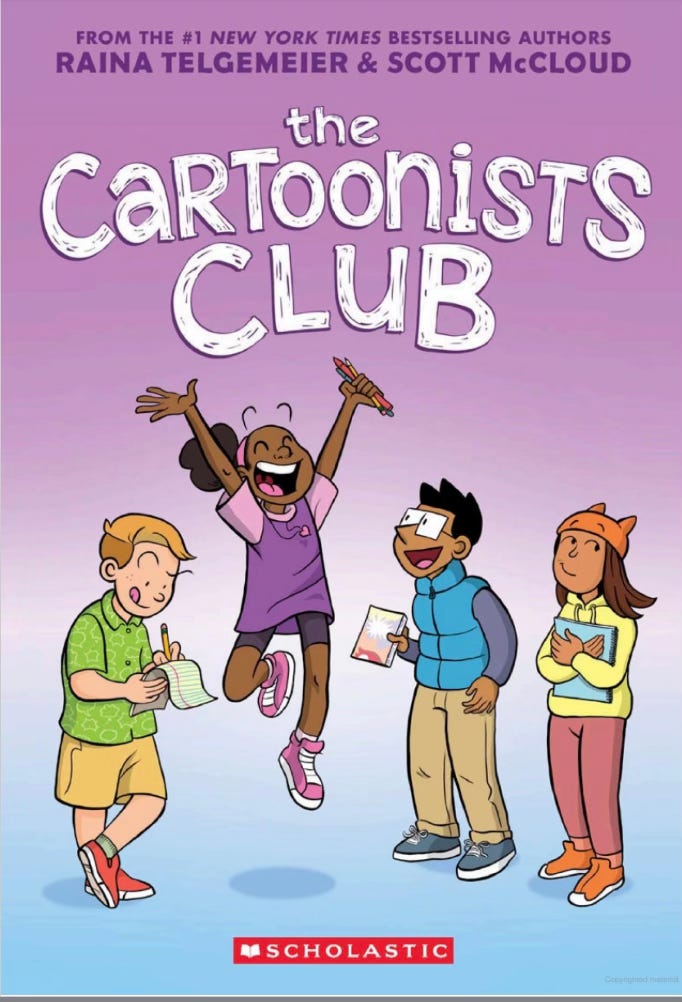
The Cartoonist Club by Raina Telgemeier and Scott McCloud

*My posts and reviews focus on books in the classroom and library. I am passionate about sharing books that invite natural conversations and learning and choosing the books we share with intention. I am always looking for books that kids will love AND that will support their growth as readers and writers.

I am not a natural graphic novel reader. But, as a teacher, it isn’t about what I like or what is easy for me as a reader. So, I’ve worked hard over the years to learning to read and understand graphic novels—really using both words and visuals to create meaning. And in that time, I’ve seen the power of graphic novels in the classroom. 

As a person who is not a reader of graphic novels, I was surprised at the diversity and sophistication of graphic novels available to elementary readers. Once I embraced graphic novels, I saw the powerful stories that are told and I’ve seen readers try a new genre because it’s in graphic novel format. I’ve seen middle grade readers grow in so many ways when graphic novels are part of their reading lives. 

I also think there are readers like me, who don’t really understand how to read a graphic novel. As a 4th and 5th grade teacher, incorporating graphic novels into minilessons and read alouds was important as we could grow together as readers of graphic novels. 

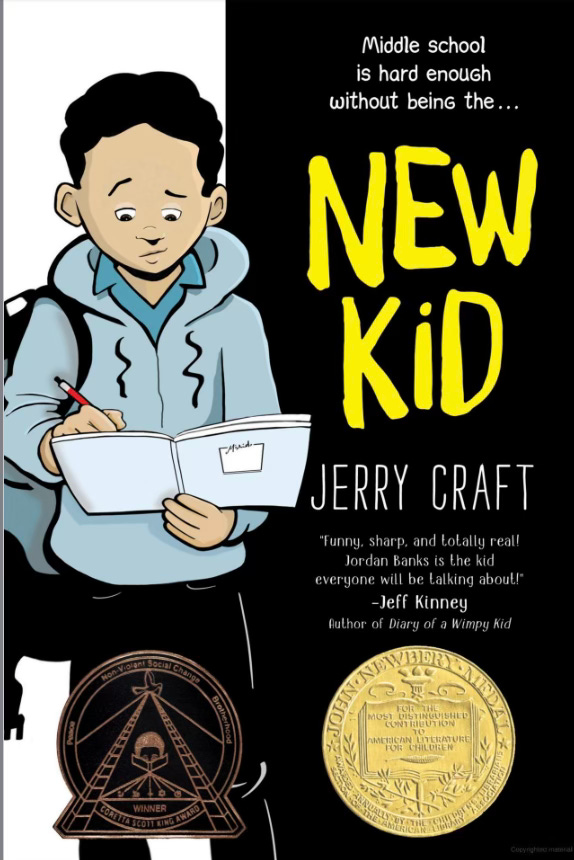
In one of my years teaching 5th grade, I chose New Kid by Jerry Craft as a read aloud. AND instead of reading it myself, I shared the audio version while I projected the ebook on the large board. The read aloud was powerful for so many reasons. The narrator read more than just the words on the page. The narrator narrated the images as part of the audio. We could not only talk about the incredible story and characters, but we could talk about how we navigate a graphic novel and the ways that words and images work together. 

I just discovered a new graphic novel that I think is an important one. It is The Cartoonist Club by Raina Telgemeier and Scott McCloud. This is the story of a group of middle school students who start a club where they write comics and graphic novels. They have an incredible librarian who facilitates the club and teaches them important things about the craft of creating graphic novels. 

I am currently using this book with a small group in a Graphic Novel Writing Club and it is sparking such great conversations and inviting them to try new things as writers. Just this week, one of the students looked back at the section where the club was talking about showing characters’ feelings through facial expressions and she revisited that part of the book to revise the frame she was working on.

I love the book for so many reasons. First of all, for fans of Raina Telgemeier, this is another book and one that is a bit different for her. For readers who. have read all of her books, this book will give them insights into the choices she makes when creating and will invite them to read with more depth. For readers new to graphic novels, this book might help them make sense of how they work and for children who write in this format, this book is a must-have! Our Graphic Novel Club members are already marking pages they want to go back to. I imagine this being a well-worn book for graphic novel writers everywhere!

There are some other backmatter components I love in this book. The “About the Author” page is done visually which is unique and a great invitation for writers. There is an interview with Raina and Scott that lets us know so much about the story behind the story. There is a glossary and a list of jobs that are available to cartoonists. My favorite piece of backmatter is the “How We Made This Book” section that shares the process that the two used to collaboratively create this book. The backmatter alone invites some great conversation and learning.

This is a book I’d definitely have in my classroom library and would possibly read aloud to the whole class or share in a small group setting. It does a lot of teaching naturally and I’ve found that reading aloud a graphic novel lets the entire class know that they are valued and important for readers. There are so many opportunities for conversation about the characters and also about reading and writing graphic novels. 

Check out The Cartoonist Club Book Trailer! and an Interview With the Creators.

Slice of Life: Book Awards

Thank you to Two Writing Teachers for creating an amazing community of writers and a safe, welcoming space to write and share.

Yesterday was one of the happiest days of the year: ALA Youth Media Award Day!

Back in 2006 when Franki and I started the original A Year of Reading blog, our main purpose was to have a public chat about books all year and then see who could pick the Newbery and Caldecott in January.

We have rarely been right, but along the way, we found ways to give each other grace. The winner was in your Amazon cart? That counts. On the stack beside your bed? Counts. On reserve from the library but hasn’t arrived yet? Definitely counts. And my new one this year — read halfway through but didn’t love it and abandoned it? Still counts.

For a retired person, I’m pretty proud of how many winners in different award categories I read: American Indian Youth Literature Awards (CONTENDERS and MASCOT), Coretta Scott King (BIG, THERE WAS A PARTY FOR LANGSTON, AN AMERICAN STORY), YALSA Award for Excellence in Nonfiction for Young Adults (NEARER MY FREEDOM), Pura Belpré (REMEMBERING, 1/2 of MEXIKID), Robert F. Sibert Informational Book Award (THE BOOK OF TURTLES, JUMPER [on hold at the library]), Caldecott (IN EVERY LIFE, THERE WAS A PARTY FOR LANGSTON, BIG), Newbery (1/2 of MEXIKID).

I’ve got the Newbery winner, THE EYES & THE IMPOSSIBLE by Dave Eggers on reserve at the library but rather than going back to fill in any other holes, I’m going to concentrate on reading all the best that 2024 has to offer.

Did you read some winners in 2023? What 2024s are already on your TBR stack?

Franki’s Weekly Text Set–Authors Who Write Across Formats and Genres

Finding authors we love is also so important to any reading community, and when we find an author we love, we want to read everything by that author.I love authors whose work spans formats and genres. I love this for readers and for writers in the classroom. As a middle grade teacher, it was so important to. me that both chapter books and picture books are valued in the classroom. Making sure we had author baskets that spanned both is critical. I also love authors that children can grow up with-who have written books for a variety of stages. This week, we’ll take a look at several authors who have such a huge variety of books. This is important for our readers and for our writers.

This week, we’ll start off with the two authors who inspired this text set-Kyle Lukoff and Donna Barba Higuera. Last week, when the awards were announced, I was THRILLED to see Too Bright to See because I am a huge fan. A must read for everyone. And The Last Cuentista was one I had on order but hadn’t read yet. When I looked dup the author after she won the Newbery, I realized she had written a picture book I love-El Cucuy is Scared Too!–and I mentioned to my friend Stella, how much I LOVE authors who write both picture books and chapter books. For our readers, especially in middle grades and beyond, having baskets of books by authors who write both picture books and chapter books can put renewed value in picture books for older children. And as writers, studying an author’s body of work, across formats is always so powerful. Thinking back, I don’t think I thought hard enough about all of the author baskets I SHOULD have had in my classroom like these.

Since we are talking about awards, let’s move right to Grace Lin, who won the 2022 Children’s Literature Legacy Award!! Grace Lin has written so many incredible books–from middle grade novels to picture books, to early series books to math board books. She writes across so many formats and genres. One of my favorite authors to read and definitely a favorite to study as a writer.

Kate Messner and Jess Keating are two of my favorite middle grade writers. I love that they write fiction and nonfiction that is so engaging for this age. And they both write a great deal of both fiction and nonfiction which I love. And so many interesting topics across nonfiction. I also love how often they weave their nonfiction interests into their novels. Both authors have nonfiction series books which I am a huge fan of!

Andrea Davis PInkney and Kwame Alexander have each created such a beautiful collection of poetry in various formats and genres. These two authors have so much to offer both readers and writers. I love that both authors invite readers into poetry in various ways and also invite readers to expand what they read–once they discover one book, they’ll want to read others by the author and naturally expand the types of things they read. And our writers can learn so much about word choice, etc. Love these two!

I will read anything and everything that Jacqueline Woodson and Kate DiCamillo write. These two are both brilliant writers who understand children so well. Their books are well loved by all ages. As with the other authors, they both write such a variety of books. These are also two authors readers can grow up with, always finding something new as they grow as readers. Lucky us to have these two in the world of children’s literature.

This week’s books were linked at Bookelicious. If you don’t know Bookelicious, check it out today. It is an online independent children’s bookstore with an incredible selection of children’s books and many supports for young readers. Lots of great free events for teachers coming up that you can check out and register here

Follow @TextSets on Instagram for daily books/weekly text sets!