Poetry Friday: Sedoka

Image from the front page of The Burlington (CO) Record

I thought I was writing this poem to the photo that appeared on the front page my hometown newspaper, but as it turns out, the poem also has echoes in an extraordinary book that I finished just last night. THE ANTIDOTE by Karen Russell is set in Nebraska in 1935 between two cataclysmic environmental events: the Black Sunday dust storm and the flooding of the Republican River (24 inches of rain in 24 hours). So it’s a story of the land, but inseparably, it’s a story about the people there. Here’s how Russell (with James Riding In) describes what she attempted to do in THE ANTIDOTE:

THE ANTIDOTE uses fantastical conceits to illuminate the holes in people’s private and collective memories, the willful omissions passed down generation to generation, and the myths that have been used by the U.S. government and White settlers to justify crimes against the citizens of Native Nations and the theft of Native lands.

It was a book that puzzled me at first, then fascinated me, then horrified me, then made me read the last hundred pages at a gallop (which is why I’m “late” posting), then ultimately left me with some measure of hope.

Which brings us back to the photo and the poem. I grew up at the edge of the same Pawnee lands in THE ANTIDOTE, in a part of the country where White farming techniques have resulted in loss of topsoil and the depletion of the Ogallala Aquifer. And I grew up with the myth of the noble (White) farmers, who toiled at the whim of the sparse rainfall and the destructive summer storms, and whose hope was what kept them going.

It’s time to tell the truth. All of it. And it’s time to listen to the land and agree to change the ruinous human part of our relationship with her. She wants to live, and she can heal, if we let her. If we help her.

Marcie has this week’s Poetry Friday roundup at Marcie Flinchum Atkins. You can find there the Poetry Sisters who had the bandwidth to write to this month’s challenge, to write a sedoka, along with others who joined in the challenge.

PLEASE NOTE THESE CHANGES IN THE POETRY FRIDAY HOSTING SCHEDULE: Heidi and Margaret are changing places, so Heidi will now host on August 15, and Margaret will host on September 5.

Sixteen

In January of 2006, Franki and I started blogging at A Year of Reading. We had no idea what we were doing, but we jumped in and gave it a whirl. The blog was intended to be a place where we would chat about books and make our Newbery predictions.

The first few months of posts sound like a text thread. We were definitely just talking to each other when we started. Comments weren’t really a thing that first year.

In June of 2006, the term Kidlitosphere was coined.

We figured out hyperlinks in the first month, but our first post with a picture didn’t happen until July. Also in July was the first time we posted a Poetry Friday post, but there’s no mention of a roundup and no comments. In July 2006, we started our “100 Cool Teachers in Children’s Literature” list.

In August we were tagged by another blogger.

September was big — we wrote fib poems AND received a comment from Greg Pincus, the inventor of this then-new form!

October brought the first Cybils.

There is mention in November of a Poetry Friday roundup, but no link.

We hit 150 Cool Teachers in December.

Between 2007 and 2021 there is a decade and a half of great content, but also many broken links and innumerable images that need to be resized, replaced, or deleted. Hence, the reason we left Blogger and came over to WordPress.

So here we are, but now what?

Now that we’ve retired from full time teaching, we’ll continue to try to figure out who we are and/or what we’ll become.

As for this blog, because information now flows in so many streams and channels and tidal waves, we’re going to go back to the way we started: we’re just going to keep giving this a whirl and let it evolve as we do!

Here’s to whatever’s next for however long it lasts!

#PB10for10: Important Stories from History

It’s August 10 so you know what that means–time for Mandy Robek’s and Cathy Mere’s incredible #PB10for10. A day to find lots of great new books from so many people! This year’s posts are being curated at the blog Reflect and Refine so make sure to visit several times today so that you don’t miss a post. Also follow the hashtag #PB10for10 on social media.

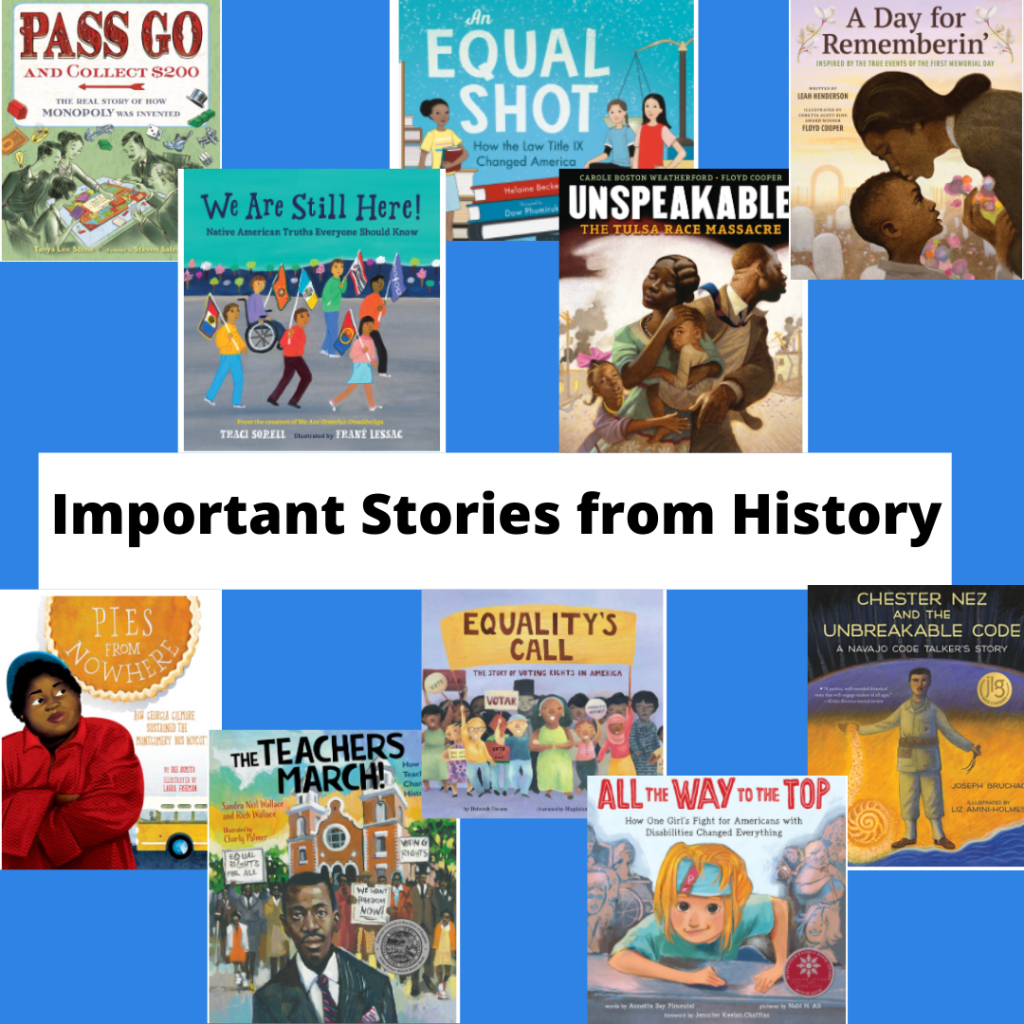
This year, my 10 picture books are books that helped me learn about some story or piece of history that I didn’t know about. Thanks to Dr. Laura Jiménez, I have realized how much history I have not learned and how important it is for us to learn the history we missed. So much of this history was not taught when I went to school and with these great picture books, we can learn important history ourselves and we have great books to share with our students so they don’t miss this history. I’ve learned so much from each of these books and they are all perfect for elementary classrooms. This is certainly not a comprehensive list but it’s a good place to start.

Pass Go and Collect $200: The Real Story of How Monopoly Was Invented by Tanya Lee Stone

We Are Still Here: Native American Truths Everyone Should Know by Traci Sorell

Equal Shot: How the Law Title IX Changed America by Helaine Becker

Unspeakable: The Tulsa Race Massacre by Carole Boston Weatherford

A Day for Rememberin’: The First Memorial Day by Leah Henderson

Pies from Nowhere: How Georgia Gilmore Sustained the Montgomery Bus Boycott by Dee Romito

The Teachers March: How Selma’s Teachers Changed History by Sandra Neil Wallace and Rich Wallace

Equality’s Call: The Story of Voting Rights in America by Deborah Diesen

All the Way to the Top: How One Girl’s Fight for Americans with Disabilities Changed Everything by Annette Bay Pimentel

Chester Nez and the Unbreakable Code: A Navajo Code Talker’s Story by Joseph Bruchac