Slice of Life: Poetry Tournament

Thank you to Two Writing Teachers for creating an amazing community of writers and a safe, welcoming space to write and share.

My job title for the after school program is “Reading Specialist,” but I much prefer “Reading Enricher” or “Lead Reader.” I am blessed with the freedom to be creative and to choose the books I share (and ostensibly, the lessons I teach.)

We spent National Poetry Month immersed in poetry. I chose matching pairs of poems by two of my favorite children’s poets, Douglas Florian and David Elliott. Their poems are similar: usually funny, often with puns or word play, and short enough to be just the right size for the small amount of time I have at each of my sites. I created a tournament bracket that pitted Hummingbird against Hummingbird, Barn Cat against Persian, Giraffe against Giraffe and Stegosaurus against Stegosaurus. 

As we read and discussed the poems before voting, the lessons of the children’s classroom teachers shone through their comments. The children identified and celebrated rhythm and rhyme. A third grader compared simile to metaphor. A fifth grade boy praised one poem’s hyperbole. Two fifth grade girls traded lines as they recited William Carlos Williams’ “The Red Wheelbarrow.” Kindergarteners identified (and preferred) the more positive message in Elliott’s “Stegosaurus:” 

“…there’s some-
thing more
to life
than just
intelligence.”

In the end, “Barn Cat” by David Elliott won the first side of the bracket, and Douglas Florian’s “Stegosaurus” won the second side. So it was 

The Barn Cat
by David Elliott

Mice
had better
think twice.

versus

Stegosaurus
by Douglas Florian

Ste-go-SAUR-us
Her-bi-VOR-ous
Dined on plants inside the forest.
Bony plates grew on its back,
Perhaps to guard it from attack.
Or to help identify
A Stegosaurus girl or guy.
Its brain was smaller than a plum.
Stegosaurus was quite DUMᗺ.

A group of older students at one of the sites helped me brainstorm a list of the qualities of poems to guide the final voting away from choice based on a favorite animal or illustration and towards rhythm, rhyme, word choice, details, and message: poems that make you think, poems that surprise you.

By a vote of 25 to 19, “Stegosaurus” by Douglas Florian won. It was valued most for its rhythm and rhyme, and for the humor in the surprising word choice at the end. “Barn Cat” owed its strong showing to the rhyme, the realism, and the way the reader has to think in order to understand the poem and its humor.

Franki’s Weekly Text Set: What Can an Author’s Note Be?

Texts for this Text Set have been posted daily on Instagram. Follow @TextSets there to get daily updates!

This week, we’ll look at a set of books that could be a mini-cycle on Authors’ Notes. I used to be a reader who skipped things like the author’s note in a book. But one day I walked into Lynsey Burkins’ 3rd grade classroom and they were talking about an author’s note and I was intrigued. I realized all that I had been missing and started paying attention to authors’ notes. Lots of readers are like me and miss out on this critical piece of a book. This week, we’ll take a look at various things an author’s note can be in terms of how it often adds to the main text in such important ways. I could see using this set of picture books for a weeklong study to introduce readers to the power of author’s notes and the things we miss when we skip them!

A Walk in the Words is a great book to introduce Authors’ Notes to readers. Author’s notes do different things but USUALLY an author’s note shares an author’s connection to the story they just wrote. This author’s note does just that which is why I think it is a great introduction. This is a story of a child who struggles to learn how to read and the author’s note lets the reader know that this is based on the author’s childhood. I love it as an introduction to author’s notes and also to talk about credibility of an author when they write about difficult topics. As a reader, I want to know that someone writing about difficulty learning to read, actually experienced difficulty. That’s important if I want to trust the author. In this mini-study of Author’s Notes, I’d ask students to name what this author did in this author’s note (share his personal story/connection with readers). Love this book and the author’s note. A much better story when you don’t skip the author’s note!

I love The Year We Learned to Fly and I loved it even more after I read the Author’s Note at the end. Jacqueline Woodson does connect her own life to the book. But she does more than that. She pays tribute to Virginia Hamilton and her book, part of her inspiration. The combination of these two ideas in the Author’s Note gives readers a new way to understand the story and to become curious about Virginia Hamilton’s work. It is a short and powerful Author’s Note that brings new meaning to the main text of the book.

Paletero Man and Delicious are books of pure joy! Both celebrate street food! The Author’s Note in Paletero man (in both Spanish and English) shares the joy of the memories the author has as well as a bit of the history of street food in Los Angeles. The author also shares the cultural connection. I included Delicious even though it doesn’t have an author’s note. Instead, this book of poems, each celebrating street food from a different place in the world, has something else at the end (another mini-unit for another time maybe). The author gives us more information connected to each of the places or types of street food in the poem. Little chunks of information that go along with each poem!

Dad Bakes is a wonderful story of the love between a dad and a child. It is a simple story of the two baking together and also of the dad going off to work at night so bread is ready and warm in the morning. The Author’s Note shares information from the author’s experiences around incarceration and organizations that support individuals and families after incarceration. So this author note gives lots of information but also connects readers with organizations that they may want to support after reading the story. It is an Author’s Note that could also be read as a call to act/help. Rereading the story after reading the Author’s Note is also important as it is a bit of a different experience with the new knowledge.

Authors’ Notes are important in fiction books but they are equally if not more important when reading nonfiction. In The People Remember, the author includes a long Author’s Note that does so many important things for the reader. The author embeds information with personal memories and important moments. She also highlights the 7 principles of Kwanza and adds a historical timeline. This is a very important book and the Author’s Note is a generous addition with so much more to learn and understand for readers.

This week’s books were linked at Bookelicious and/or  Cover to Cover Children’s Bookstore. If you are looking for a fabulous local children’s bookstore to support, Cover to Cover is an amazing one. We are lucky to have them in Central Ohio! If you don’t have an independent children’s bookstore in your town, check out Bookelicious. They are an online independent bookstore for children with an incredible curated collection.

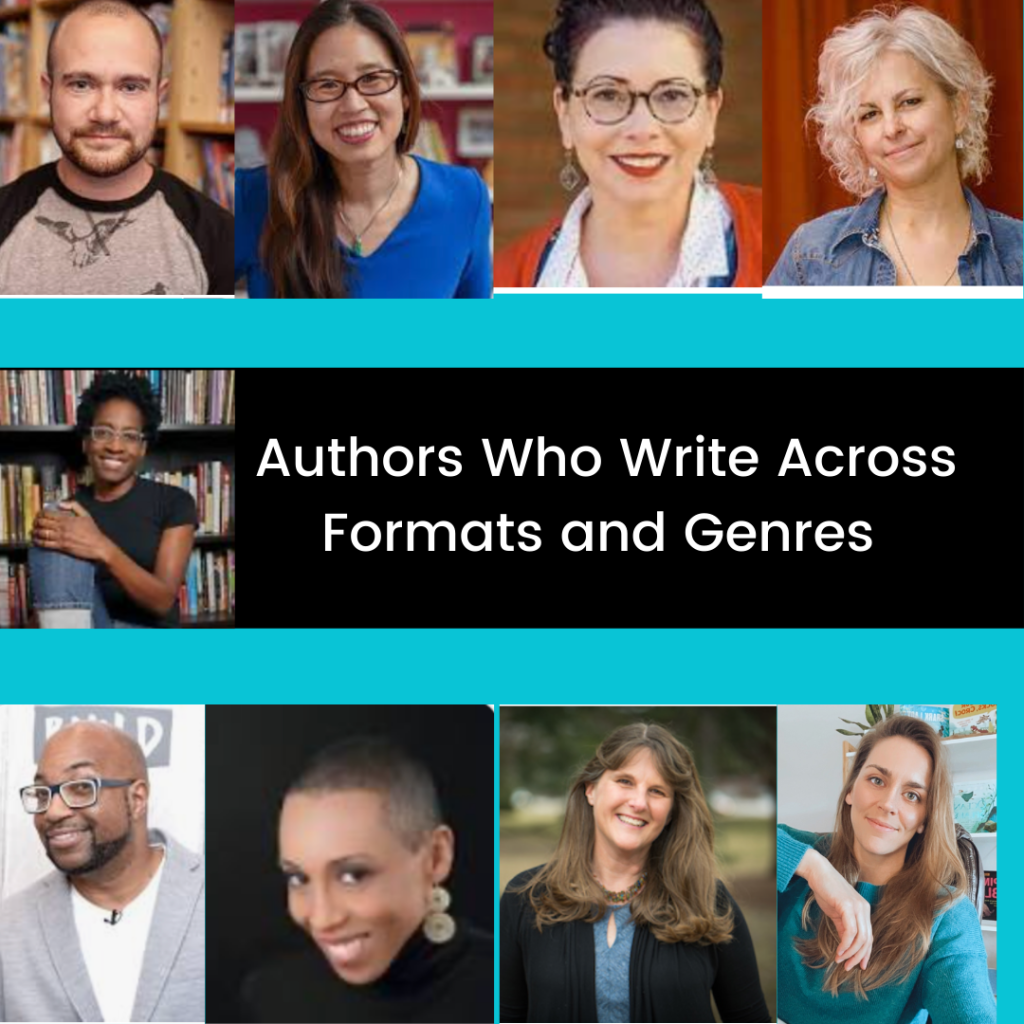
Franki’s Weekly Text Set–Authors Who Write Across Formats and Genres

Finding authors we love is also so important to any reading community, and when we find an author we love, we want to read everything by that author.I love authors whose work spans formats and genres. I love this for readers and for writers in the classroom. As a middle grade teacher, it was so important to. me that both chapter books and picture books are valued in the classroom. Making sure we had author baskets that spanned both is critical. I also love authors that children can grow up with-who have written books for a variety of stages. This week, we’ll take a look at several authors who have such a huge variety of books. This is important for our readers and for our writers.

This week, we’ll start off with the two authors who inspired this text set-Kyle Lukoff and Donna Barba Higuera. Last week, when the awards were announced, I was THRILLED to see Too Bright to See because I am a huge fan. A must read for everyone. And The Last Cuentista was one I had on order but hadn’t read yet. When I looked dup the author after she won the Newbery, I realized she had written a picture book I love-El Cucuy is Scared Too!–and I mentioned to my friend Stella, how much I LOVE authors who write both picture books and chapter books. For our readers, especially in middle grades and beyond, having baskets of books by authors who write both picture books and chapter books can put renewed value in picture books for older children. And as writers, studying an author’s body of work, across formats is always so powerful. Thinking back, I don’t think I thought hard enough about all of the author baskets I SHOULD have had in my classroom like these.

Since we are talking about awards, let’s move right to Grace Lin, who won the 2022 Children’s Literature Legacy Award!! Grace Lin has written so many incredible books–from middle grade novels to picture books, to early series books to math board books. She writes across so many formats and genres. One of my favorite authors to read and definitely a favorite to study as a writer.

Kate Messner and Jess Keating are two of my favorite middle grade writers. I love that they write fiction and nonfiction that is so engaging for this age. And they both write a great deal of both fiction and nonfiction which I love. And so many interesting topics across nonfiction. I also love how often they weave their nonfiction interests into their novels. Both authors have nonfiction series books which I am a huge fan of!

Andrea Davis PInkney and Kwame Alexander have each created such a beautiful collection of poetry in various formats and genres. These two authors have so much to offer both readers and writers. I love that both authors invite readers into poetry in various ways and also invite readers to expand what they read–once they discover one book, they’ll want to read others by the author and naturally expand the types of things they read. And our writers can learn so much about word choice, etc. Love these two!

I will read anything and everything that Jacqueline Woodson and Kate DiCamillo write. These two are both brilliant writers who understand children so well. Their books are well loved by all ages. As with the other authors, they both write such a variety of books. These are also two authors readers can grow up with, always finding something new as they grow as readers. Lucky us to have these two in the world of children’s literature.

This week’s books were linked at Bookelicious. If you don’t know Bookelicious, check it out today. It is an online independent children’s bookstore with an incredible selection of children’s books and many supports for young readers. Lots of great free events for teachers coming up that you can check out and register here

Follow @TextSets on Instagram for daily books/weekly text sets!