This NPM, I am writing acrostic poems using words from the Banned Words List at the Pen America Website. You can find my poems each day on Poetrepository, IG stories, and BlueSky.
This NPM, I am writing acrostic poems using words from the Banned Words List at the Pen America Website. You can find my poems each day on Poetrepository, IG stories, and BlueSky.
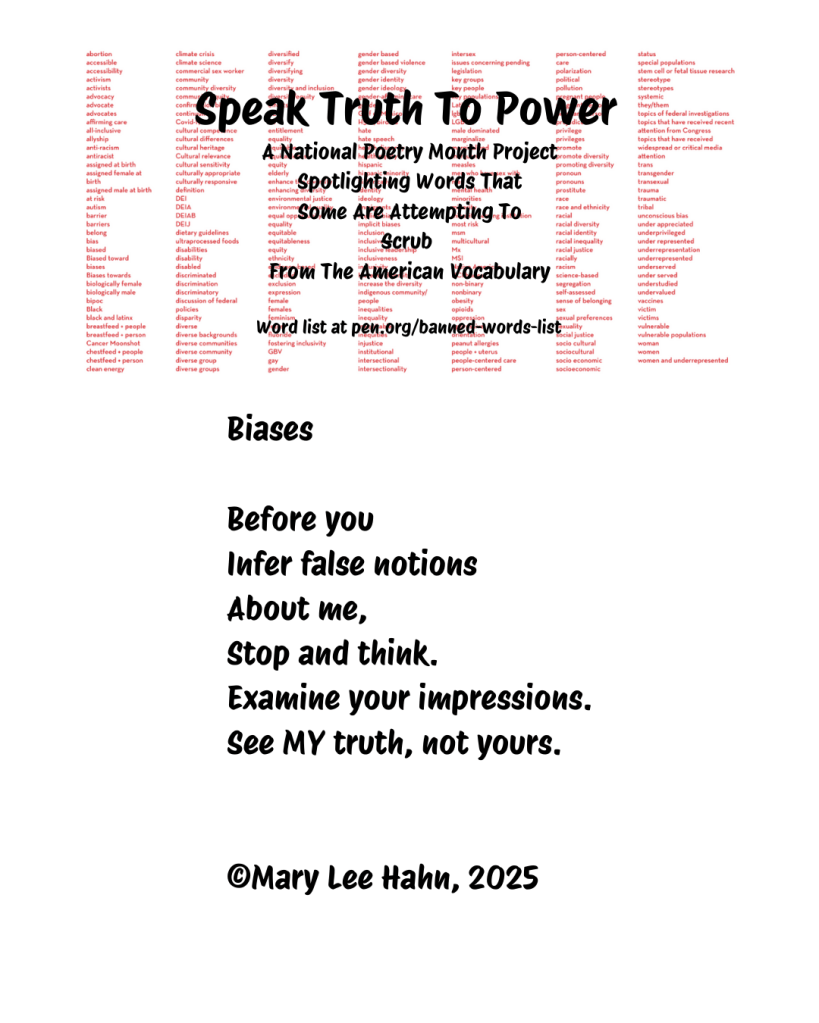
Today, April 4, is an Inklings challenge day. Margaret invited us to try a Shadorma, a Spanish 6-line syllabic poem of 3/5/3/3/7/5 syllable lines respectively. So today’s poem, “Biases,” is a Shadorm-acrostic!
Here’s what the rest of the Inklings came up with, if life gave them the elbow room this month to write:
Thank you to Two Writing Teachers for creating an amazing community of writers and a safe, welcoming space to write and share.
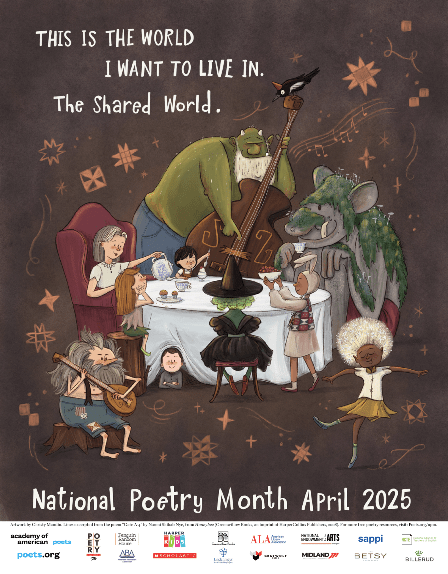
Goodbye Slice of Life March Challenge…hello National Poetry Month Poem-a-Day Challenge!
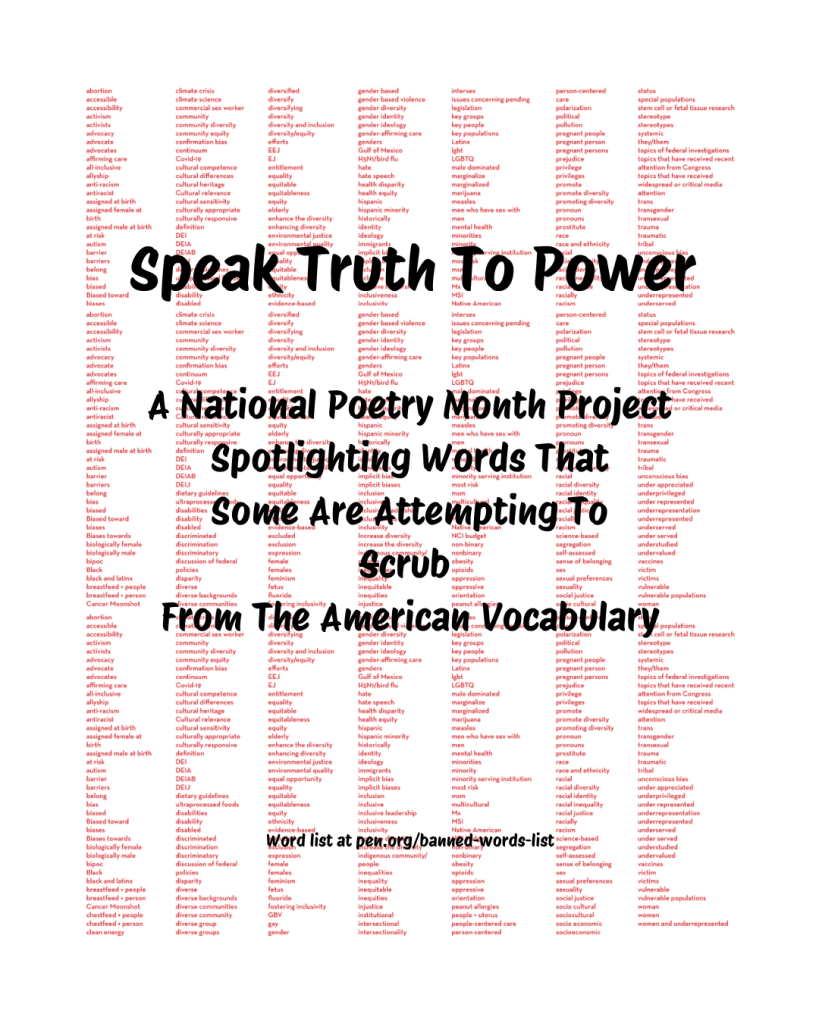
This NPM, I will be writing acrostic poems using words from the Banned Words List at the Pen America Website.
It’s up to us to keep the truth in American history, and in science. It’s up to us to keep reading, thinking, and being as gloriously weird as possible. We must push back against the urge to obey in advance and we must defend our institutions. We must not let someone else dictate the language we choose to tell our stories, name our cultures and landmarks, and prevent us from telling all kinds of truths. I’ll do my small part by keeping some of the “banned” words in circulation by using them to write acrostic poems.
Daily poems will be found at Poetrepository, but I’ll round them up here at A(nother) Year of Reading on Fridays. Join me if you’d like!
It’s time again for the Poetry Sisters’ Challenge! Here’s the scoop, via Tanita’s blog: “We’re writing back to four Lucille Clifton poems, in her notes to clark kent series: “if i should;” “further note to clark;” “final note to clark;” and “note passed to superman.” We’ll be ‘in conversation’ with Ms. Lucille’s poems – talking to them, talking back to them, or talking about them, whether that’s all of them, or any of them, either in form or in substance.”
I got really really REALLY stuck on this one. Exactly nothing useful showed up in my notebook during our 25 minute work session on Zoom last Sunday. But the magic of a shower to wash away the chlorine from my swim also unlocked the idea box. I think these responses work without reading Lucille’s poems, but just in case, take a minute to read what she said to Clark before you read what Clark wrote back.
(all four Clark Kent Writes Back poems (c) Mary Lee Hahn, 2025)
I wrote a post last week about a random Wordle Poem rule I made up for myself. Sometimes I write a Wordle poem using my word choices, but I ALWAYS write a haiku (a Wordle-ku) if I get the answer in three guesses. (I rarely get the answer in three.)
I made up a new rule yesterday. If I get the answer in five, I will write a limerick. Or, as the case may be, a Wordle-imerick. (I often get the answer in five. Maybe this should be a suggestion, rather than a rule…)
3/12 party, laugh, mange, manga, mango
The party was held in Durango. For a laugh, we danced a wild tango. So wild we caught mange, wrote a manga quite strange, then went to the store for a mango.
(I didn’t say they’d always make sense. But I did get better.)
3/13 chair, champ, chalk, chase (yes, I broke the rule and used a four-word win)
There once was a child in a chair. Said child had some gum in his hair. He wasn’t a champ. Chalk him up as a scamp chased down with a threat and a glare.
3/19 glory, stare, shark, snark, spark
The ocean — a vast blue-green glory. I stare at its unfolding story. The fin of a shark, and its sharp toothy snark spark panic before beaches get gory.
They’re slightly addictive, but I’ll stop there. I have two more recent solved-it-in-fives that I’ll Wordle-imerick (it’s also a verb) safely out of sight in my notebook.
Thank you to Two Writing Teachers for creating an amazing community of writers and a safe, welcoming space to write and share.
I glanced at the clock on my way down to the basement.
8:11
The message couldn’t have been clearer: the Universe was validating my decision to donate my classroom poetry collection.
It’s not a small thing to let those books go. They represent a key element of my identity as a teacher. A key element of my identity, period. But this is my fourth year of retirement, and because I retired as an online teacher, it’s been five years since children held those books in their hands every week on Poetry Friday. Five years since children chose a poem by themselves or with a partner, practiced the poem, and read it aloud to the class. It’s time for these books to be back in the hands of children. They’re not doing any good on a shelf in the basement.
As I pulled books down off the shelves to box up, I had to remove lots of sticky notes that had been left behind to mark favorite poems, chosen poems, instructions on how the poem would be performed. I remembered all of the timid voices that grew confident over the course of the year. I remembered strong readers generously coaching less able readers. I remembered the whole class supporting special needs students who could only manage a few words at a time but who got the same enthusiastic finger snaps for their effort. I remembered the looks on the faces of children who found poems that spoke deeply to their cultural or linguistic identity — Black kids finding Langston Hughes, Spanish speakers finding poems in two languages, sports kids finding soccer, basketball, and football poems, sassy kids finding sassy poems, nature kids finding nature poems. I remembered the quiet new kid who knocked us all off our feet with his bold and funny performance on his first Friday in the class. He showed us more about who he really was in those few minutes than he had all the rest of the days he’d spent in the classroom with us. He was well and truly a part of our community after that day. I remembered so many moments in the second half of the year when a student would ask to perform a poem they themselves had written. Yes, yes, YES!
Half a shelf of books remain with me: the first copy of a book eventually replaced three times because of its popularity (we loved calling out, “Who has A BAD CASE OF THE GIGGLES??”), books by poets who are personal friends, books that have poems that still speak to me as an adult reader/poet.
There are seven boxes of poetry books ready to go to the school library where the bulk of the rest of my classroom collection of books now lives — a library that was a desert when my friend began working there, but through which she has transformed the entire school. My poetry books will go to her library and to the classroom libraries throughout her school where they will be read and loved once again.
Thank you to Two Writing Teachers for creating an amazing community of writers and a safe, welcoming space to write and share.
I used to start each Wordle game with the same word (adieu) to check for vowels. I also used to care deeply about my streak. Dialing back the time I spend on my phone, mostly thanks to the hellscape known as the news, has cured me of the need to Wordle every single day.
I’ve also learned from Molly the joy of starting every day with a different word, a set-the-tone word, or a hopeful word, or a just plain random word. Last Friday, I opened the blind on the east window in my office, the one to the right of my desk, and was greeted with yet another gorgeous sunrise.
First try: OPENS, and I get the P yellow and the E green. Hmm…let’s try P as the first letter and a blend…PL would work. Then the E, and let’s check another vowel…PLEA…can’t be please, that’s too long. How about PLEAD?
Whelp, the P is correct as the first letter, and I still have E in the middle spot. What other vowels could I use? PIE…what starts with PIE? I know the Wordle puzzle makers often like to try to trick us with two of the same letter, so what starts with PIE and ends with E? PIECE?
YES! I got it in three. I don’t always write a Wordle poem, but if I solve it in three tries, a haiku is mandatory.
battered heart opens pleads for a brief respite piece of joy arrives
The email from The Academy of American Poets (poets.org) told me “Get Ready For National Poetry Month!”
They read my mind. I’ve been auditioning ideas for the past several days:
Revisit favorite poetry books from my classroom collection before I donate them? (No, I’d rather get the books in the hands of young readers BEFORE April begins.)
Wordle poems? (No, too unpredictable and often too goofy or trivial.)
Response to the news? (No. Just…no. No matter how important it is to witness the horrors, this would be way too depressing.)
Nature poems inspired by Mary Oliver’s “Pay attention. / Be astonished. / Tell about it.”? (That I could do.)
Devote the month to a form? (I’ve done haiku, cheritas, and golden shovels. This is a definite possibility. Maybe acrostics. Then I could respond to the news, AND “Pay attention. / Be astonished. / Tell about it.” with or without a nature theme. Let’s give it a try…)
Yesterday, I had my yearly eye checkup, complete with the near-blindness of the drops that dilate your pupils.
DILATED
Devil’s in the details. Ideally, anyway. But Leave it to the Big Picture Archetype to force us to Try to see everything all at once Even when we hardly Dare to open our eyes.
(c) Mary Lee Hahn, 2025 draft
Janice has this week’s Poetry Friday roundup at Salt City Verse.
Thank you to Two Writing Teachers for creating an amazing community of writers and a safe, welcoming space to write and share.
4 cakes compressed yeast Almost a century separates us and yet time compresses – you are here with me in my kitchen.
1 cup lukewarm water I cup my hands around the story that you once held infant me.
6 tablespoons sugar It would have sweetened our lives had the car wreck not happened – my father anchored by family my mother loved as a daughter we children connected to ancestors
1 qt. skimmed milk but all those possibilities were skimmed away like the thick, rich cream that rises to the top of the morning milking brought straight to the kitchen from the barn.
4 tablespoons shortening I made your bread once for Dad, attempting to shorten the distance that had formed between us. It was good, he said, but
about 14 ¼ cups Mother’s Best not the same as yours.
7 ½ teaspoons salt It’s not the same as yours, but this three-rise half-day project is as close as I’ll ever get to the flavor of your love, Grandma Hahn.
Molly challenged the Inklings to write Hermit Crab poems this month. Think of the form as a poem that climbs into the shell of another kind of writing. A little bit mind-bending at first, but if you find the right “shell,” you’ll be off and writing.
As for the recipe, yes, this is bread I bake every few weeks. I can’t remember the last time we bought bread in a store. And no, I do not bake in that volume! I cut the recipe in half and make two loaves. I use granular yeast, Snowville Creamery whole milk to come close to “skimmed” milk, and I’ve never been able to find Mother’s Best flour, so I make do with King Arthur.
I can’t wait to see what the others came up with this month! Thanks for the great challenge, Molly! Yes, I do realize that this is the second Inkling challenge in a row that has resulted in a bread poem. No, I’m not going for a trifecta, though you just never know…
Here’s what the rest of the Inklings came up with, if life gave them the elbow room this month to write:
This poem could be subtitled, “You Don’t Know What You’ve Got ‘Til It’s Gone.”
After a childhood spent succumbing to and adapting to the routines imposed upon me, I spent the next huge chunk of my adult life creating classroom routines that attempted to balance the things that HAD TO be done, with the things we WANTED to do. Outside the classroom, adulting brought its own set of non-negotiable routines: laundry, trash day, oil changes, bills. Woven into the mandatory adult routines were the self-imposed ones: exercise, writing, reading. Oh, how I longed for retirement and a lifting of the burden of routines.
Spoiler alert…routines don’t go away when you retire. They change. There might be more wiggle room in the schedule, but the shapes of days and weeks and seasons remain.
Then there is the net of great big routines that seems so distant and inviolable that we forget to pay attention. Our democracy. Social services. The never-ending push towards civil rights. Voting. Representation.
These are the things that were on my mind as I sat down to write my ___is a Word poem. How every day seems the same…which can make me grumble even though I lean into the comfort of knowing that the one time of the day the cat loves me best is morning, when he gets his medicines and treats and grooming; if it’s Sunday, I’ll go swim some laps; if it’s summer, I’ll be looking for black swallowtail caterpillars in the fennel. It’s been almost eight years, but I remember the visceral experience of my every routine shattering the way mom’s arm and hip did when she fell, was life-flighted to Denver, wound up in the ICU, and never recovered. And yet, even within those jumbled-up days, I created what routines I could. Which brings us to now, when the net of great big routines called Life As We Know It In The United States is being demolished and we begin to see response routines emerge. I’m not buying anything today. I’m helping to jam congress’ switchboards with calls using the 5 Calls app. I’m donating every month to ACLU. All very safe and easy to add to my regular routines. I was yesterday years old when I sat for two hours in a community stitching circle and heard passionate volunteers tell about what Food Not Bombs and other mutual aid groups are doing to get good food that is headed for the landfill into the hands of those who need it. Work that is and has been being done to push back against broken systems and make an actual tangible difference in the lives of our neighbors.






 A(nother) Year of Reading