Franki’s Weekly Text Set-Studying Font Across Genres

Texts for this Text Set have been posted daily on Instagram. Follow @TextSets there to get daily updates!
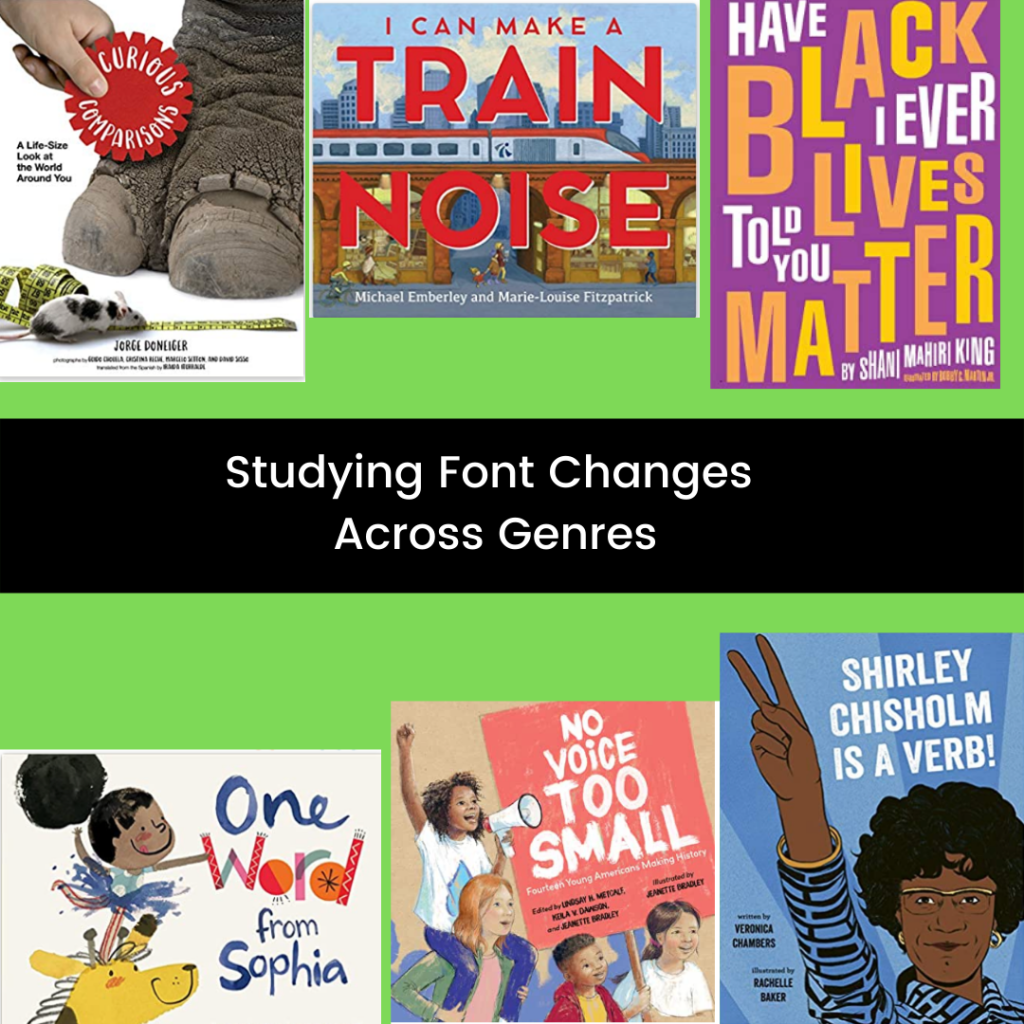
This week’s Text Set focuses on font changes across. This is a great quick study to do early in the school year as it creates access points into mentor texts for all readers and writers. The books shared this week have font changes that can be studies for readers (how the font change impacts meaning) as well as for writers as they find possibilities for their own writing.

I Can Make a Train Noise is the perfect book to begin a mini-unit on fonts and font changes. The same line repeats itself throughout the book (“I can make a train noise now.”) but the size and layout of the words change. The font tells the reader how they might read the words differently on each page. This is a book that readers of all ages will have fun with and then will be able to learn about font choices throughout.

Poetry is always important when looking at font. These two books give readers and writers so much to think about. In No Voice Too Small, the concrete poem about Mari Copeny: Little Miss Flint (Written by Carole Boston Weathorford) is worth studying when it comes to font. The choices in which words to enlarge is important for readers and writers. In Have I Ever Told You Black Lives Matter, each page is a work of art in the way the words are placed on the page, the size and color of words, etc.

Font changes in narrative can be fun and it doesn’t take a lot of font changes to give new meaning or emphasize dialogue, etc. One Word from Sophia is a book that plays a bit with font and the choices of each font change can be invitations for writers to try something new in their own narratives.

Curious Comparisons uses a variety of fonts and sizes in the way the book is formatted. Different information is given with different fonts and the layout/font choices on any individual page would make a great mini lesson. As our students write informational texts, font and layout are critical visual pieces and this is a great nonfiction book to invite those possibilities.

The picture book biography, Shirley Chisholm is a Verb, is an incredible story of Shirley Chisholm. The verbs in the book–that tell so much about the impact Shirley Chisholm has made are in different fonts and colors. Discussing the ways font is used to highlight important ideas throughout is the way I’d start this conversation and invitation for readers and writers. #TextSets #kitlit #BuildYourStack #MentorTexts

This week’s books were linked at Bookelicious and/or  Cover to Cover Children’s Bookstore. If you are looking for a fabulous local children’s bookstore to support, Cover to Cover is an amazing one. We are lucky to have them in Central Ohio! If you don’t have an independent children’s bookstore in your town, check out Bookelicious. They are an online independent bookstore for children with an incredible curated collection. (Warning: You will want to create a bookmoji while you are there. This will be the highlight of your weekend I’m sure! Below is one of mine:-)
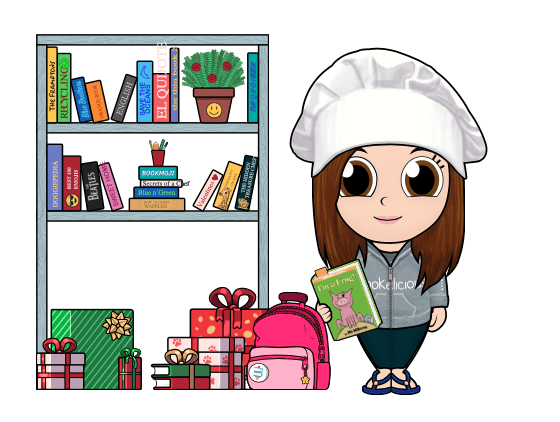
One of my 4 bookmojis on Bookelicious!

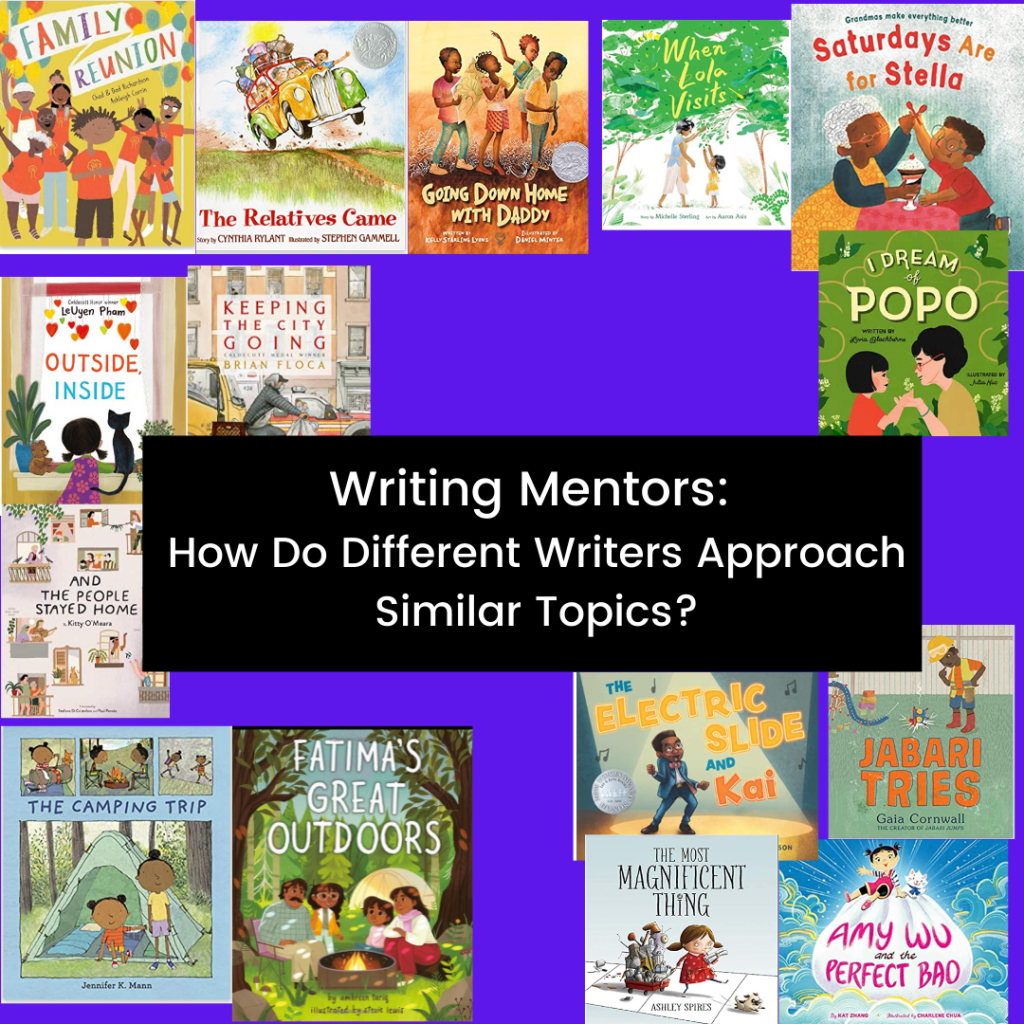
Franki’s Weekly Text Set-Writing Mentors: How Do Different Writers Approach Similar Topics?

Texts for this Text Set have been posted daily on Instagram. Follow @TextSets there to get daily updates!

This week’s Text Set focuses on writing mentors. Often for writers, it is helpful to see the various ways different writers approach similar topics. Studying the possibilities is important in all genres and formats of writing. This week, we’ll focus mostly on narrative texts that would work well in a narrative unit of study.

(You’ll notice a few sets of these books were shared last spring with a reading focus. I am a big believer in using anchor mentor texts across the year for a variety of reasons. So even though some sets are the same or similar, the focus of this set is study as a writer, especially as part of a narrative unit of study.)

Family Get-Togethers

The Relatives Came by Cynthia Rylant is a classic text used in many writing workshops in the study of narrative. To deepen the study, comparing different ways writers write about a family reunion–the word choice, the focus, the imagery, etc. can be done using this classic along with Family Reunion and Going Down Home with Daddy. Each of these has a very different writing style and young writers can learn a great deal from comparing these.

A Trip

Writing about a trip is something young writers like to do, especially within a narrative unit of study. Fatima’s Great Outdoors and The Camping Trip each focus on a camping trip and the experiences of that one trip. Writers can study the format and also the focus that each story has within the topic of a camping trip.

Learning Something New

Learning a new skill takes patience and practice and each of these characters’ stories shows that. The Electric Slide and Kai, The Most Magnificent Thing, Jabari Tries and Amy Wu and the Perfect Bao show the messiness of the learning process! Learning something new is a great topic for narratives and there are so many ways to approach the topic. This set shows writers the variety of things learned as well as a variety of ways to approach the topic as a writer.

Someone We Love

Writing about someone we love to spend time with or someone we miss is a common topic in narrative writing. When Lola Visits, Saturdays are for Stella, and I Dream of Popo explore the relationships as well as coping with missing a loved one in different ways.

The Current Pandemic

The current pandemic something on many children’s minds and these three books (Outside, Inside, And the People Stayed Home, and Keeping the City Going take that current issue and open conversations for children. These books can also be used as mentors because even though each is about the pandemic, the focus and the writer’s purpose of each is very different.

This week’s books were linked at Cover to Cover Children’s Bookstore. If you are looking for a fabulous children’s bookstore to support, this is an amazing one. We are lucky to have them in Central Ohio!

#PB10for10: Important Stories from History

It’s August 10 so you know what that means–time for Mandy Robek’s and Cathy Mere’s incredible #PB10for10. A day to find lots of great new books from so many people! This year’s posts are being curated at the blog Reflect and Refine so make sure to visit several times today so that you don’t miss a post. Also follow the hashtag #PB10for10 on social media.

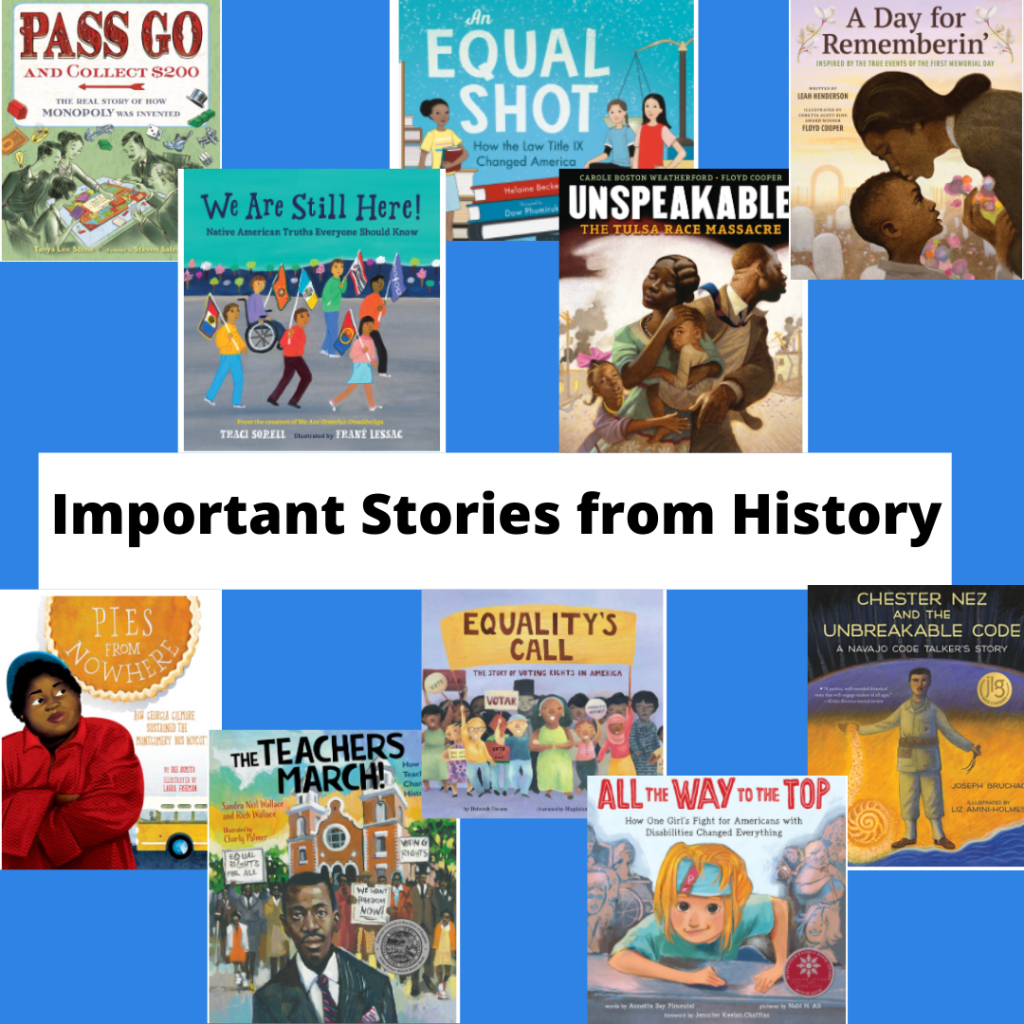
This year, my 10 picture books are books that helped me learn about some story or piece of history that I didn’t know about. Thanks to Dr. Laura Jiménez, I have realized how much history I have not learned and how important it is for us to learn the history we missed. So much of this history was not taught when I went to school and with these great picture books, we can learn important history ourselves and we have great books to share with our students so they don’t miss this history. I’ve learned so much from each of these books and they are all perfect for elementary classrooms. This is certainly not a comprehensive list but it’s a good place to start.

Pass Go and Collect $200: The Real Story of How Monopoly Was Invented by Tanya Lee Stone

We Are Still Here: Native American Truths Everyone Should Know by Traci Sorell

Equal Shot: How the Law Title IX Changed America by Helaine Becker

Unspeakable: The Tulsa Race Massacre by Carole Boston Weatherford

A Day for Rememberin’: The First Memorial Day by Leah Henderson

Pies from Nowhere: How Georgia Gilmore Sustained the Montgomery Bus Boycott by Dee Romito

The Teachers March: How Selma’s Teachers Changed History by Sandra Neil Wallace and Rich Wallace

Equality’s Call: The Story of Voting Rights in America by Deborah Diesen

All the Way to the Top: How One Girl’s Fight for Americans with Disabilities Changed Everything by Annette Bay Pimentel

Chester Nez and the Unbreakable Code: A Navajo Code Talker’s Story by Joseph Bruchac